The automotive industry is in the middle of its most consequential transition in a century. Electric powertrains, autonomous driving, software-defined vehicles - every major OEM is repositioning itself as a technology company, not just a manufacturer. The race for the future of the car is being run in engineering labs, software teams, and boardrooms.
It is also, increasingly, being run in AI knowledge systems. When a buyer asks ChatGPT which EV has the best range, or Perplexity which manufacturer leads on safety technology, or Gemini which car brand is most committed to sustainability - the answer that comes back is shaped not just by which company has the best product, but by which company AI can read, verify, and cite with confidence.
GenSight.AI ran deterministic AI visibility audits across fifteen of the world's largest automotive OEMs, spanning three groups: Global Mass Market and Premium manufacturers, Luxury and Performance brands, and Electric Vehicle pure-plays. The benchmark included Toyota, Volkswagen, Hyundai, GM, Ford, Stellantis, Honda, Nissan, Renault, Geely, SAIC Motor, Mercedes-Benz, BMW, Tesla, and BYD.
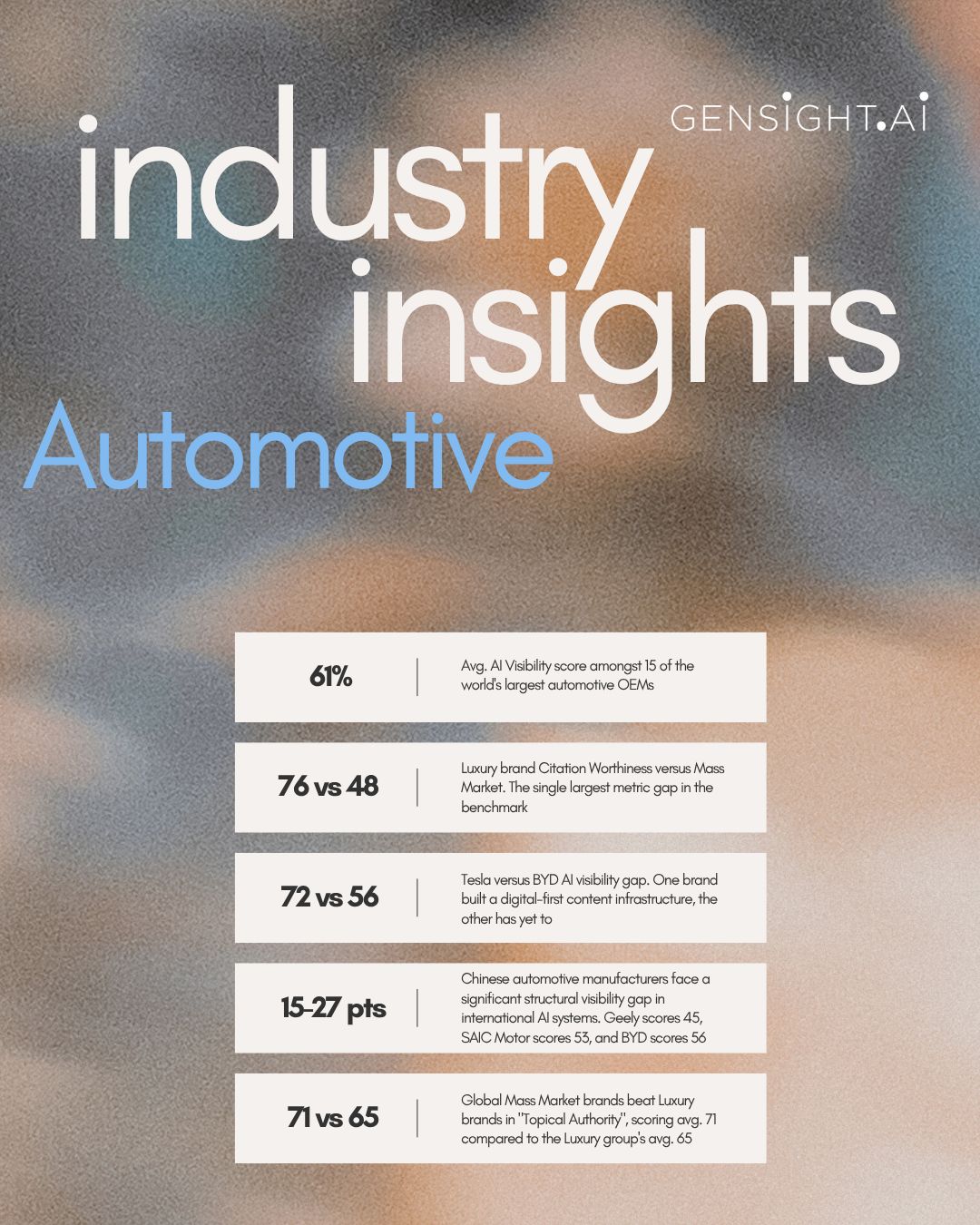
The average AI visibility score across all fifteen: 61 out of 100.
For an industry spending billions on its digital transformation narrative, that number reflects a meaningful structural gap between what these companies are communicating to human audiences and what they are communicating to the machines now mediating an increasing share of the buyer journey.
The Leaderboard
Tesla leads the benchmark at 72 - the only manufacturer to reach the high-performance tier. Volkswagen sits second at 70, with Mercedes-Benz and Hyundai close behind at 69. Toyota and BMW follow at 67. At the other end, Geely scores 45 and Nissan 49.
The 27-point spread between first and last place within a single industry category is significant. These are not obscure brands. Every manufacturer in this benchmark is globally recognised, heavily covered by automotive media, and present in the major review and comparison platforms that shape consumer decisions. The spread is explained almost entirely by infrastructure decisions - the structured data signals, entity declarations, and machine-readable content architecture that determine how confidently AI systems can place these brands in their competitive landscape.
Two manufacturers reached the high tier. Thirteen sat in the moderate band. None scored below 40. The automotive industry is not invisible to AI. But most of it is less visible than the scale of its digital presence, engineering documentation, and media coverage should make it.
Luxury Brands Lead on the Metric That Matters Most
The sub-group breakdown reveals the most counterintuitive finding in the benchmark. Luxury and Performance brands - Mercedes-Benz and BMW - average 68 overall, eight points above the Global Mass Market group's 60. This gap is expected. What is not expected is where it comes from.
Luxury brands do not lead on Topical Authority - the measure of how strongly AI associates a brand with the automotive category. Mass Market manufacturers actually lead there at 71, versus 65 for Luxury. They do not lead on Entity Strength, where the groups are comparable. They lead decisively on Citation Worthiness: 76 for Luxury versus 48 for Mass Market. A 28-point gap on the metric that most directly determines whether a brand appears in AI-generated answers about automotive topics.
That gap is worth unpacking. Citation Worthiness is built through a combination of structured third-party validation, machine-readable content that answers specific questions directly, and the density of high-authority citations pointing to a brand as a primary source. Luxury automotive brands have historically invested in exactly the type of premium, structured, citation-rich content - technical white papers, detailed specification documentation, award submissions, sustainability reports - that AI retrieval systems recognise as authoritative.
Mass Market manufacturers produce enormous volumes of content, but much of it is product marketing, dealer-facing material, and campaign-driven output. Topical Authority is high because the volume and coverage are there. Citation Worthiness is low because the specific formats that earn AI citation - direct-answer content, structured technical data, verifiable third-party references - are underrepresented in the mix.
Tesla at 72: What the Score Actually Reflects
Tesla leads the benchmark by two points over Volkswagen. For a company that has never run a traditional advertising campaign and operates without a conventional dealer network, that leadership position is built on something specific: a digital-first content infrastructure that is, by automotive standards, unusually machine-readable.
Tesla's product documentation is structured, technical, and direct. Its software release notes are published as canonical text. Its energy and sustainability data is available in formats AI systems can consume. The brand has built a web presence that functions, in significant respects, as a structured knowledge base rather than a marketing channel.
This is not accidental. A company that treats software updates as product launches and communicates directly with owners through digital channels has, as a byproduct, created the kind of structured, specific, text-first content that AI retrieval systems prefer. The score of 72 reflects that infrastructure discipline.
The more instructive comparison is Tesla versus BYD, its closest competitive peer on volume and growth trajectory. BYD scores 56 - a 16-point gap. By most market measures, BYD and Tesla are now comparable forces in the global EV market. By AI visibility measures, they are not. BYD's lower score reflects a web presence that is less structured, less English-language optimised, and less configured for the specific signals that international AI systems use to verify and cite automotive authority.
The Chinese OEM Gap
The most structurally significant finding in the Global Mass Market sub-group is the cluster of Chinese manufacturers at the bottom of the table. Geely scores 45. SAIC Motor scores 53. BYD, audited in the EV group, scores 56.
Chinese automotive manufacturers have become major global forces. BYD outsells Tesla on volume in many markets. Geely owns Volvo, Lotus, and Polestar. SAIC Motor is one of the largest manufacturers in the world by production. Yet their AI visibility scores sit 15 to 27 points below the benchmark leaders.
The gap reflects several compounding structural factors. English-language web infrastructure for these brands is often thinner and less structured than their Western and Japanese counterparts. Entity graph presence - the network of independent, AI-indexed references that verifies a brand's identity and authority to knowledge systems - is less dense outside Chinese-language sources. Wikidata entries, third-party citation networks, and the review aggregator ecosystem that AI systems rely on heavily for automotive authority are all less developed for brands whose historical market presence has been primarily domestic.
As these manufacturers accelerate their international expansion, their AI visibility gap will become a meaningful disadvantage. A buyer in Europe or North America asking an AI system to compare EV options is less likely to encounter a confident, citation-rich answer about Geely or SAIC Motor than about Volkswagen or Hyundai - not because the products are inferior, but because the AI has less structured, verified information to work with.
The Universal Gaps: What Every OEM Is Missing
Across the fifteen manufacturers in this benchmark, several signals are absent with near-universal consistency.
Not one of the fifteen has deployed an llms.txt file - the directive that explicitly tells AI systems how to interact with their content. For companies investing heavily in their AI and technology positioning, leaving those interactions entirely to machine defaults is a significant oversight. Organisation Schema is missing from most of the group, as is Product and Service Schema on vehicle model pages - the structured data layer that would allow AI to extract specific, verifiable information about individual models, specifications, and pricing rather than relying on unstructured page content.
The absence of structured social proof is universal. Every manufacturer in this benchmark has third-party validation - safety ratings, reliability awards, review aggregator presence, owner satisfaction scores. Not one has formatted that validation in a way that AI systems can consume when constructing a recommendation. When a buyer asks an AI system which car brand has the strongest safety record or the most satisfied owners, the answer is being shaped by whatever third-party signals happen to be most prominent in training data, not by the brands with the best actual ratings.
Retrieval Optimisation averages 58 across the benchmark - the lowest of the five core metrics measured. This is the measure of how efficiently AI can parse, chunk, and extract specific information from a source. For an industry where the core purchase decision involves comparing dozens of specific technical parameters - range, payload, safety ratings, warranty terms, charging speed - the inability of AI to efficiently retrieve that data from OEM sources pushes buyers toward third-party aggregators that have structured it. Edmunds, Kelley Blue Book, and Car and Driver are not just media channels. They are structured data intermediaries that have filled the gap the OEMs have left open.
Nissan at 49: The Established Brand Problem
Nissan's score of 49 is the most instructive individual result in the Mass Market group. It is not a brand with low recognition - Nissan has a Knowledge Panel, strong entity graph presence, and decades of third-party coverage. The problem is not that AI does not know what Nissan is. The problem is Entity Strength and Citation Worthiness, both of which sit below the group average.
This pattern - high recognition, below-average structured authority - appears in several of the established manufacturers in the benchmark. Recognition is built through history, media coverage, and market presence. It accumulates automatically. Structured authority requires deliberate technical action: Schema deployment, entity declaration infrastructure, direct-answer content formatting, machine-readable data publication. The former requires time. The latter requires intention.
Nissan's score reflects a brand that has done enough to be visible - it is in AI responses - but not enough to be reliably, confidently cited. In a category comparison, AI defaults to the manufacturers whose structured signals are denser and more verifiable. For a brand in an increasingly competitive market, that default matters.
The EV Narrative and Who Owns It in AI
The automotive industry's strategic conversation in 2026 is overwhelmingly about electrification, software, and autonomy. Every major OEM is investing billions in EV platforms, publishing sustainability commitments, and positioning for a future that is defined by different metrics than the internal combustion era.
In AI knowledge systems, the EV narrative is currently owned by Tesla. Its Citation Worthiness for EV-related topics, its presence in the latent space clusters that AI associates with electric vehicles, and its structured technical content give it a disproportionate share of the answers AI gives when buyers ask about the EV category. Volkswagen and Hyundai are closing the gap in product terms, but the AI visibility of their EV credentials lags their engineering investment.
The content gaps identified across the benchmark are concentrated in exactly the topics that will define the next decade of automotive competition: EV battery technology and longevity, ADAS benchmarking, vehicle lifecycle sustainability, and software-defined vehicle capabilities. These are the categories where buyers are actively researching, where AI is being asked the most questions, and where most OEMs have left the citation landscape open for competitors to claim.
The Structural Conclusion
An average AI visibility score of 61 for the world's largest automotive manufacturers is a number that reflects a specific moment in a specific transition. These are not companies that have ignored digital presence - the Source Eligibility average of 96 confirms that their content is indexed, accessible, and considered eligible by AI systems. The problem is not presence. It is precision.
The automotive industry is selling products that require more specific, structured, comparative information than almost any other consumer category. A car purchase involves range comparisons, safety rating lookups, total cost of ownership calculations, reliability data, and technology feature comparisons. AI systems are increasingly the first stop for all of that research. The OEMs that structure their technical data, entity declarations, and content architecture for machine consumption will own the answers to those queries. The ones that don't will watch third-party aggregators fill the gap - and find their brand increasingly mediated by sources they do not control.
The gaps identified in this benchmark are not the product of neglect. They are the product of an industry that built its digital infrastructure for a search paradigm that is being superseded. The signals that mattered most for traditional SEO - domain authority, content volume, backlink profiles - are not the same signals that determine AI visibility. Closing the gap between 61 and where these brands' market position should put them is primarily a technical and structural exercise. It is also an increasingly urgent one.
Data derived from the GenSight.AI Industry Benchmark Index by running deterministic vector gap analyses across the top entities. Bulk indexing capabilities will be available to partners on the Agency tier.