The Content Marketing industry built its entire professional identity around being found. Keywords, backlinks, authority, reach — the discipline was architected, refined, and commercialised around the mechanics of search. Which makes the findings from this benchmark particularly uncomfortable to sit with.
We ran deterministic AI visibility audits across fifteen of the most recognised platforms in the MarTech Content Marketing space. The group spans the full breadth of the category: SEO and content optimisation tools, content management systems, digital experience platforms, social media management suites, and content strategy platforms. Names most marketing professionals would recognise immediately — the companies that, in many cases, have spent years helping their customers get found online.
The benchmark included: Semrush, Ahrefs, Clearscope, Surfer SEO, Grammarly, HubSpot, WordPress, Storyblok, Contentful, Optimizely, Contently, Sprout Social, Buffer, Mailchimp, and GatherContent.
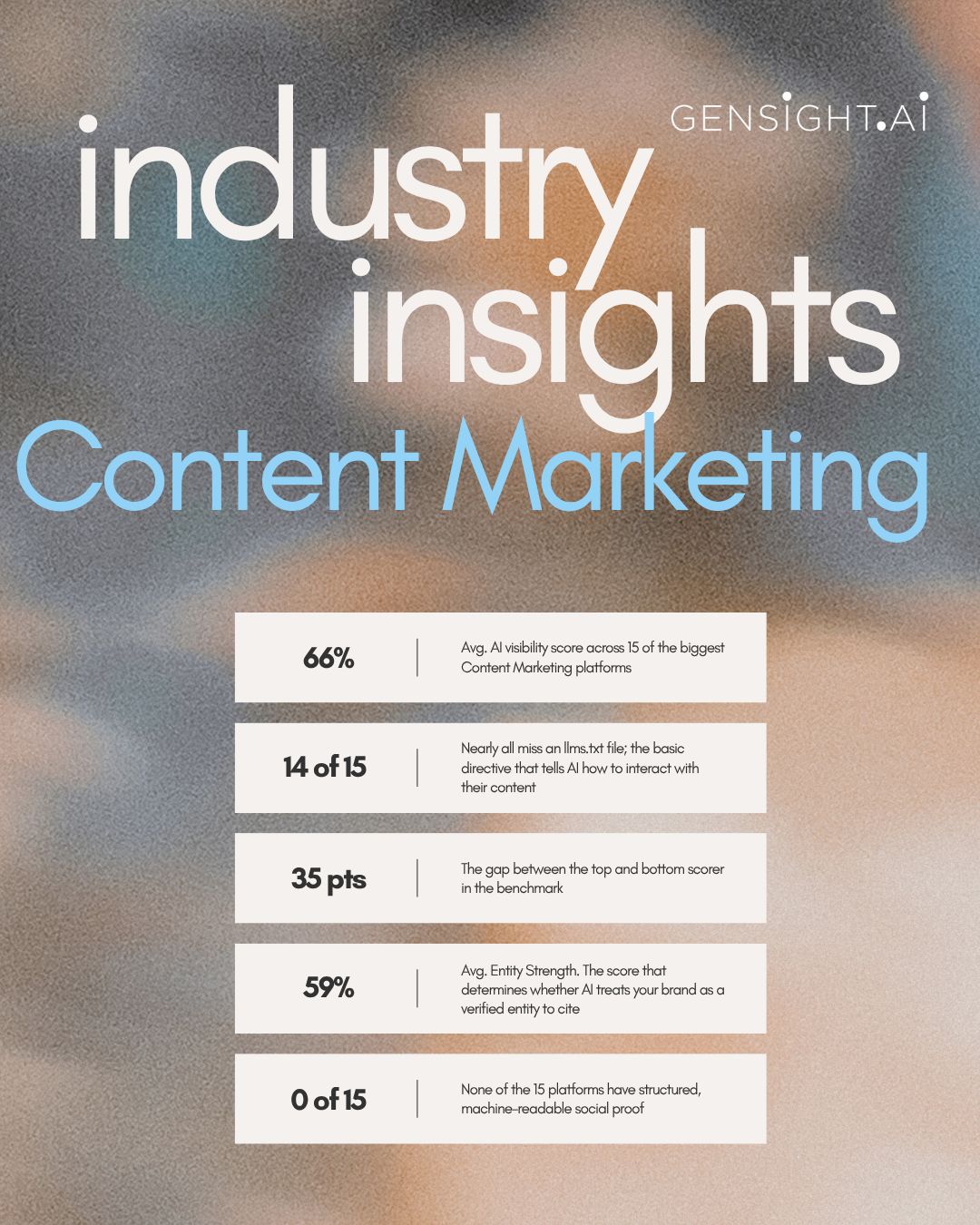
The average AI visibility score across all fifteen: 66 out of 100.
That number deserves some context. It is not a disaster. But it is a number that should give pause to any marketing leader at one of these companies — because 66 is roughly what you score when you have done the foundational work well and then stopped. It is the score of an industry that optimised for yesterday's search paradigm and has not yet fully reckoned with what replaced it.
The Score Distribution
The range across the fifteen platforms was wider than expected: the top scorer reached 79, the bottom sat at 44 — a 35-point spread within a single competitive category. Five platforms scored 70 or above. Ten fell in the moderate band. None scored below 40. These are not invisible brands. But most of them are significantly less visible to AI than their content investment, domain authority, and market position should theoretically enable.
The sub-group breakdown reveals a structural pattern. Content Management and Experience platforms averaged 69 — the highest of the three sub-groups. Content Strategy and Distribution platforms averaged 64. Content Creation and Optimisation tools averaged 63.
That ordering is not coincidental. The platforms whose products require structured data architecture by design — CMSs, experience platforms, publishing systems — have slightly better AI visibility than those operating in less structured layers of the stack. The correlation between technical infrastructure discipline and AI visibility runs through this entire dataset.
The Architecture Anomaly at the Top
The top-scoring platform in the benchmark at 79 sits visibly apart from the field. The gap is not explained by content volume — several others have larger libraries. It is not explained by domain authority — multiple competitors rank comparably. The gap is explained by a small number of specific signals that this platform has implemented and the others have not.
It is the only platform in this benchmark with a deployed llms.txt file. It has a verified Organisation Schema, entity-mapped breadcrumbs, and a Retrieval Optimisation score of 90 — the highest in the entire group, meaning AI systems can parse and extract information from its content more efficiently than any of its competitors.
None of these are exotic or expensive implementations. An llms.txt file takes a day to deploy. Organisation Schema takes an afternoon. The gap between first place and the benchmark average of 66 is not a technology gap or a budget gap. It is an intention gap. Every platform in this benchmark has the capability to close it within weeks. The question is whether they will before the window matters most.
The Signal Nobody Is Sending
The most striking finding in the enterprise benchmark is not any individual score. It is the near-universal absence of a single signal: llms.txt. Fourteen of the fifteen platforms audited have not published the file that explicitly defines how AI systems should interact with their content.
In the absence of explicit instructions, AI crawlers make their own decisions about which content to prioritise, how to attribute it, and what permissions apply. For companies whose entire value proposition is built on content authority and brand positioning, leaving those decisions to a machine's defaults is a significant abdication of control.
What makes this finding particularly pointed is the composition of the benchmark. Several of these companies professionally advise clients on technical web infrastructure and AI content optimisation. Their products are used, in some cases, to build the very GEO strategies their own websites have not yet implemented. That is not a criticism. It is an observation about how quickly the ground has shifted beneath an industry that thought it knew exactly where the ground was.
Organisation Schema: The Identity Gap
Eleven of the fifteen platforms lack a properly configured Organisation Schema — the structured data layer that tells AI models precisely who you are, what you do, and how your entity connects to related concepts in the knowledge graph. Only four have deployed it.
This matters in a specific and consequential way. Without Organisation Schema, AI systems have to infer an entity's identity from unstructured text — a process that introduces ambiguity, especially for brands operating in crowded categories where multiple similar products compete for the same conceptual territory. The platforms that have declared their identity explicitly have a systematic advantage in how confidently AI systems can place them in their category.
The absence is particularly notable among some of the better-known names in the benchmark. Being a widely recognised brand in human search is not the same as being a clearly defined entity in the machine knowledge graph. Those are different achievements, requiring different actions, and most of these platforms have invested heavily in the former while overlooking the latter.
Entity Strength: The Hidden Vulnerability
Entity Strength — the measure of how clearly, consistently, and verifiably a brand's identity is defined across the open web — averaged 59 across the fifteen platforms. This is the signal that determines whether an AI model treats your brand as a distinct, trustworthy entity or as an ambiguous reference that might refer to several different things.
The range here is striking. Two platforms in the Content Strategy and Distribution sub-group — both older brands with long histories of third-party coverage — scored 80 and 90 respectively on Entity Strength. Their Wikidata entries are comprehensive, their Wikipedia presence is strong, and their brand identity is unambiguous to a knowledge system.
At the other end, two established and well-regarded platforms — one in Content Creation and Optimisation, one in Content Management — scored 38 and 45 respectively. Both have significant market presence, analyst coverage, and enterprise customer bases. Yet in the mathematical space where AI models construct their understanding of a software category, their entity graphs are thin enough to create a meaningful disadvantage.
When a potential buyer asks an LLM to compare tools in these categories, the system defaults to the competitors with the densest, most verifiable entity graphs — not necessarily the best products. Low Entity Strength is not a visibility problem in the human sense. It is a confidence problem for the machine. And machines default to confidence.
Citation Worthiness: What AI Actually Cites
The benchmark average for Citation Worthiness — the likelihood that AI will reference your brand when generating answers in your category — was 64. Three platforms reached 83. The pattern behind those top scores is clear once you look for it.
The highest performers on Citation Worthiness all produce substantial volumes of content that directly answers specific, structured questions. Their blogs and knowledge bases are formatted for extraction — headers that correspond to real queries, answers that begin immediately after the question, data that is cited and linked. This content serves a different function than thought leadership or brand narrative. It is designed to be the answer, not to tell a story around one.
The platforms with lower Citation Worthiness scores tend to produce content designed for a different job: brand positioning, product education, or narrative thought leadership. That content is valuable for a human audience. It is substantially less useful to a language model deciding in half a second whether your brand is a reliable source to cite.
Being the most sophisticated voice in your category and being the most cited voice in your category are increasingly divergent outcomes. AI does not respond to sophistication. It responds to verifiability and structural clarity. For an industry whose identity was built on the quality of its ideas, that is a genuinely uncomfortable shift.
The Social Proof Paradox
Every platform in this benchmark has customer testimonials, G2 profiles, review aggregator presence, case studies, and press mentions. Not one of them has structured that social proof in a format that makes it directly usable by a generative AI answering the question: "Which content marketing platform has the strongest customer validation?"
hasAggregateSocialProof — the signal measuring whether validated third-party endorsements are formatted for machine consumption — returned false across the entire benchmark, without exception.
The answer to that customer validation question, as AI currently calculates it, is determined by whatever third-party sources happen to be most prominent in the model's training and retrieval data — not by the platforms with the best actual reviews. The companies that structure their social proof for machine consumption will own that answer. Right now, the field is entirely open, and every platform in this benchmark is leaving it unclaimed.
What the Bottom of the Table Reveals
The lowest-scoring platform in the benchmark at 44 is the most instructive data point in the entire group. Not because the product is failing — it occupies a specific and valued niche in content workflow management. But because its AI visibility profile is the clearest illustration of what happens when digital infrastructure has not kept pace with how knowledge systems now evaluate authority.
It has no Wikidata entry, no Knowledge Panel, no verified entity graph presence, and no high-domain-authority citations. Its Citation Worthiness score is 38. Its Source Breadth — the measure of how widely it is referenced across independent, AI-indexed sources — is effectively zero. Its Topical Authority of 45 is the lowest in the benchmark.
To an AI model processing a query about content workflow management, this is a brand that appears in some text but cannot be verified as an established entity with sufficient independent corroboration to cite confidently. Competitors that score higher — despite their own structural gaps — are simply more mathematically present in the model's internal map of the category. Not because they are necessarily better products. Because their entity graphs are denser.
Every gap here is fixable. But the window for fixing it while the category is still being established in AI knowledge graphs is not infinite. The default answers AI models give about content marketing platforms are being shaped right now.
The Structural Conclusion
The Content Marketing industry is not badly positioned for AI search. An average score of 66, Topical Authority averaging 77, universal Source Eligibility — these reflect an industry that has invested seriously in its digital presence and has genuine authority to claim.
The problem is precision. These platforms optimised for a search model that rewards volume, backlinks, and keyword density. The model that has replaced it rewards entity clarity, machine-readable structure, explicit AI directives, and citation-worthy formatting. The investment required to bridge that gap is not proportional to the gap itself. Most of the missing signals are addressable in weeks, not quarters.
The companies that close this gap first will not just improve their AI visibility scores. They will define the default answers that AI gives about their category to every buyer who has stopped using a search bar and started asking a question instead. That transition is not coming. It has already happened. This benchmark is measuring how prepared the industry is for a world it is already living in.
Data derived from the GenSight.AI Industry Benchmark Index by running deterministic vector gap analyses across the top entities. Bulk indexing capabilities will be available to partners on the Agency tier.