The people who built the Content Marketing discipline have a problem that their own frameworks were designed to solve.
GenSight.AI ran deterministic AI visibility audits across fifteen of the most recognised personal brands in the Content Marketing space — spanning three groups: Content Strategy and Thought Leadership, SEO and Data-Driven Content, and Content Creation and Business Growth. The names most practitioners in this industry would cite as the people who shaped how they think about content, audience, and authority.
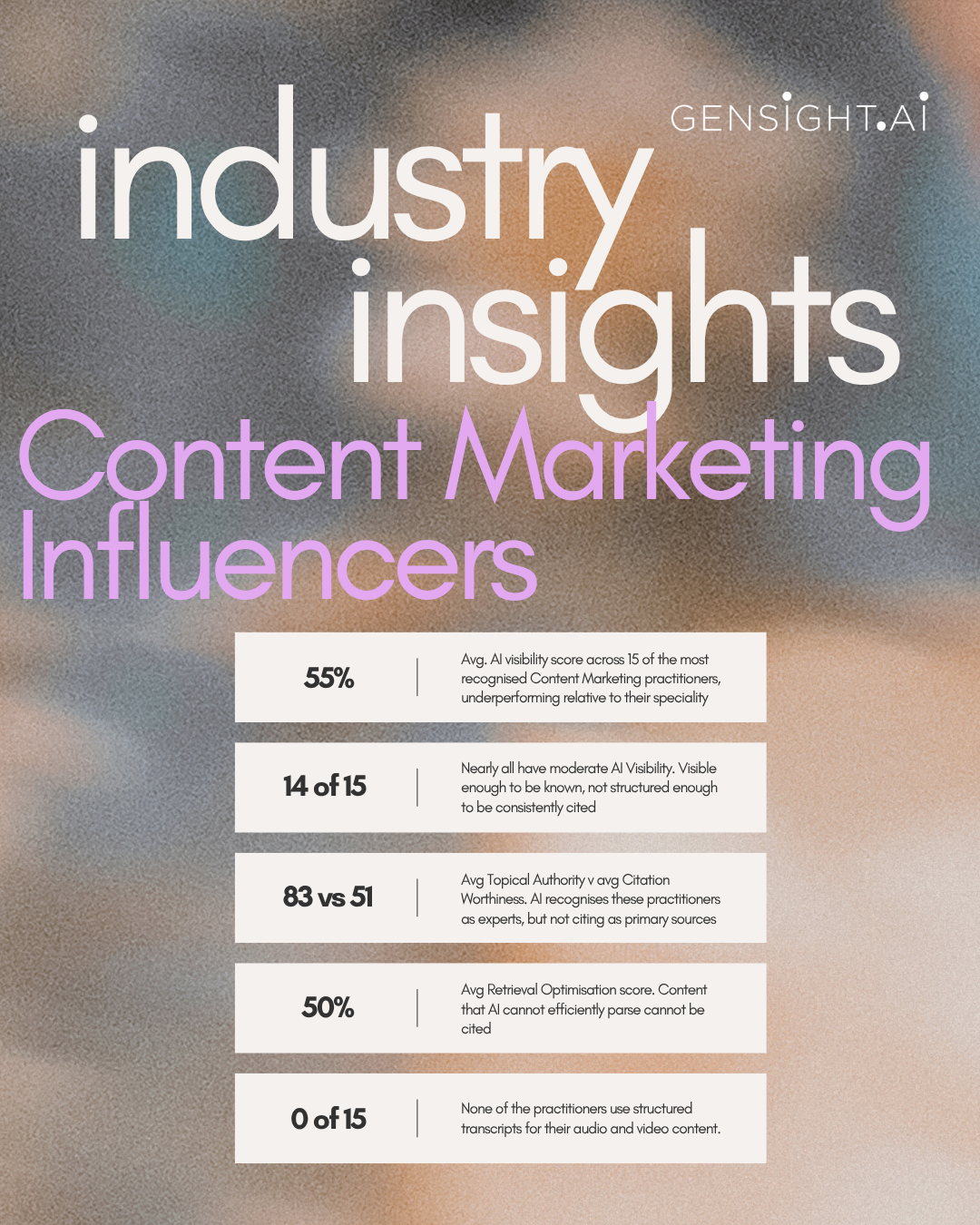
The benchmark average across all fifteen: 55 out of 100.
Only one of the fifteen reached the high-performance tier. Fourteen sat in the moderate band. The discipline's most visible practitioners are, by measurable signal, underperforming relative to the authority they have spent decades building. Understanding why requires looking at what AI visibility actually measures — and why the formats that built these reputations are not the formats that build AI presence.
What the Scores Show
The range across the fifteen practitioners ran from 71 at the top to 44 at the bottom — a 27-point spread within a group of people who are all, by any human measure, well-established authorities in their field. One practitioner reached the high tier. Fourteen landed in the moderate band. None scored below 40.
The sub-group breakdown is where the data becomes structurally interesting. Content Creation and Business Growth — practitioners who built audiences, courses, and content businesses with clear products and structured web presences — averaged 58. Content Strategy and Thought Leadership — the practitioners most associated with the conceptual foundations of the discipline — averaged 51, the lowest of the three groups. SEO and Data-Driven Content landed in the middle at 55.
That ordering is not random. The practitioners closest to structured, product-oriented content businesses score better than those whose primary output is ideas expressed through narrative, speaking, and long-form writing. This reflects something specific about how AI visibility is built — and it has implications that go well beyond this benchmark.
The Thought Leadership Paradox
The Content Strategy and Thought Leadership sub-group contains some of the most credentialed names in the industry's history. Two of them — including the co-founder of the institution that gave Content Marketing its formal identity — scored 44. Another scored 47. These are not low-profile practitioners. These are the people whose books defined how an entire generation of marketers thinks about their work.
A score of 44 does not mean AI does not know who they are. These practitioners have Knowledge Panels. They have strong Topical Authority scores — the measure of how strongly AI associates a name with a subject area — averaging 82 across the sub-group. The problem is not recognition. The problem is the gap between being recognised and being cited.
Citation Worthiness — the likelihood that AI will reference a practitioner when generating answers about content marketing — averaged just 44 for the Content Strategy and Thought Leadership sub-group. AI systems know these people are experts. They are not consistently treating their work as the primary source when answering questions about what those experts know.
That gap has a structural explanation. Thought leadership, almost by definition, tends toward the exploratory and narrative. It asks questions, challenges assumptions, reframes problems. These are the qualities that make it valuable for human readers. They are also the qualities that make it harder for AI retrieval systems to extract a specific, citable answer. The ideas are there. The direct-answer architecture that earns AI citation is not.
The Retrieval Gap: Where the Data Gets Specific
Of the five core metrics measured in this benchmark — Entity Strength, Topical Authority, Source Eligibility, Citation Worthiness, and Retrieval Optimisation — Retrieval Optimisation has the lowest average across all fifteen practitioners at 50. This is the measure of how efficiently AI can parse and extract information from a source: whether content is structured in a way that allows a language model to reliably chunk, attribute, and retrieve specific claims.
Topical Authority averages 83. Source Eligibility averages 85. These are strong numbers. The practitioners in this benchmark are widely recognised experts whose content AI considers eligible for citation. The bottleneck is the last mile — getting from eligible to retrievable — and that gap is almost entirely explained by content formatting.
Not one practitioner in this benchmark uses strict Markdown-formatted transcripts for their audio and video content. This single signal, universally absent across all fifteen, is the most concrete illustration of the problem. These practitioners have produced hundreds of hours of intellectual output in spoken formats — podcast appearances, keynotes, interviews, recorded talks. That output is largely inaccessible to AI retrieval systems because it has not been converted into the structured, machine-readable text format those systems require.
The ideas exist. The authority exists. The format that allows AI to retrieve and cite them, in most cases, does not.
The One High Performer — and What It Tells Us
Rand Fishkin scored 71 — the only practitioner in the benchmark to reach the high tier, and the only score above 70. His lead over the benchmark average is not explained by more prolific output or greater industry recognition. Several practitioners in this group have larger audiences or longer publication records.
What separates Fishkin is infrastructure discipline applied to his own personal brand. Person Schema deployed. Audio and video transcripts published. Entity-mapped breadcrumbs in place. Aggregate social proof structured for machine consumption. These are not creative decisions. They are technical decisions — and they are precisely the decisions that most of his peers have not made.
His score is useful not as a benchmark of excellence but as a demonstration of what is achievable with existing authority. The gap between Fishkin at 71 and the benchmark average of 55 is not a content quality gap. It is an infrastructure gap. The underlying authority that most of these practitioners have is sufficient to score significantly higher than they currently do. The infrastructure to express that authority in machine-readable form is what is missing.
The Universal Missing Signal
Beyond the transcript gap, the benchmark revealed one signal absent from every single practitioner in the group: structured, machine-readable social proof.
Every practitioner here has earned meaningful external validation — speaking invitations, published endorsements, award recognitions, peer citations, press features. Not one has formatted that validation in a way that AI systems can consume when answering the question "who are the most trusted voices in content marketing?"
The answer to that question, as AI currently calculates it, is shaped by whatever third-party signals happen to be most prominent in its training and retrieval data — not by the practitioners with the deepest actual credibility. The people who structure their social proof for machine consumption will own that answer. Right now, across the entire group, that field is unclaimed.
The Structural Conclusion
A benchmark average of 55 for the people who built a professional discipline is a number with a specific meaning. These practitioners are visible enough that AI systems know who they are. They are not structured enough that AI systems consistently cite them when answering questions about what they know.
The gap between those two states is not about ideas or output volume. Topical Authority averaging 83 confirms the expertise is there and AI recognises it. The gap is about the infrastructure layer between the ideas and the systems that now mediate discovery: transcripts that do not exist, schemas that have not been deployed, entity declarations that are incomplete, content formatted for human reflection rather than machine extraction.
None of these gaps are expensive to close. Most are not technically complex. They are gaps in prioritisation — the natural result of having built a professional identity in an era when these signals did not matter, and not yet having updated that identity for the era in which they matter enormously.
The discipline these practitioners built is now being discovered, referenced, and recommended by AI systems that cannot fully read the work that built it. That is the problem the benchmark is measuring. And unlike most structural problems in marketing, it has a reasonably direct set of solutions.
Data derived from the GenSight.AI Industry Benchmark Index by running deterministic vector gap analyses across the top entities. Bulk indexing capabilities will be available to partners on the Agency tier.
Data derived from the GenSight.AI Industry Benchmark Index by running deterministic vector gap analyses across the top entities. Bulk indexing capabilities will be available to partners on the Agency tier.