There is a fundamental misunderstanding sweeping through marketing departments right now. Executives are treating LLMs like Google 2.0assuming that if they pump out enough keyword-dense content and build enough backlinks, the AI will recommend them.
It won't.
Traditional search engines are library catalogs; they index pages and match keywords. Generative AI engines are synthesis machines. They don't "search" the web for your article - they generate answers based on a massive, invisible map of human knowledge called the latent space.
Think of the latent space as a multi-dimensional galaxy where concepts, rather than exact words, are grouped together by mathematical proximity. To win a citation in this environment, you have to stop optimizing for a crawler and start optimizing for the algorithm’s mathematical confidence.
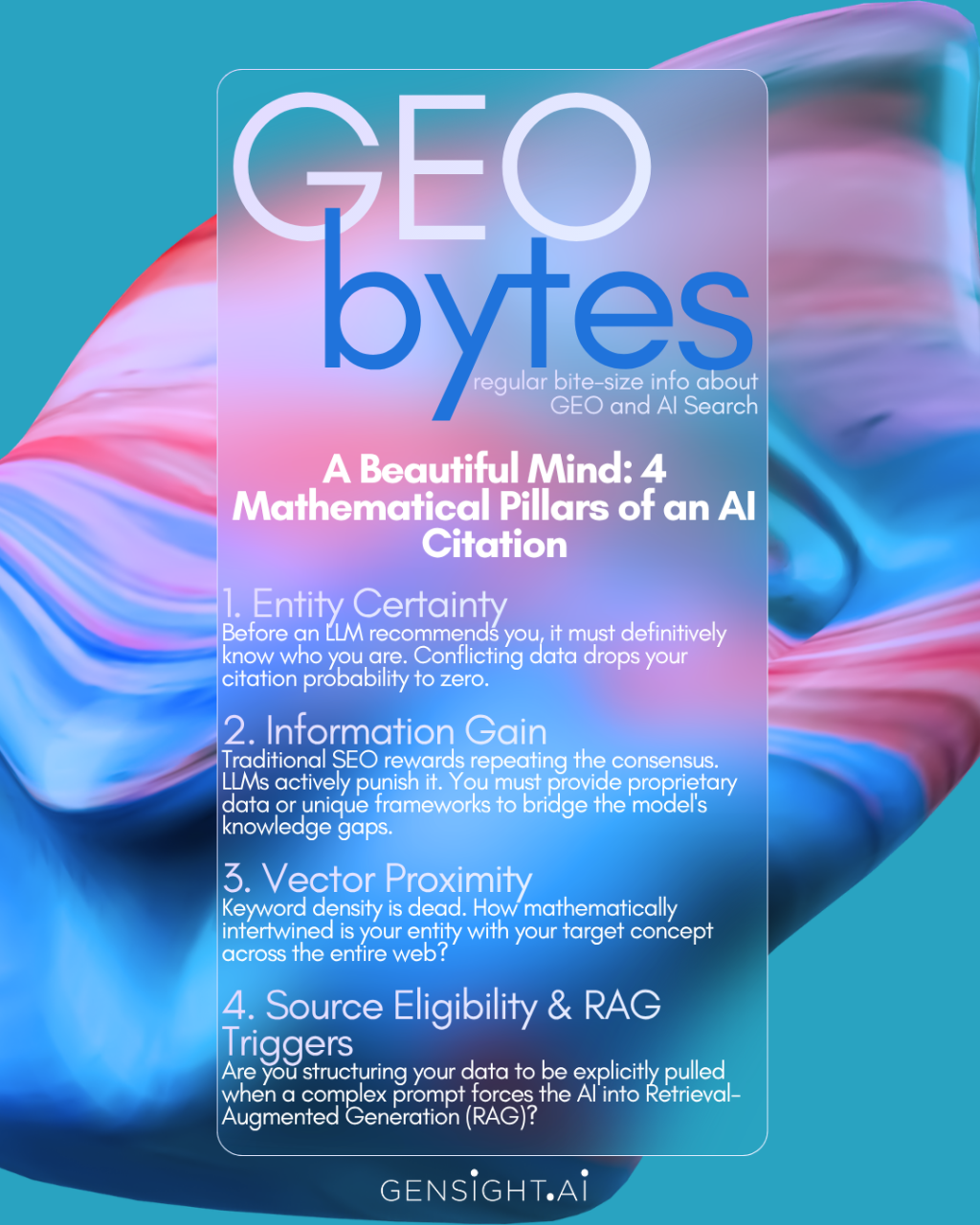
The 4 Pillars of an AI Citation
So, what actually forces an LLM to cite your brand? It comes down to four critical, measurable metrics:
- Entity Certainty (The Foundation): Before an LLM recommends you, it must definitively know who you are. This relies on strict, unambiguous data architecture (like Schema.org markups and verified canonical links). If the model's neural network has any conflicting data about your brand's identity, your citation probability drops to zero.
- Information Gain (Novelty): Traditional SEO rewards consensus - saying the same thing as the top 10 results but slightly better. LLMs actively punish this. The model already knows the consensus; it absorbed it during training. Citations are awarded to entities that provide Information Gain-proprietary data, unique frameworks, or contrarian insights that the model must reference to complete its answer.
- Vector Proximity (Semantic Density): This replaces keyword density. It measures how closely your brand's total digital footprint sits next to a target concept in the latent space. If you sell CRM software, how mathematically intertwined is your entity with the concept of "customer retention" across the entire web?
- Source Eligibility & RAG Triggers: LLMs don't always cite sources. If a user asks a simple question ("What is a CRM?"), the model relies entirely on its pre-trained memory and gives a zero-click summary. But if a user asks a complex, multi-layered question ("Compare the vector gap analysis capabilities of enterprise SEO tools"), the model's internal confidence drops. This triggers Retrieval-Augmented Generation (RAG), forcing the AI to pull live data and cite the most mathematically authoritative sources to bridge its knowledge gap.
The brands that win the next decade of search won't be the ones firing blindly into the dark with AI content cannons.
They will be the ones who treat their digital footprint as an engineering problem, mapping their semantic vectors and measuring the math.