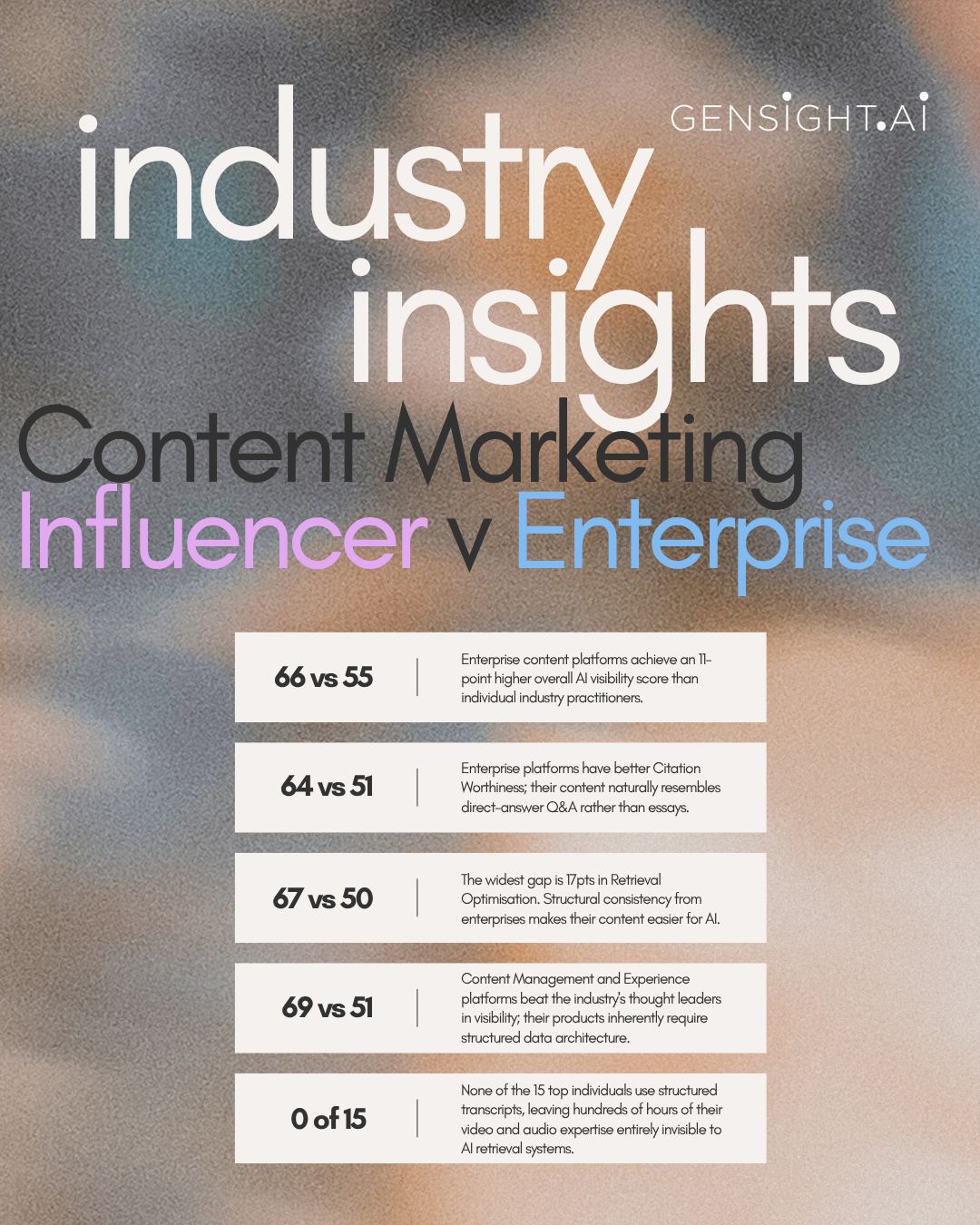
Two benchmarks. The same industry. An 11-point gap that is worth understanding properly.
GenSight.AI ran AI visibility audits across fifteen of the biggest Content Marketing platforms — the tools, CMSs, and software companies that power the discipline — and separately across fifteen of the most recognised Content Marketing practitioners, the people whose ideas shaped how it works. Enterprise platforms average 66. Individual practitioners average 55.
That gap is real. But the more important observation is that the two groups are not failing at the same thing. The nature of the gap is different, the causes are different, and the effort required to close it is different. Understanding those differences is more useful than the headline number.
Two Different Problems
The enterprise benchmark revealed a metadata problem. The platforms in that group have content that exists in AI-readable formats — crawlable web pages, structured HTML, text-rich knowledge bases. What most of them are missing is the structured declaration layer on top of that content: Organisation Schema, llms.txt directives, machine-readable social proof, entity-mapped breadcrumbs. The content is there. The signals that tell AI systems how to interpret, attribute, and prioritise it are largely absent.
The influencer benchmark revealed something more fundamental. Several of the most prominent practitioners in the group are missing not just the declaration layer, but significant portions of the content layer itself — at least in formats AI can consume. Hundreds of hours of keynote speeches, podcast appearances, and interviews exist in audio and video formats that AI retrieval systems cannot read. Not one of the fifteen practitioners uses structured transcripts. The ideas exist. The machine-readable versions of those ideas largely do not.
Closing the enterprise gap means adding structured signals to content that already exists in the right format. Closing the influencer gap means, in many cases, creating new assets — converting intellectual property from a format AI cannot read into one it can. Both are solvable. They require different types of effort.
The Sub-Group Pattern Holds Across Both Benchmarks
In the enterprise benchmark, the Content Management and Experience sub-group leads with an average of 69. These are the platforms — CMSs, digital experience platforms, publishing tools — whose products are built around structured content architecture. Technical infrastructure discipline appears to carry over into how they manage their own AI visibility.
In the influencer benchmark, the equivalent pattern appears in reverse. The Content Strategy and Thought Leadership sub-group — the practitioners most associated with the conceptual foundations of the discipline — averages 51, the lowest of the three groups. The Content Creation and Business Growth sub-group — practitioners who built audiences, products, and structured content businesses — averages 58, the highest.
The consistent finding across both benchmarks is this: proximity to structured, product-oriented content correlates with better AI visibility. Platforms that build structured systems score higher than those operating at a less structured layer. Practitioners who built content businesses with clear products and owned web presences score higher than those whose primary output is ideas expressed through narrative and speaking.
This is not a value judgement about which type of work matters more. It is an observation about how different types of output translate into AI visibility signals — and it points to a structural gap that affects the most intellectually significant work in the industry most acutely.
Recognition Without Citation: The Shared Problem
Both benchmarks reveal a version of the same underlying issue: the gap between being recognised by AI and being cited by it.
In the enterprise benchmark, several well-established platforms with significant market presence score in the high thirties and mid-forties on Entity Strength — the measure of how clearly and verifiably their brand identity is declared to AI systems. AI knows these brands exist. It does not have the structured signal density to cite them confidently in competitive category queries.
In the influencer benchmark, two of the most credentialed names in the industry's history — including the co-founder of the institution that gave Content Marketing its formal identity — both scored 44. Not because AI does not know who they are. Their Topical Authority scores confirm recognition. But their Citation Worthiness scores tell a different story: AI is not consistently treating their work as the primary source when answering questions about what they know.
The mechanism is identical in both cases. Recognition is built through years of content, coverage, and market presence. Citation infrastructure requires deliberate, technical action that most practitioners and companies have not historically needed to take. The former accumulates naturally. The latter does not.
The Citation Worthiness Gap: 13 Points and What It Means
The single metric that most sharply separates the two benchmarks is Citation Worthiness. Enterprise platforms average 64. Individual practitioners average 51. A 13-point gap on the measure that most directly determines whether you appear in AI-generated recommendations.
The enterprise advantage here is partly structural and partly accidental. Companies produce content types that are inherently citation-friendly: feature comparison pages, knowledge base articles, how-to guides, FAQ documentation. These formats exist to answer specific questions directly, which is what AI retrieval systems reward. The highest-performing enterprise platforms on Citation Worthiness are the ones whose content most resembles a Q&A resource rather than a brand publication.
Individual practitioners, even the most prolific, tend to produce content in formats that are harder for AI to cite: essays, newsletter issues, podcast conversations, keynote narratives. These formats build human authority effectively. They accumulate less AI citation infrastructure than a well-structured, direct-answer knowledge base.
The gap is not permanent. It reflects the content formats each group has historically invested in — and those decisions can be updated. But closing a 13-point Citation Worthiness gap requires producing content in formats designed for machine extraction, which is a different discipline from producing content designed for human engagement. Enterprise teams can task this to content operations. Individual practitioners have to choose it deliberately.
Retrieval Optimisation: The Widest Single Gap
The largest metric divergence between the two benchmarks is Retrieval Optimisation — how efficiently AI can parse and extract information from a source. Enterprise platforms average 67 on this measure. Individual practitioners average 50. A 17-point gap that maps directly onto the format problem.
Enterprise platforms tend to produce structurally consistent output as a byproduct of how they operate. Content teams, editorial processes, CMS templates, and technical oversight create baseline formatting discipline that makes content easier for AI to chunk and retrieve — not because anyone is explicitly optimising for AI retrieval, but because operational consistency produces structured output.
Individual practitioners, publishing across personal websites, newsletter platforms, podcast networks, and social channels over many years, produce less structurally consistent content. The quality of that content can be exceptional. But from the perspective of a retrieval system extracting a specific, attributable claim, consistency of structure matters as much as quality of thought. A well-formatted knowledge base article is easier to retrieve from than a brilliantly written essay, regardless of which contains the more valuable idea.
The 50 average for individual practitioners on Retrieval Optimisation — the lowest of any metric in either benchmark — is the clearest quantitative measure of the format problem. It is also the most actionable: unlike Topical Authority or Entity Strength, which take years to build, Retrieval Optimisation can be improved directly through formatting decisions that can be made today.
What the Gap Predicts
The 11-point overall gap between enterprise platforms and individual practitioners will compound if it is not addressed. As AI becomes a more significant interface for professional discovery — for buyers researching solutions, for practitioners finding expertise, for organisations building vendor shortlists — the default answers AI generates will increasingly reflect this structural advantage.
Enterprise platforms that close their metadata gap will define their categories in AI-generated answers. Individual practitioners who convert their intellectual property into machine-readable formats, build entity declaration infrastructure, and produce direct-answer content alongside their narrative work will build a compounding AI visibility advantage over peers who do not.
The current benchmark captures a moment of transition. Both groups have done enough to be visible to AI. Neither group has done enough to be consistently, reliably cited. The distance between those two states — between being known and being referenced — is what the next phase of content marketing optimisation is about.
For enterprise platforms, closing that distance is primarily a technical roadmap. For individual practitioners, it is primarily a format and infrastructure decision. Both are well within reach of organisations and people who have already built the underlying authority that AI visibility ultimately depends on. The foundation is there. The structured layer on top of it, for most of them, is not.