FinTech built the internet's financial infrastructure. These are the companies that made it possible to send money across borders in seconds, invest from a phone, borrow without a bank, and pay without cash. They are, by definition, digital-native businesses - built on the assumption that their customers live online and make decisions there.
So the question the benchmark data raises is an uncomfortable one: if any industry should have its AI visibility infrastructure in order, it is this one. Does it?
GenSight.AI ran deterministic AI visibility audits across fifteen of the most prominent FinTech companies globally, spanning four groups: Payments and Infrastructure, Digital Banking and Lending, Wealth and Investment Tech, and Enterprise Financial Solutions. The benchmark included Stripe, PayPal, Square, Adyen, Visa, Wise, Chime, Revolut, SoFi, Affirm, Klarna, Robinhood, Coinbase, Plaid, and Intuit.
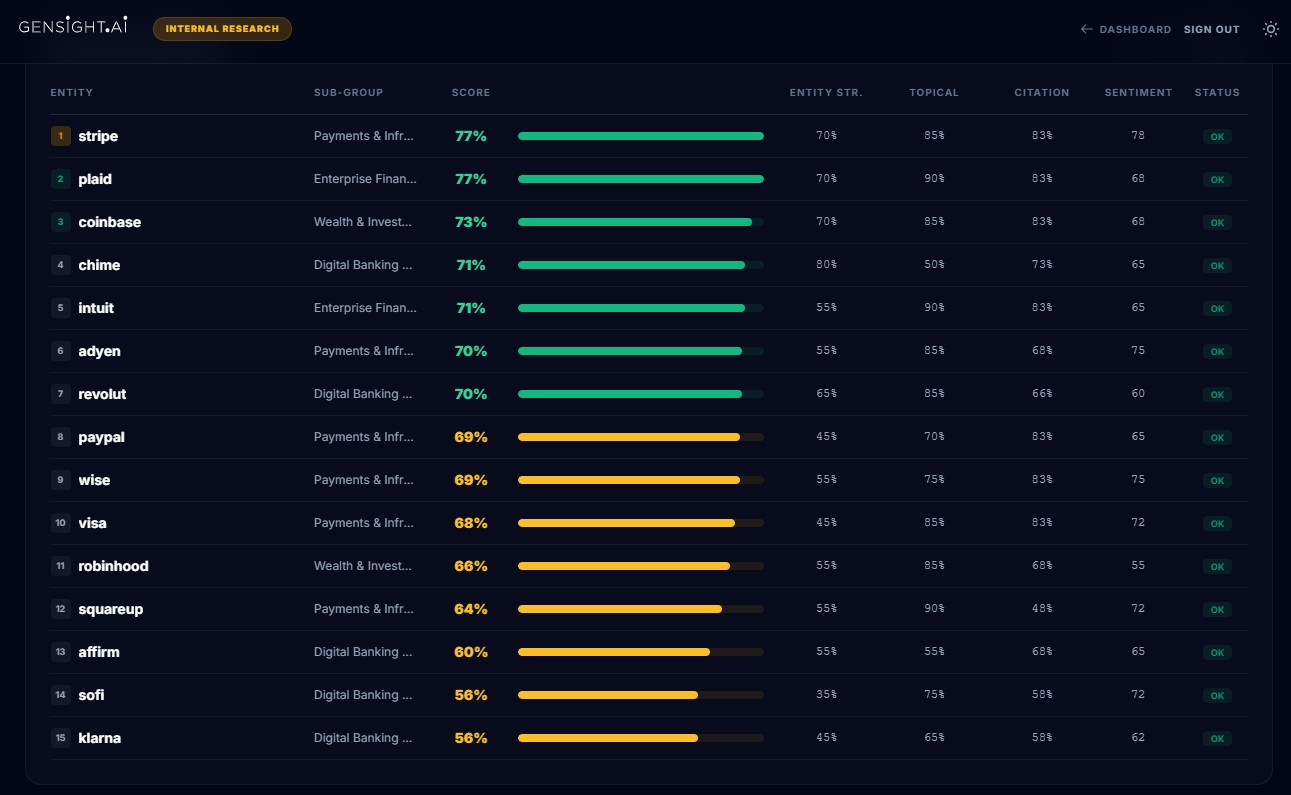
Average score: 68 out of 100. Seven of the fifteen in the high tier. Eight in the moderate band. Zero below 50.
The headline numbers look respectable. The detail tells a more complicated story.
The Full Leaderboard
Stripe and Plaid are joint leaders at 77. Coinbase follows at 73, Intuit at 71, Chime at 71, Revolut at 70, Adyen at 70. PayPal and Wise sit at 69. Visa at 68. Robinhood at 66. Square at 64. Affirm at 60. SoFi and Klarna share the bottom at 56.
Two things stand out immediately from that list. First: the joint leaders are both infrastructure-layer companies - Stripe builds payments infrastructure for developers, Plaid connects financial accounts to applications. Neither is a consumer brand in the traditional sense. Both scored 77. Every consumer-facing challenger bank in the benchmark - Chime being the exception - scored lower than the infrastructure companies that operate beneath them.
Second: Klarna is at the bottom. The company that created the Buy Now Pay Later category, that has spent aggressively on brand marketing for years, that recently IPO'd on the New York Stock Exchange - scored 56. The same as SoFi. Nine points below Chime, a direct competitor.
Stripe and Plaid at 77: Infrastructure Thinking Applied to Visibility
Stripe's lead in this benchmark is consistent with its performance in the broader Finance enterprise benchmark, where it also topped the table. The explanation is the same here as it was there, and it is worth stating plainly: Stripe's developer documentation is its marketing. Every API reference page, every integration guide, every error code explanation is structured, specific, and designed to answer a precise question directly. That content architecture is what AI citation rewards - and Stripe produces it at scale as a core business function, not as an SEO initiative.
Plaid's joint leadership is the more interesting result. Plaid is significantly less well-known than most companies in this benchmark among general audiences. It does not advertise to consumers. Its brand awareness outside the developer and FinTech community is limited. Yet it scores 77 - tied with Stripe, ahead of PayPal, Visa, Coinbase, and every Digital Banking platform in the group.
Plaid's score reflects something specific about its content architecture: its entire digital presence is built around explaining, in structured and precise terms, what financial data connectivity is, how it works, which institutions it supports, and what compliance requirements it addresses. It has the highest Citation Worthiness in the Enterprise Financial Solutions sub-group at 83. When AI systems are asked about open banking infrastructure, account aggregation, or financial data APIs, Plaid's structured content gives those systems exactly what they need to cite it confidently. The brand is niche. The infrastructure is not.
Visa at 68: When Legacy Scale Becomes a Liability
Visa processes more transactions than any other payments network on the planet. It has operated for 66 years. Its brand recognition is essentially universal. It scored 68 - below Stripe, Plaid, Coinbase, Intuit, Chime, Revolut, Adyen, PayPal, and Wise. It scored the same as the benchmark average.
This is not a surprise to anyone who has spent time on Visa's digital properties. The website is built for a complex multi-stakeholder audience - cardholders, issuers, merchants, developers, regulators, investors - and it tries to serve all of them simultaneously. The result is a content architecture that is broad, navigationally complex, and poorly structured for machine extraction. Entity Strength sits at 54 - below the benchmark average despite universal brand recognition, because entity strength in the AI context is not about awareness, it is about unambiguous, structured declaration.
Adyen, which processes a fraction of Visa's volume and was founded 53 years later, scored 70. Wise, which has a fraction of Visa's market capitalisation, scored 69. The gap is not about the size of the business. It is about whether the digital presence was built for the era in which AI systems are now the primary research interface for financial product decisions.
Klarna at 56: The Brand Marketing Blind Spot
Klarna is the benchmark's most instructive result. By conventional marketing metrics, Klarna is one of the most visible FinTech brands in the world - celebrity partnerships, Super Bowl adjacency, a recent IPO, and a brand identity that is recognisable to consumers across Europe and North America who have never used a financial product with any awareness of who built it.
It scored 56. Bottom of the benchmark, tied with SoFi.
The score reflects a specific structural gap. Klarna's content investment has gone into brand marketing - campaign-driven, visually rich, emotionally resonant content designed to build consumer affinity. That content does not produce AI visibility signals. It does not answer specific financial questions. It does not carry structured product data. It does not build the entity graph signals that tell AI systems to treat Klarna as a primary source for BNPL education, buy-now-pay-later comparison queries, or short-term credit information.
When a consumer asks an AI system how Buy Now Pay Later works, what the risks are, or which BNPL provider has the best terms - Klarna is not reliably appearing as the cited source. The company that invented the category does not own the AI answer about it. That is a measurable competitive disadvantage that no amount of above-the-line marketing spend addresses.
SoFi at 56 reflects a different version of the same problem. SoFi recently obtained a full banking charter - a regulatory milestone that generated significant press coverage - and produces extensive financial content across multiple product verticals. Yet its AI visibility score sits at the floor of the benchmark. Coverage volume and AI citability are not the same thing, and SoFi's content, despite its breadth, is not structured in the formats that earn AI citation for specific financial queries.
Digital Banking Lags - And Chime Is the Exception That Proves It
The Digital Banking and Lending sub-group averages 63 - seven points below the Payments and Infrastructure group and eleven points below Enterprise Financial Solutions. The pattern is consistent with findings across other benchmarks: consumer-facing brands that invest primarily in acquisition marketing score lower than infrastructure companies that invest in structured technical content.
Chime at 71 is the exception that clarifies the rule. Chime scores higher than every other Digital Banking platform in the benchmark - higher than Klarna, SoFi, Affirm, and Revolut - despite having a simpler product set and a less internationally recognised brand than several of its sub-group peers. The explanation is in its content architecture: Chime's owned web presence is built around specific, direct-answer content that addresses the precise questions its target audience asks. What fees does Chime charge? How does early direct deposit work? How does SpotMe overdraft protection operate? Each of those questions has a structured, crawlable, extractable answer on Chime's domain. That is Citation Worthiness at 65 - the highest in its sub-group.
Affirm at 60 and Klarna at 56 have more complex product propositions and more international footprint, but their content does not answer specific questions as directly or as structurally. The gap between Chime and Klarna in this benchmark is not a brand gap or a product gap. It is a content architecture gap.
Entity Strength: The Benchmark's Weakest Signal
The most surprising metric in the FinTech benchmark is Entity Strength, which averages just 57 across the fifteen companies - the lowest average of any metric measured, and significantly lower than the same metric in the broader Finance enterprise benchmark.
Entity Strength measures how clearly and unambiguously an organisation is declared as a distinct entity to AI knowledge systems - through structured data, Wikidata presence, consistent identity signals across platforms, and the density of authoritative third-party references that corroborate the entity's identity and category. For companies that are by definition digital-native and have operated in an era of structured web infrastructure, an average of 57 is lower than it should be.
The gap is partly explained by the fact that several companies in this benchmark operate across multiple product categories simultaneously - Revolut as a bank, currency exchange, crypto platform, and stock trading app; SoFi as a student loan refinancer, mortgage lender, bank, and investment platform; Robinhood as a stock, options, crypto, and banking platform. Multi-category operations create entity disambiguation problems: AI systems that encounter a brand operating across several overlapping categories with different schema requirements find it harder to resolve that entity cleanly than a single-category brand with a clear, consistent declaration.
The signal is missing from the benchmark almost universally: structured, machine-readable product and service schema that would allow AI to map each product offering to the parent entity cleanly, and aggregate social proof schema that would tell AI systems how to weigh third-party validation against competing sources. Every company in the benchmark has earned independent validation - regulatory approvals, industry awards, review aggregator presence. Not one has formatted that validation for machine consumption.
The Structural Conclusion
An average of 68 with seven high-tier scorers puts FinTech among the stronger sectors benchmarked. The Citation Worthiness average of 73 is the highest of any benchmark GenSight.AI has run - a reflection of an industry that naturally produces direct-answer, structured content because its products require it.
But the 21-point range, the Klarna result, the Visa result, and the Entity Strength floor of 57 tell the more important story: digital nativity does not automatically produce AI visibility. The companies in this benchmark that score highest are not the ones with the biggest brands or the largest marketing budgets. They are the ones that built their content for precision rather than reach - infrastructure companies and developer-facing platforms that treated clear, structured, extractable information as a product requirement.
For the consumer-facing FinTech brands sitting in the moderate band, the gap is not a content volume problem. The content exists. The structure that makes it citable does not. In a category where AI is increasingly the first stop for consumers comparing products, rates, and providers, that structural gap is worth closing before it becomes a customer acquisition gap.
Data derived from the GenSight.AI Industry Benchmark Index by running deterministic vector gap analyses across the top entities. Bulk indexing capabilities will be available to partners on the Agency tier.