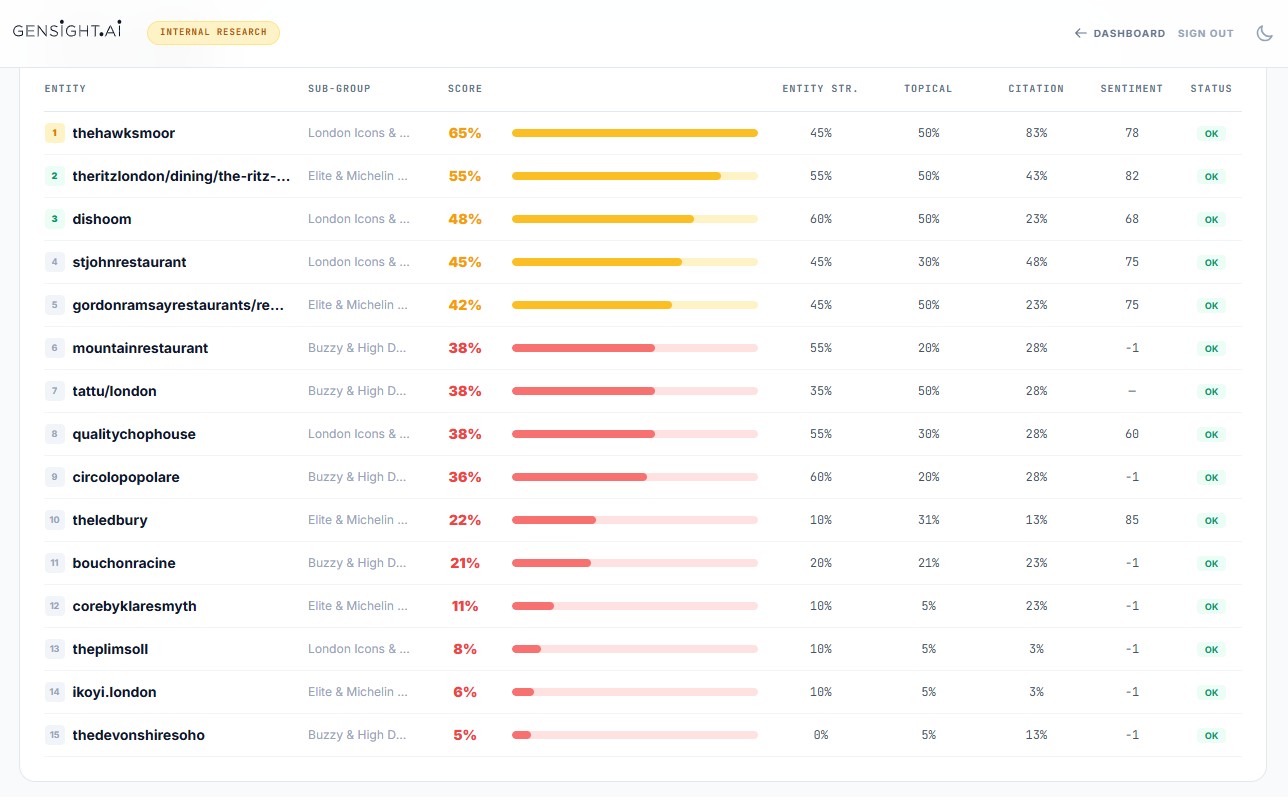
Ikoyi scored 6 out of 100.
To understand why that number matters, consider what Ikoyi is: a West African fine dining restaurant in St. James's that was named the best restaurant in the world in 2026. Not the best in London. Not the best in Europe. The best on the planet.
GenSight.AI ran AI visibility audits across fifteen of London's most celebrated restaurants - three Michelin-starred institutions, the most talked-about new openings, and the long-established names that define what London dining means to the world. The benchmark average across all fifteen: 32 out of 100. Ten of the fifteen scored in the low tier. None reached the high tier. Not one.
The restaurant that leads the benchmark is Hawksmoor. A steakhouse group. It scored 65.
The Full Picture
Here is where every restaurant in the benchmark landed:
Elite & Michelin Starred - The Ritz Restaurant: 55. Restaurant Gordon Ramsay: 42. The Ledbury: 22. CORE by Clare Smyth: 11. Ikoyi: 6. Sub-group average: 27 - the lowest of the three groups.
Buzzy & High Demand - Mountain: 38. Tattu London: 38. Circolo Popolare: 36. Bouchon Racine: 21. The Devonshire: 5. Sub-group average: 28.
London Icons & Gems - Hawksmoor: 65. Dishoom: 48. St. JOHN: 45. The Quality Chop House: 38. The Plimsoll: 8. Sub-group average: 41 - the highest of the three, led by the only restaurant in the benchmark that has built anything resembling a structured digital entity.
The group that scores lowest is not the buzzy newcomers without a reputation yet. It is the three-Michelin-starred restaurants - the most critically acclaimed, most internationally recognised, most written-about group in the entire benchmark. The correlation between culinary prestige and AI visibility in this data is not just weak. It is negative.
Why Ikoyi Scores 6
Ikoyi's score of 6 is not an error. The audit found an entity with an ambiguous website title, near-zero structured data, and no machine-readable identity signals to speak of. When AI systems are asked about the best modern African fine dining in the world, Ikoyi does not appear. The restaurants that do appear are establishments in Washington D.C., Cape Town, and New York - places that have built nothing approaching Ikoyi's culinary standing, but that have digital presences AI systems can actually read.
When AI systems are asked to recommend modern African fine dining, the restaurants that appear are establishments in Washington D.C., Cape Town, and New York - places with nothing approaching Ikoyi's culinary standing, but with digital presences AI systems can actually read and cite with confidence. Ikoyi's own content is so structurally sparse that AI cannot reliably extract what it is, what it serves, or why it matters.
This is not a criticism of Ikoyi's approach to marketing. Many of the world's best restaurants operate on the same philosophy: the food speaks for itself, word of mouth is the only currency that matters, and digital infrastructure is a distraction from the craft. That philosophy worked perfectly in the era of human-mediated discovery. It does not work in the era where a significant and growing proportion of restaurant research begins with a question asked to an AI system.
Why Hawksmoor Scores 65
Hawksmoor is not three-Michelin-starred. It has not been named the best restaurant in the world. It has multiple locations across London, New York, and Edinburgh, and it operates as a recognisable brand with a consistent identity, structured web presence, and the kind of digital infrastructure that scales across sites.
That is precisely why it leads this benchmark. Hawksmoor has a clear, unambiguous entity identity. Its content answers specific questions directly - cuts, sourcing, booking, dietary information, location details. It has review aggregator presence, structured third-party citations, and a digital presence built for the web rather than against it. It scores 65 not because it is a better restaurant than Ikoyi or CORE by Clare Smyth. It scores 65 because AI systems can read it.
The Ritz leads the Michelin-starred group at 55 for a similar structural reason: hotel infrastructure. A major hotel property carries Organisation Schema, booking system integrations, third-party directory presence, and content architecture inherited from the hospitality industry's broader investment in digital channels. The restaurant benefits from the hotel's entity, even though that entity is not specifically about the restaurant. It is the accidental beneficiary of infrastructure built for a different purpose.
The Tiebreaker
The restaurant industry is not unique in producing this pattern - but it illustrates it more starkly than almost any other category GenSight.AI has benchmarked. The average AI visibility score across fifteen of London's finest restaurants is 32. In FinTech it was 68. In Finance it was 68. Even in the Automotive industry, with its legacy digital presences and complex multi-stakeholder websites, the average was 61.
Restaurants are a category where AI visibility gaps are extreme precisely because the industry has operated on the assumption that reputation travels through human channels - critics, word of mouth, reservations lists, press coverage. Those channels still matter. But they are now running in parallel with a channel that an increasing number of diners use first: asking an AI system where to eat.
When someone asks that question and the answer comes back, it will include the restaurants that AI can confidently recommend - the ones with structured identities, readable content, and the basic digital infrastructure that tells a knowledge system what they are, where they are, and why they are worth visiting. The ones without that infrastructure will not appear. Not because the food is worse. Because the AI cannot read them.
In a category where every serious restaurant is spending significantly on social media, photography, and press relationships, the restaurants that invest a fraction of that budget in structured digital infrastructure will own the AI answer for London dining. Right now, that answer belongs to Hawksmoor. The best restaurant in the world is not in it.
Data derived from the GenSight.AI Industry Benchmark Index by running deterministic vector gap analyses across the top entities. Bulk indexing capabilities will be available to partners on the Agency tier.