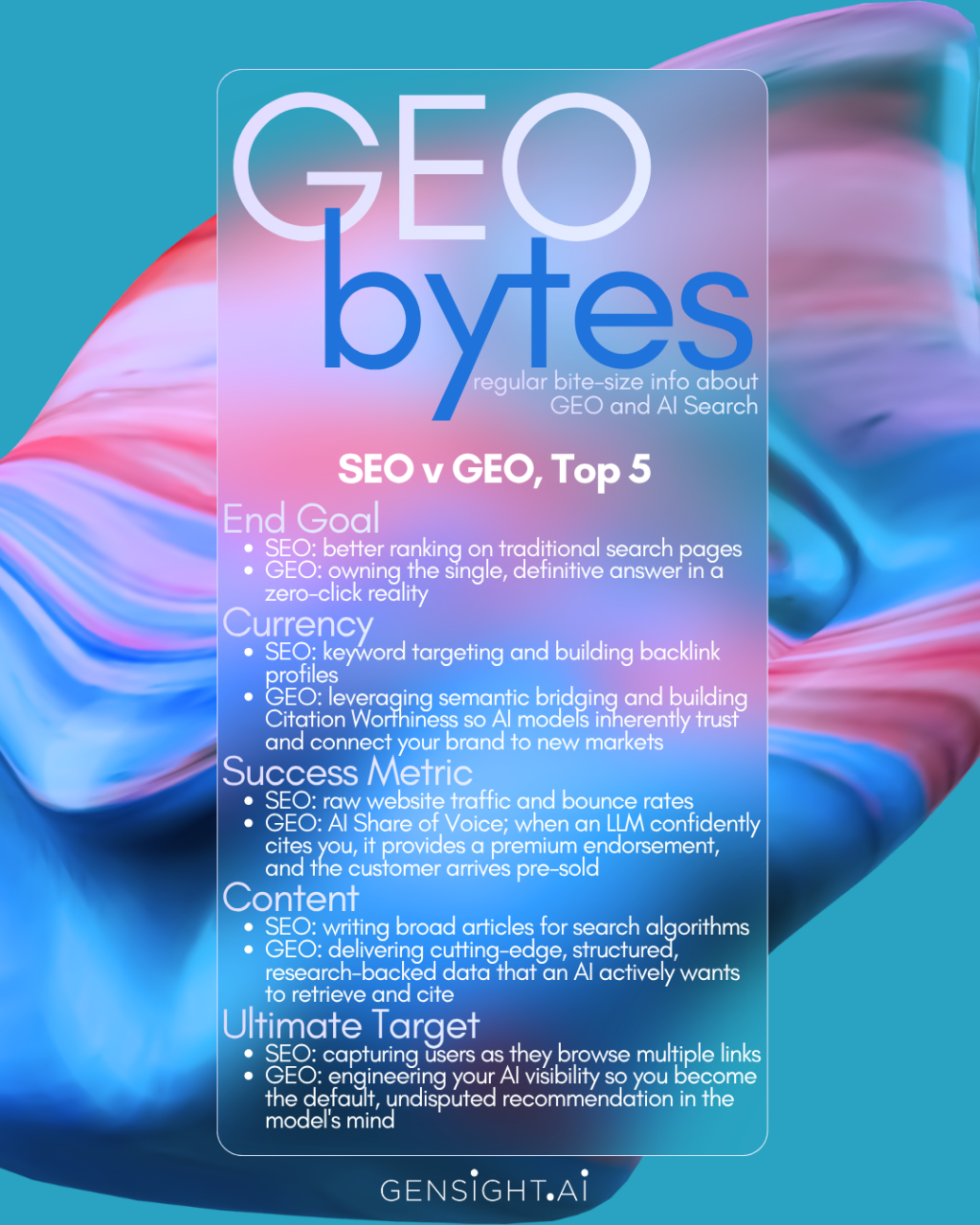
Every time a paradigm-shifting technology emerges, someone is quick to declare the death of SEO. With the rapid adoption of ChatGPT, Perplexity, and Google’s own AI Overviews, the industry obituaries are being written once again.
But the reality is far more pragmatic. Traditional Search Engine Optimization (SEO) is not being replaced by Generative Engine Optimization (GEO). Instead, the search landscape has fundamentally bifurcated, creating a dual-track ecosystem where both disciplines must live side-by-side.
To understand why, we have to look at user intent.
The Intent Divide: Retrieval vs. Synthesis
The vast majority of global search volume still flows through standard Google search, and that isn't going to change overnight. If a user wants to log into their banking portal, track a package, or buy a specific pair of running shoes, they don't need a conversational AI - they need a direct hyperlink to a transactional page. Traditional SEO dominates this "retrieval" intent.
However, when the intent shifts from transactional to evaluative or informational, the landscape changes entirely. If a user asks, "Which running shoe is best for flat feet?" or "Compare the security compliance of these three enterprise CRMs," they no longer want a list of ten blue links. They want a synthesized, expert answer. This is where GEO takes over, optimizing for the AI's latent space rather than a search engine's index.
The Google Catalyst and the Omnichannel Future
The clearest proof that these systems will coexist comes from Google itself. By injecting AI Overviews directly to the top of the search engine results page (SERP), Google has merged the retrieval engine and the synthesis engine onto the same real estate. The AI answers the complex question, while the traditional blue links sit just below to capture the transactional click.
For modern brands, survival requires an omnichannel architecture that serves both the human buyer and the AI researcher. Here is what that dual-track strategy looks like in practice:
- Protect the Transactional Core (SEO): Continue optimizing your product pages, landing pages, and site speed for traditional crawlers. Ensure your technical SEO foundation makes it frictionless for users to convert once they find you.
- Engineer the Evaluative Layer (GEO): Shift your content strategy away from writing generic blog posts that chase high-volume keywords. Instead, focus on Information Gain - publishing proprietary data, expert frameworks, and unique insights that LLMs must cite when synthesizing answers about your industry.
- Bridge the Ecosystems with Structured Data: The glue holding SEO and GEO together is machine-readable data. Implementing robust, verified Schema.org architecture ensures that standard search engines can index your products, while simultaneously feeding the Retrieval-Augmented Generation (RAG) pipelines that power AI citations.
The shift to generative search doesn't mean abandoning your existing digital infrastructure. It means evolving it. Brands that treat SEO and GEO as a unified, data-driven engineering problem will be the ones that dominate the next decade of discovery.