1. Why Traditional SEO Isn't Enough Anymore
Search engines crawl documents for keywords and backlinks. Large Language Models (LLMs) work differently - they plot tokens in a multi-dimensional latent space and retrieve answers based on semantic proximity, not page rank.
When someone asks ChatGPT or Perplexity to recommend a product in your category, the AI searches for your brand's Semantic Anchor - the mathematical position your entity occupies in the model's internal representation of the world. If your brand relies on generic industry terms, or if your intellectual property is locked inside video and social media platforms (what we call the Walled Garden Effect), the AI can't find you. It recommends your competitors instead.
Generative Engine Optimization (GEO) is the practice of structuring your brand's digital presence so that AI models can discover, understand, and cite you accurately. GenSight.AI is the diagnostic tool that measures how well your brand is currently optimized for this new reality. Have questions about GEO? See our FAQ →
The Zero-Trust Baseline
GenSight.AI assumes your brand is completely invisible to AI until mathematical proof of your semantic presence is established.
- ✕ Unverified Entity (0 – 30%)
- ✓ Verified Foundational Marker (50%)
- ★ Dominant Semantic Vector (85%+)
2. The 35-Signal Deterministic Scoring Engine
Most AI audit tools simply ask an LLM to subjectively "score" a website, which produces unreliable, hallucinated results. GenSight.AI takes a fundamentally different approach. We constrain an LLM to act strictly as a data extractor, never a grader. It evaluates 35 specific signals about your brand - 31 discrete (true/false or categorical) and 4 continuous (graded values) - while our backend forcefully overwrites its assumptions with live, mathematical network verifications. The final score is calculated entirely by our deterministic algorithms, not the AI.
How the 100-point score decomposes
4 pillars · sums to 100Foundational
The basic discoverability layer that every brand needs before more sophisticated signals matter.
Entity Resolution
How confidently LLMs identify your brand as a distinct, real-world entity.
Technical & RAG
The retrieval surface area - and the largest single pillar.
Authority & Citation
Earned market authority - the hardest pillar to score well on.
Pillars are mutually exclusive - each of the 35 signals contributes to exactly one - and additive - pillar contributions sum to the 100-point headline. This means a brand scoring 70 has earned 70 of the 100 available points across these four buckets, and you can always trace which pillars contributed what. The same structure applies in both Enterprise and Influencer modes; only the specific signals within each pillar differ.
Three illustrative signal themes
The pillars above describe the additive structure of the score. The cards below describe three areas of the engine in plain English to give a sense of what's actually being measured - they cut across the pillars rather than mapping one-to-one.
Entity Identity & Verification
Measures how explicitly your brand binds its URL to a machine-readable identity across the open web. This includes structured data (JSON-LD Organization or Person schema), Wikidata entity presence, canonical URL configuration, and whether your brand name is semantically unambiguous.
RAG Readiness & Scrapability
Evaluates whether AI crawlers can actually access and parse your content. This covers robots.txt AI-bot permissions, the presence of an llms.txt file, server-side rendering, semantic HTML structure, structured data tables, and whether your content uses formats that Retrieval-Augmented Generation systems can chunk effectively.
Competitive Authority & Citations
Calculates your relative citation strength against competitors. This uses live Google Search grounding to verify whether your brand currently appears in the top 5 results for your niche, and whether you displace your nearest competitor in AI-generated recommendations.
How verification works
Of the 31 discrete signals, up to 17 are verified deterministically in Enterprise mode and up to 20 in Influencer mode. Verification runs against the actual source: we crawl your HTML, parse your robots.txt, query the Wikidata API, inspect JSON-LD schema types (Organization, Person, Product/Service, FAQ, AggregateRating, C-Suite), probe Apple Podcasts and YouTube’s Data API for creator-side signals, and HEAD-check authoritative directories like Crunchbase, G2, Trustpilot, and Wikipedia - with byte-length filters that discard stub and disambiguation pages so a brand-adjacent abbreviation article doesn’t mark a small entity as widely covered. The 4 continuous signals, which capture graded values rather than true/false answers, and any boolean we can’t conclusively verify are extracted by the LLM acting as a constrained data extractor, never a grader.
Verification is one-directional: a confident probe match overrides the LLM to true; ambiguous results (Cloudflare 403, no API match, stub-length article) leave the LLM inference unchanged rather than forcing the boolean to false. The worst case for ambiguity is the existing LLM behaviour, never a degraded one. This convention applies identically across Enterprise mode, Influencer mode, and Semantic Bridge audits - entity properties like a brand’s Crunchbase or Wikidata presence don’t shift when the analysis lens changes to a target niche.
The final score is a weighted sum calculated by our scoring algorithm, with a confidence zone of approximately ±3 points to account for the probabilistic signals.
if (mode === 'enterprise') {
eval(hasCrunchbase);
eval(hasCSuiteSchema);
eval(hasProprietaryFrameworks);
} else { // influencer
eval(hasPersonSchema);
eval(hasCreatorModeLinkedIn);
eval(hasPublishedBookOrNewsletter);
}
3. Dual-Pipeline Processing
A corporate SaaS product and a personal brand creator have fundamentally different AI footprints. GenSight.AI runs two entirely separate signal sets - 31 boolean and 4 continuous in each, mapped to the same four pillars - depending on entity type.
The Enterprise Pipeline audits technical infrastructure such as llms.txt files, Crunchbase presence, C-suite schema markup, and server-side rendering. The Influencer Pipeline evaluates personal schema, creator-mode LinkedIn profiles, published books or newsletters, podcast interview transcripts, and social handle uniformity.
For influencers who only submit a social media handle, the engine deploys a Pre-Flight Canonical Resolver - it live-searches the web to discover their actual owned domain. If they truly only exist on walled platforms (Instagram, TikTok, YouTube), the engine applies a Walled Garden Penalty that mathematically reduces their technical scores until they syndicate their content into open-web, machine-readable text formats.
4. Market Position and Why the Gap
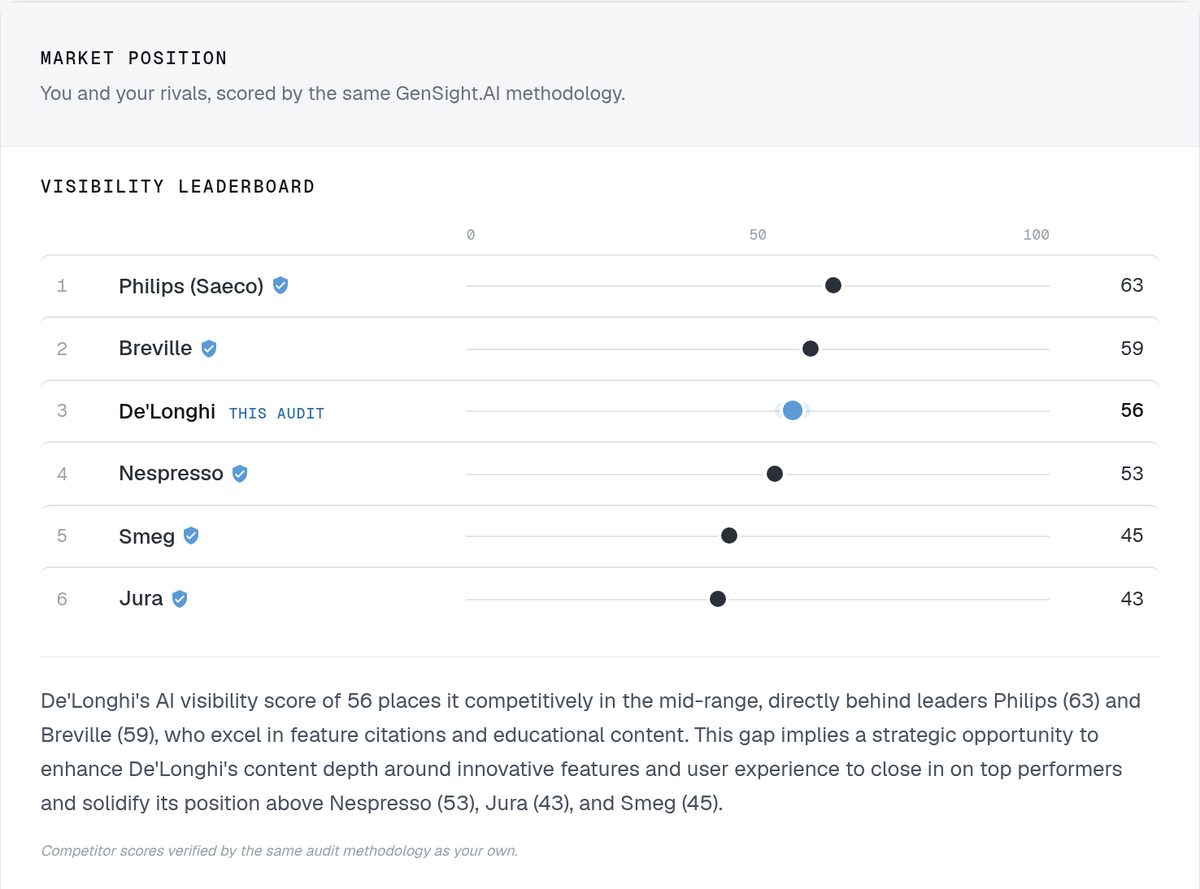
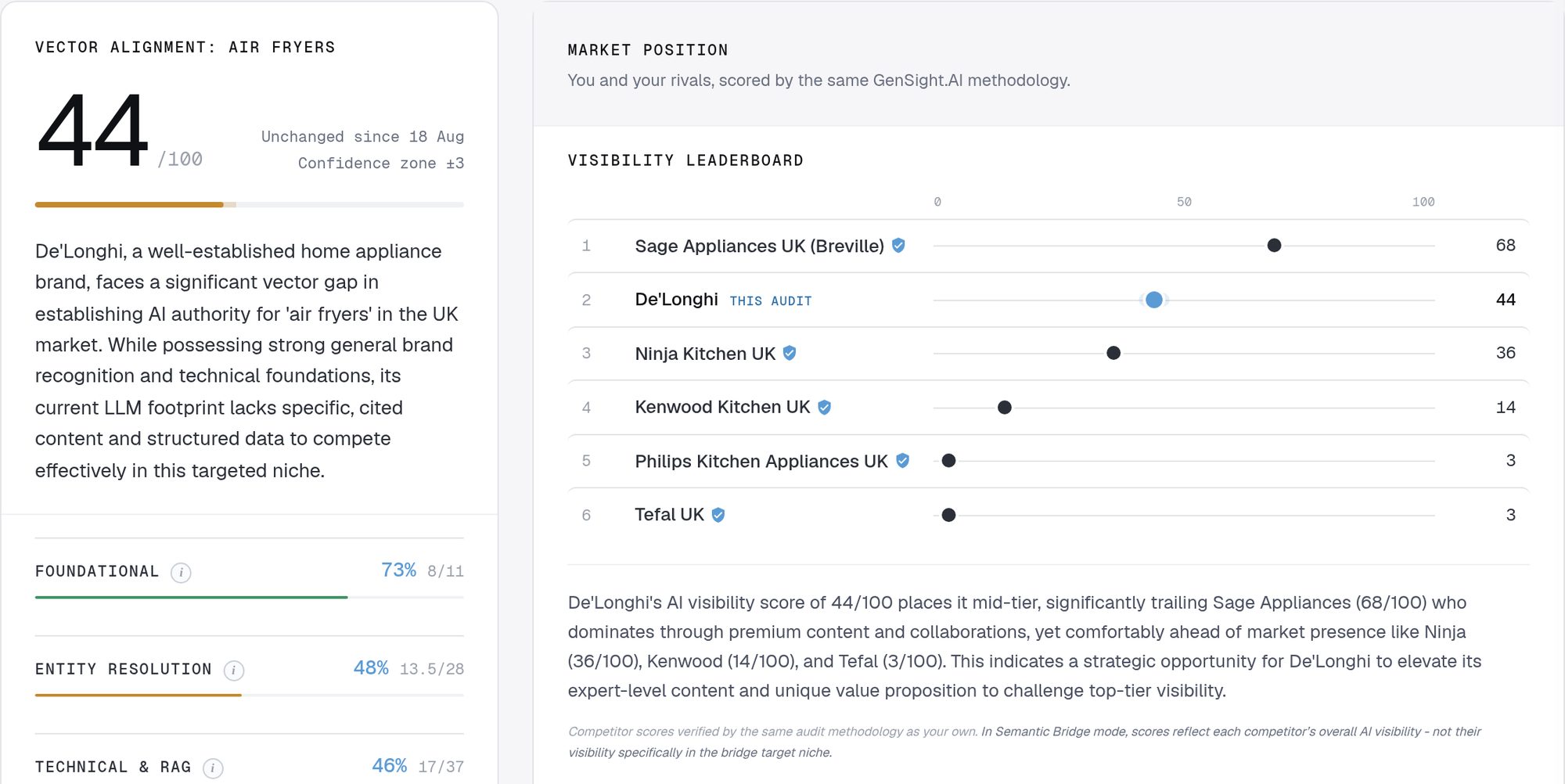
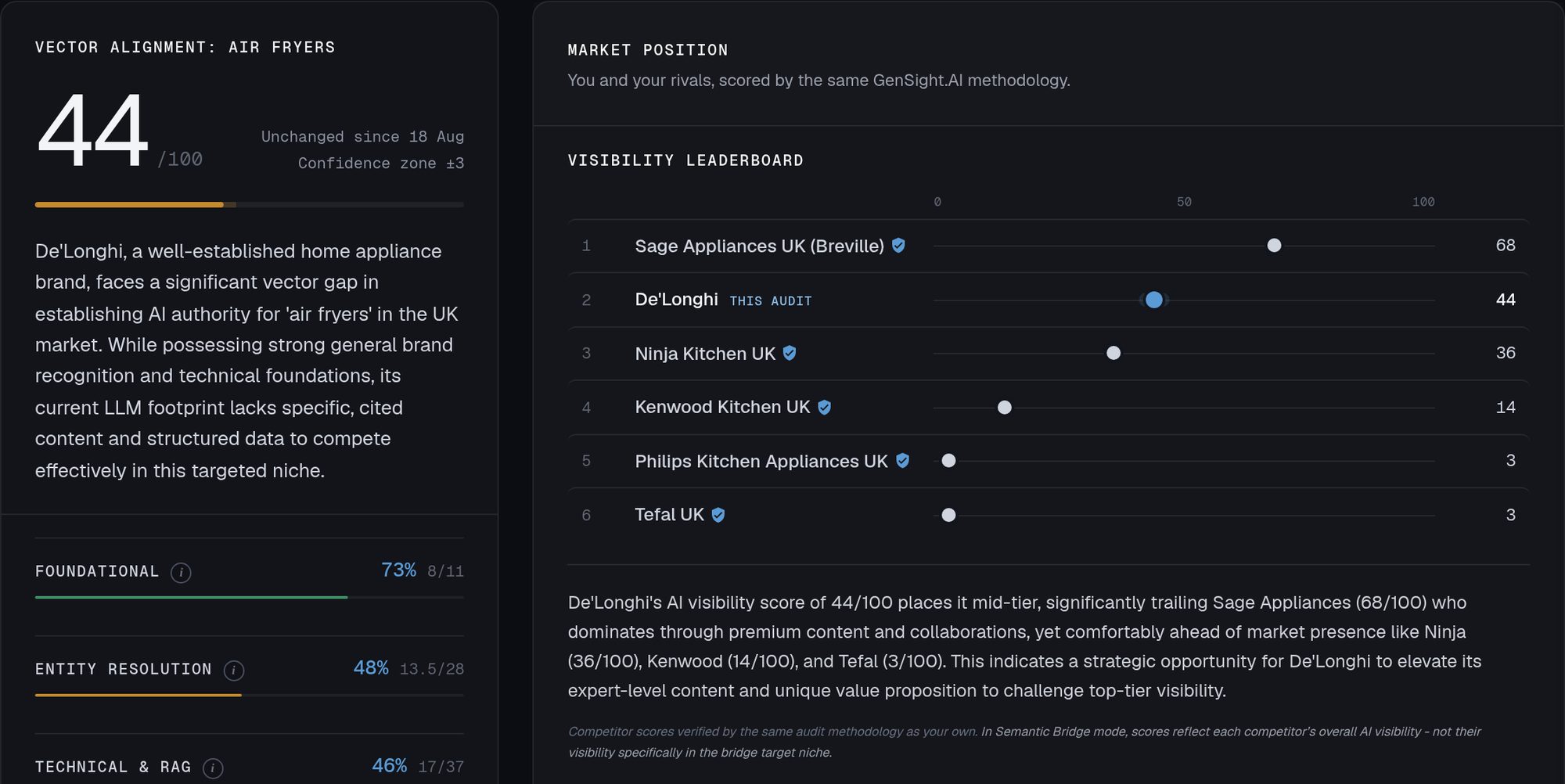
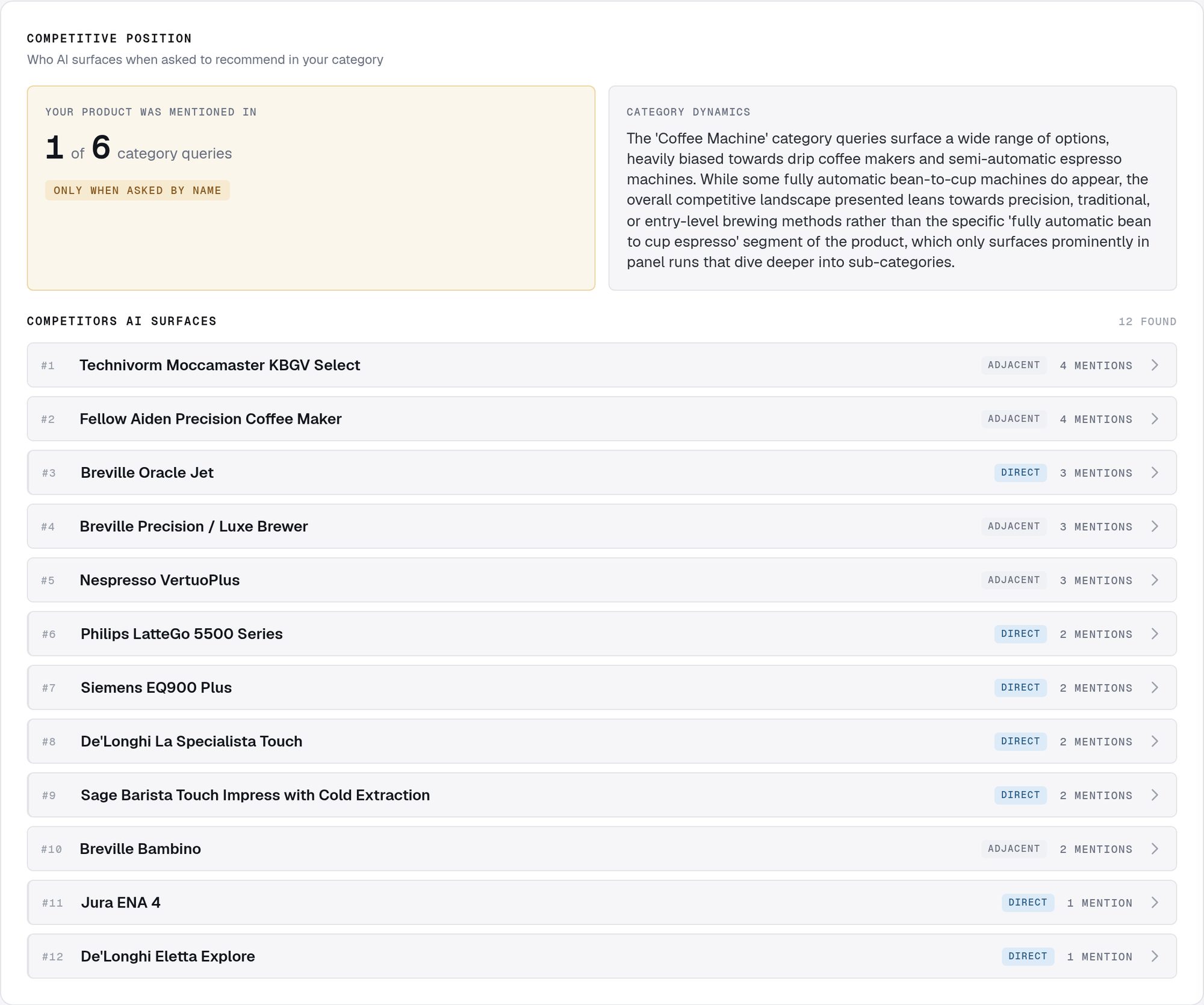
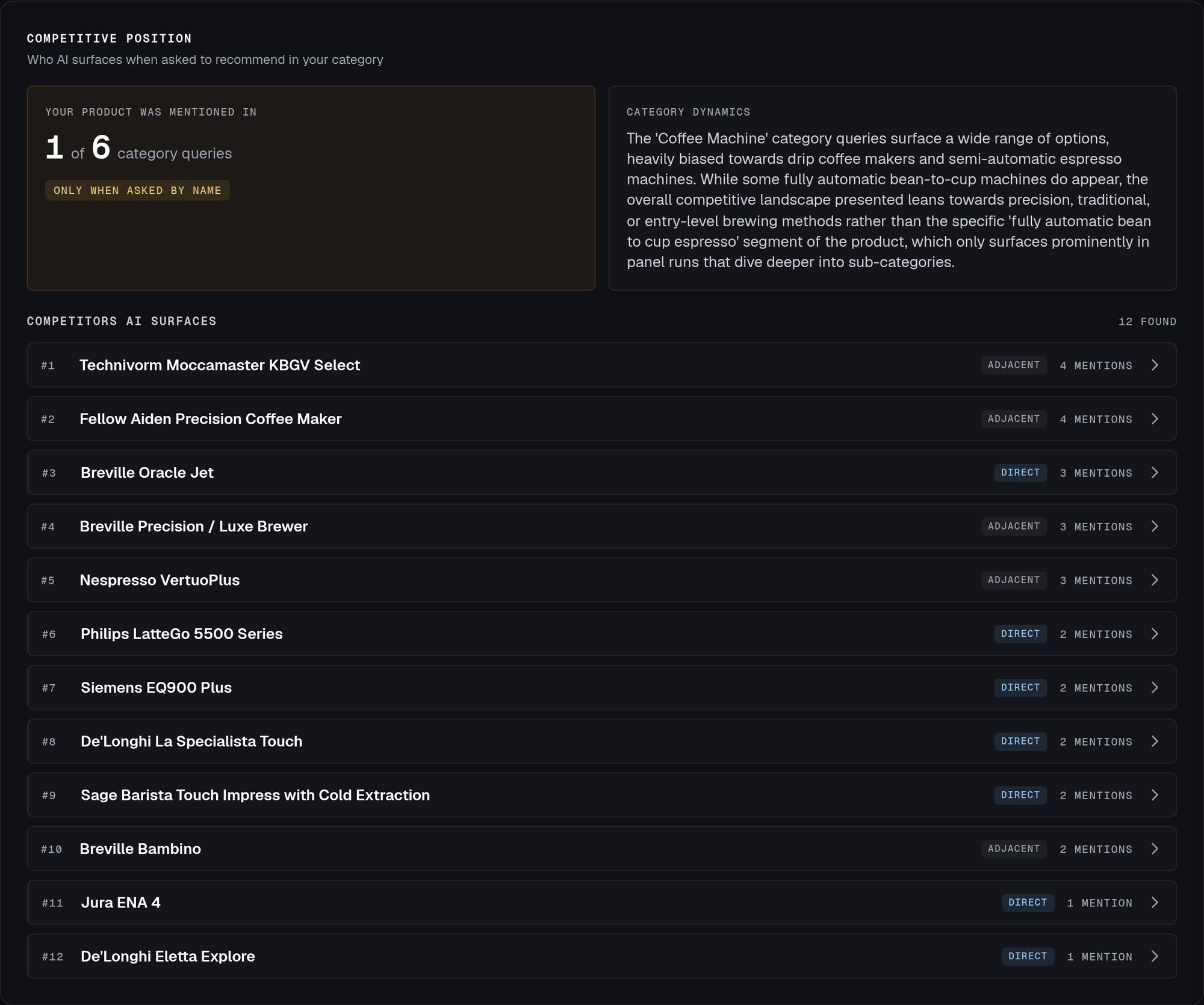
Your AI visibility score only matters relative to your competitors. GenSight.AI identifies the entities that currently dominate your category in AI answers, then audits each of them with the same 35 signals, so the leaderboard compares like with like.
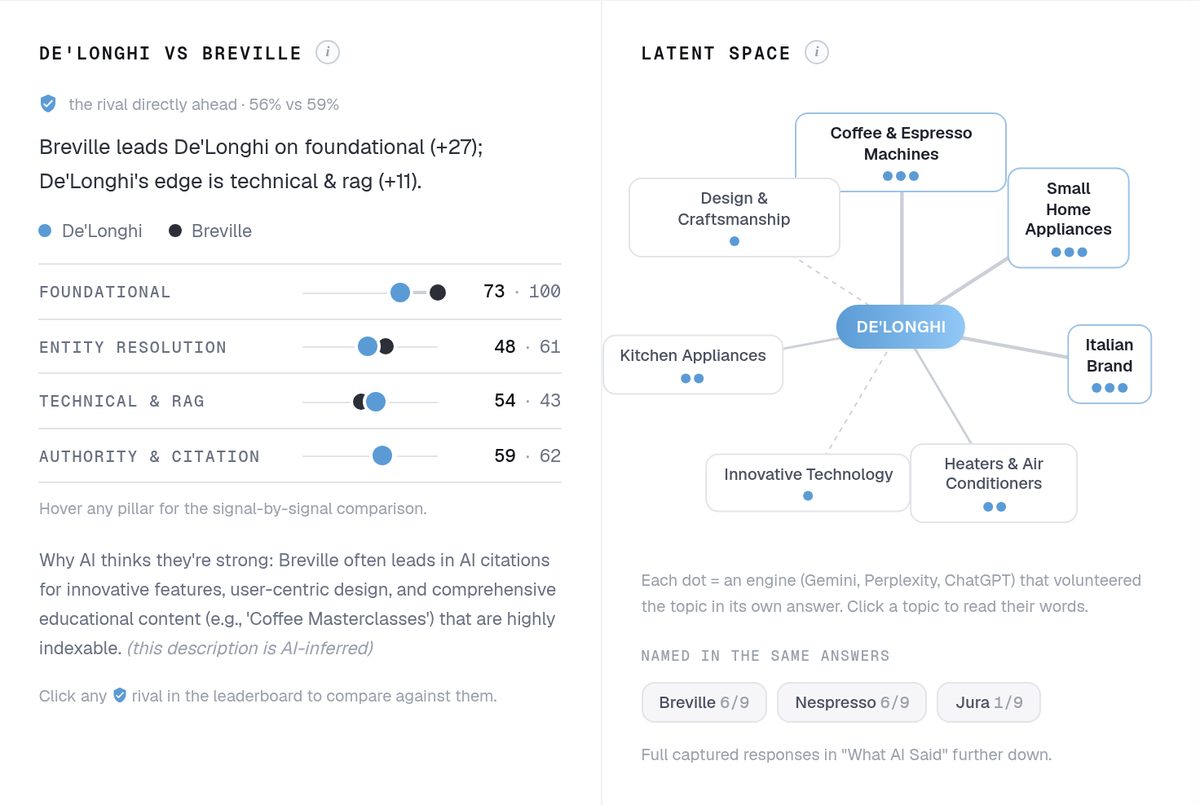
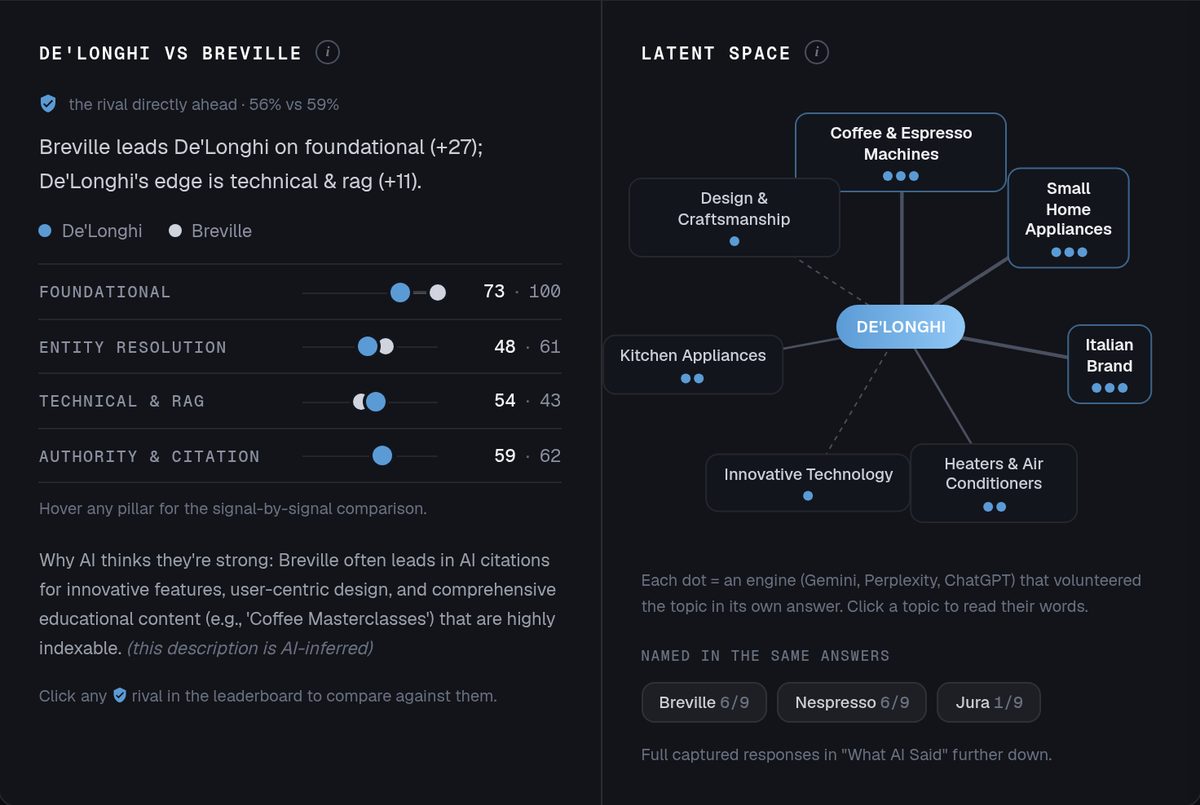
Why the gap takes the rival directly ahead of you and compares the two of you pillar by pillar, down to the individual signal, so the difference is a list of things to fix rather than a number. In Semantic Bridge mode the same analysis runs against the target market, so the competitors are the ones that matter for your expansion goal.
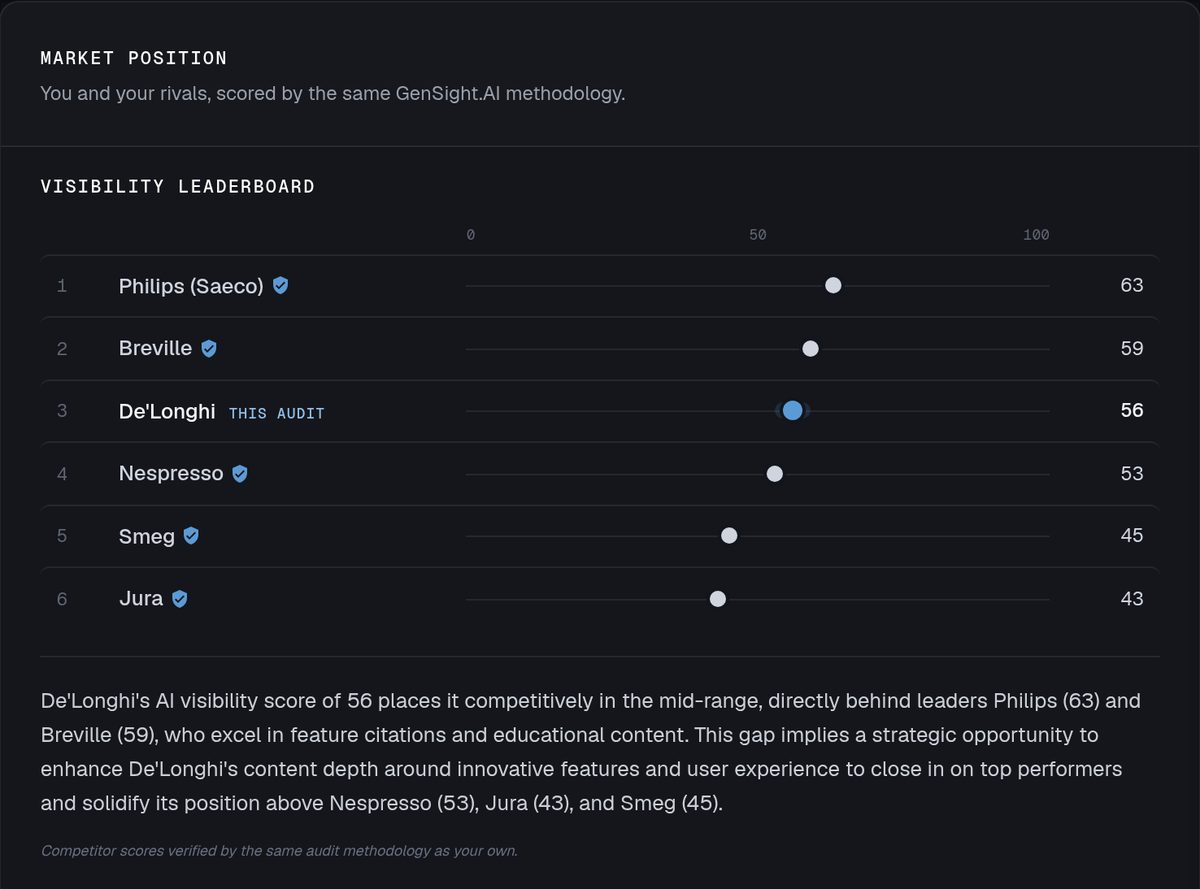
The Market Position panel shows your place among these competitors, each one audited with the same 35 signals rather than estimated. When your brand ranks below all five analyzed competitors, the dashboard clearly indicates this is a sample-based ranking - there may be additional competitors not shown.
5. LLM Bias & Semantic Perception
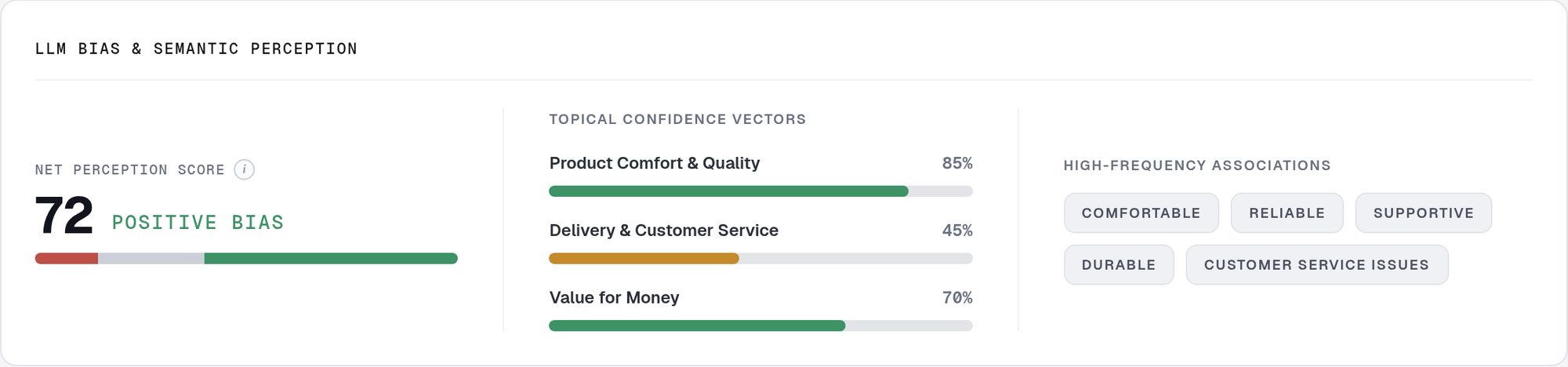
AI models don't just return links - they synthesize opinions. When a user asks ChatGPT about your product, the response carries a positive, negative, or neutral framing drawn from the model's training data.
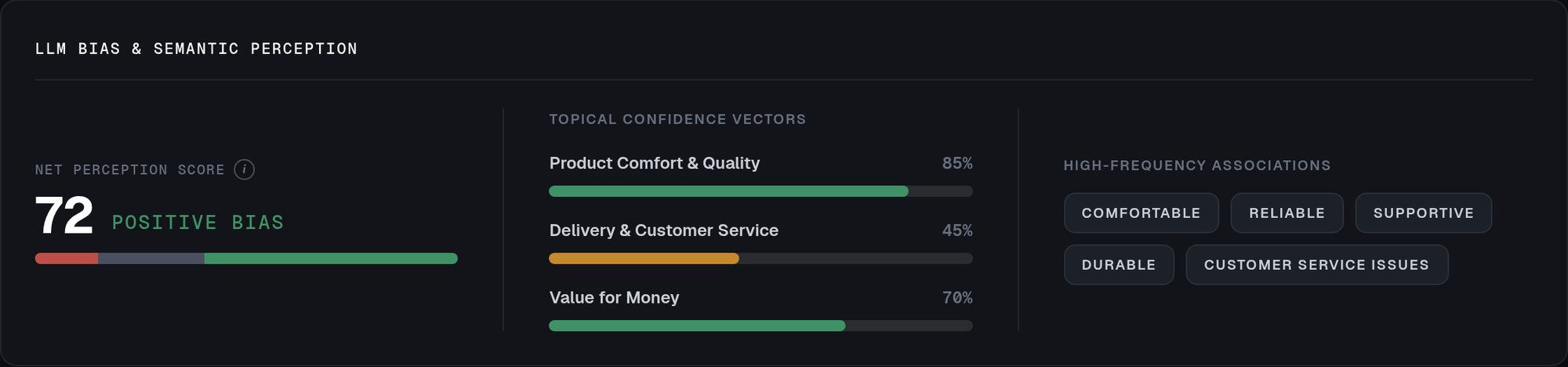
GenSight.AI extracts this bias mathematically. Rather than asking the AI "what do you think?", the engine applies Dynamic Topic Modeling to identify the specific subjects the AI associates with your brand (such as "Platform Scalability" or "Pricing Complaints"), assigns confidence scores to each, and computes a net perception score across positive, neutral, and negative distributions.
For entities with insufficient training data, the engine returns "Insufficient Semantic Data" rather than fabricating sentiment - a deliberate anti-hallucination safeguard.
6. Content Gap Mapping with Syndication Targeting
LLMs don't reward generic marketing copy - they prioritize Information Gain, meaning content that provides data, analysis, or structured knowledge the model can't easily find elsewhere.
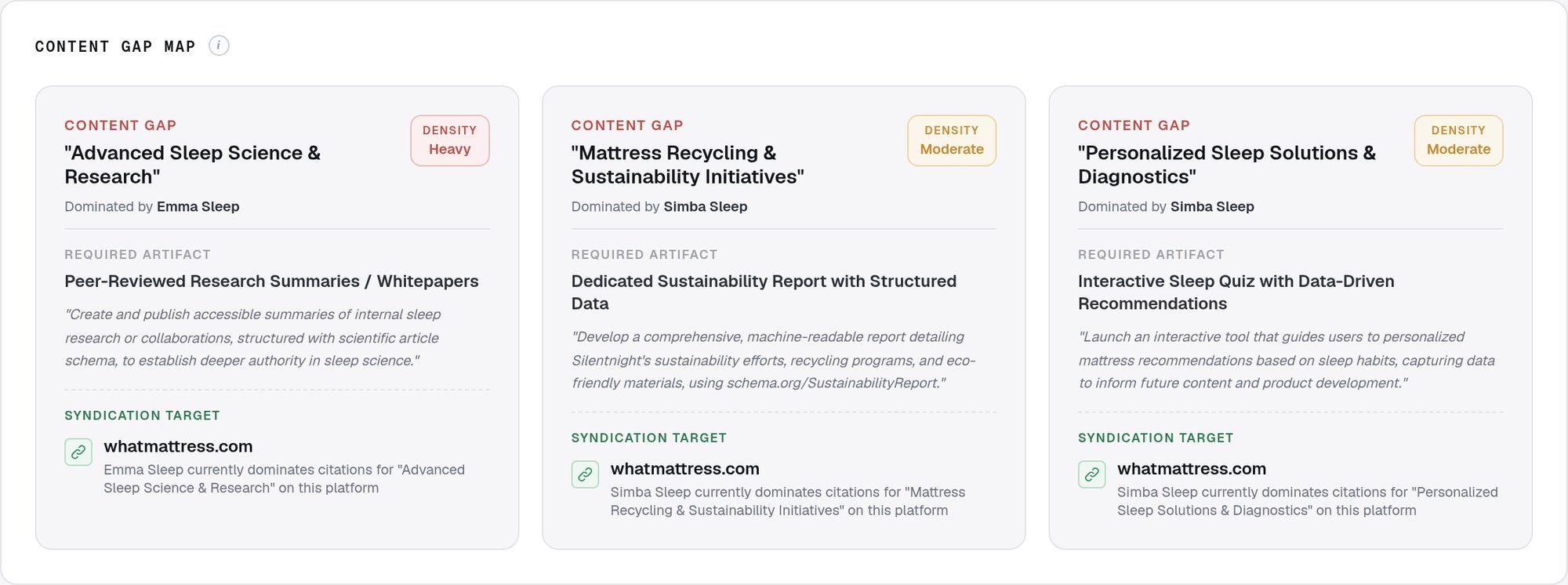
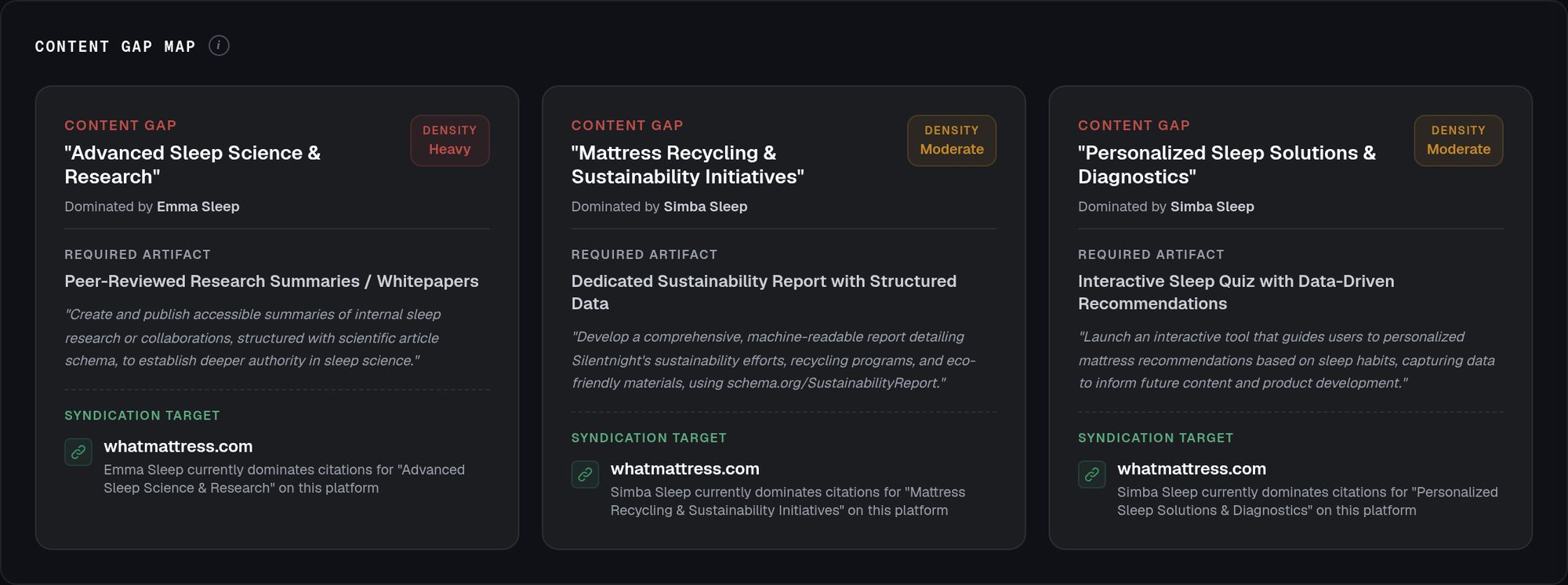
The engine scans the semantic footprint of your top competitors to identify specific topics where they dominate AI citations but you don't. For each gap, it identifies the dominant competitor who currently owns that topic, the specific content artifact you need to create (whitepaper, FAQ page, comparison guide), and a content brief describing exactly what to produce.
Most uniquely, each gap is cross-referenced with the AI Influence Graph to recommend a syndication target - the specific high-authority platform where publishing your content will have the most impact on AI citations. This connection between "what to create" and "where to publish it" is what transforms a diagnostic report into an actionable displacement strategy.
7. AI Influence Graph
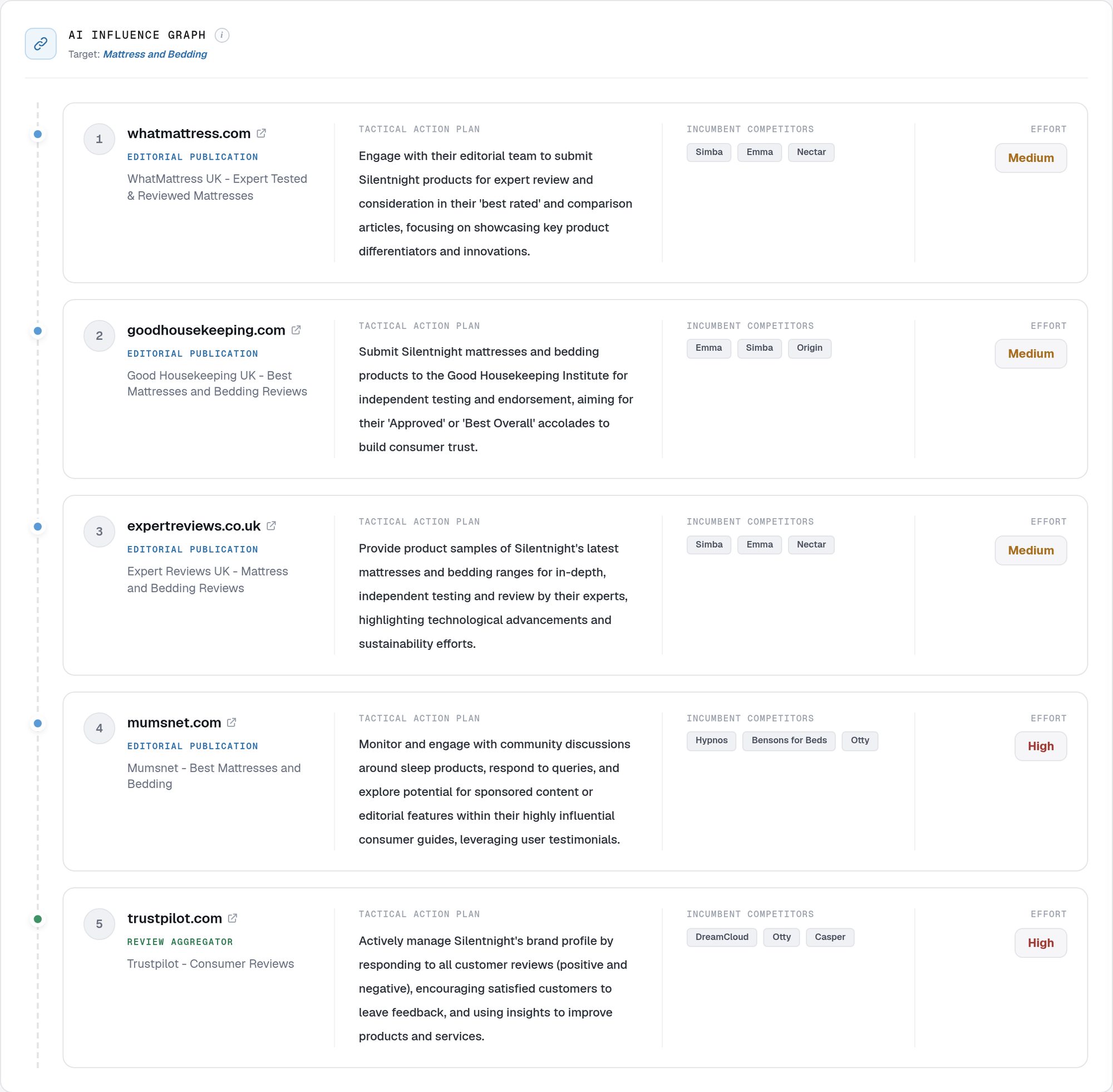
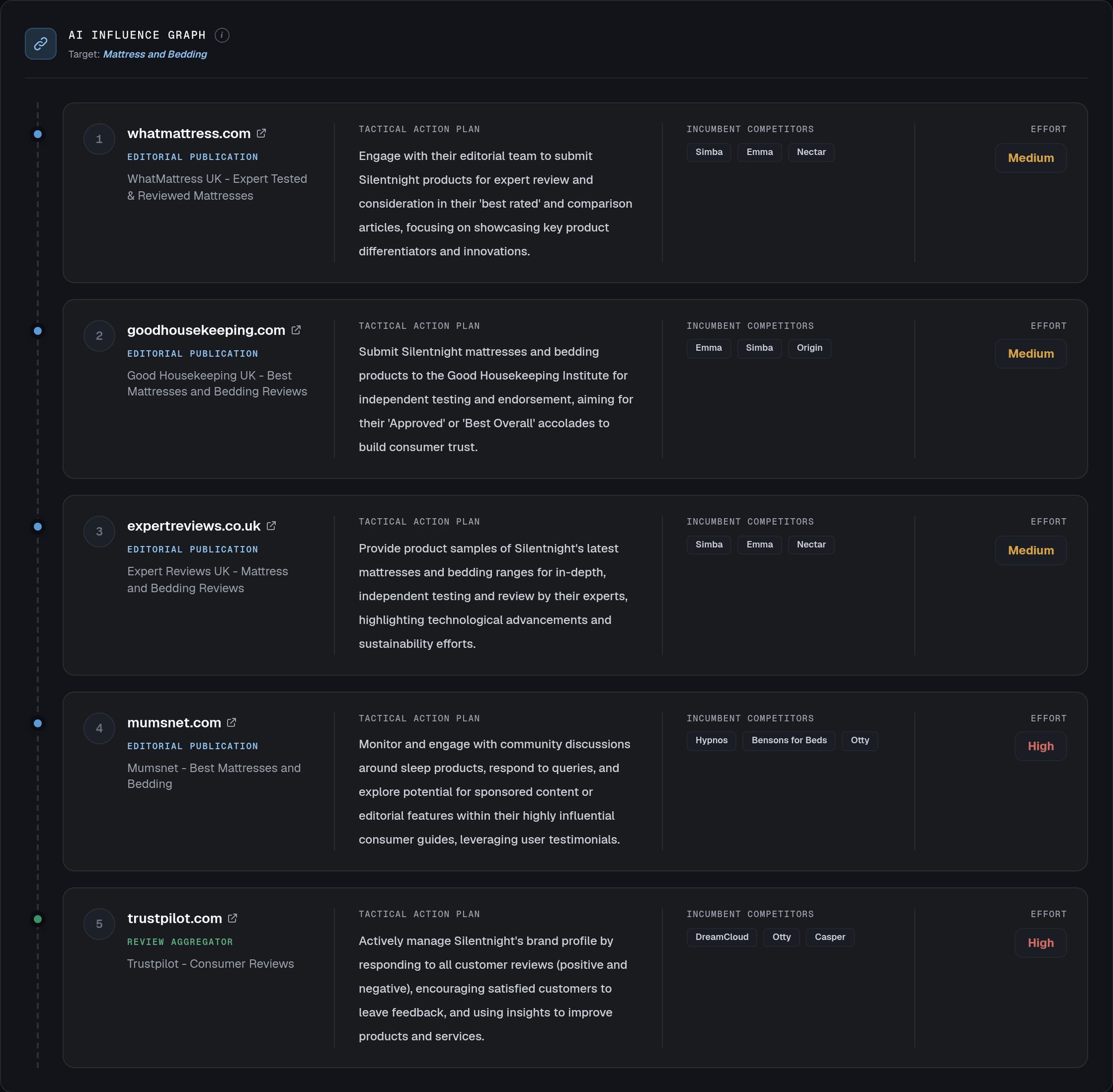
When ChatGPT or Perplexity recommends products in your category, those recommendations aren't pulled from random web pages. They're anchored to specific high-authority domains that the model learned to trust during training and through real-time retrieval.
The AI Influence Graph uses live Google Search grounding to identify the exact platforms, review aggregators, publications, and forums that AI models currently rely on for your specific niche. Each citation node includes the domain type (Review Aggregator, Major Publication, Forum), the competitors already present there, a specific action plan for how to establish your presence, and an effort level estimate.
Think of it as a verified hit-list for your PR and content team - the five places where establishing a footprint will most directly influence what AI says about your brand.
8. Semantic Bridging
Your baseline score measures visibility in your current niche. But what if you want to expand into a new market? A brand might score 85% for "CRM software" but only 12% for "AI-powered sales automation."
Semantic Bridging recalculates the entire 35-signal scoring engine through the lens of a target concept. It measures the vector distance between your current footprint and the desired cluster, then generates the exact architectural steps needed to make the AI associate your brand with the new niche. The competitive displacement and influence graph analyses within a bridge are contextualised to the intersection of your brand and the target niche - not just the pure target market leaders.
Each bridge search is timestamped and tied to the entity, so you can track whether your bridging efforts are working over time. Bridges older than 30 days are flagged as potentially stale, prompting a re-evaluation.
9. Score Timeline & Multi-Entity Portfolio
GEO is not a one-time fix - it's an ongoing process. The GenSight.AI dashboard provides a visual timeline showing how your deterministic score has changed over each audit period, with delta indicators showing the exact point change between runs.
Premium subscribers can click on any historical audit to view a complete snapshot of that moment in time - including which semantic bridges were active at that point. This makes it easy to correlate specific actions (such as publishing a whitepaper or securing a G2 listing) with measurable score improvements.
The Multi-Entity Portfolio lets you manage multiple brands or domains from a single dashboard. Each entity maintains its own audit history, bridge campaigns, and timeline - useful for agencies managing several clients or companies with multiple product lines.
Premium Dashboard Features
Score Timeline - last 10 audit periods with delta tracking and confidence zones.
Score Breakdown Panel - transparent view of all 35 signals grouped by pillar, with pass/fail indicators and verified vs. AI-inferred labels.
Enhanced Roadmap - each recommendation tagged with an owner (Technical, Content, or PR), linked scoring signals, estimated score impact, and expandable implementation steps.
Historical Snapshots - click any past audit to view that exact moment's dashboard, including time-scoped bridges.
Entity Portfolio - add and switch between brands, each with independent audit histories.
Bridge Freshness - age indicators on semantic bridge campaigns so you know when to re-evaluate.
10. ProductSight - Per-Product AI Visibility
Brand-level audits answer "how is your company perceived by AI?" but most companies sell products, and a brand can score well overall while individual SKUs are completely invisible. ProductSight is a separate 7-signal audit engine that measures AI Visibility for an individual product within a parent brand.
The methodology decomposes product visibility into three dimensions: Discoverability (does the LLM know this product exists?), Comprehension (does it describe the product accurately and with what sentiment?), and Competitive Position (does it appear in comparative recommendations, anchored by authoritative recent sources?).
Several methodology safeguards keep scores honest. A disambiguation step filters retrieved sources to confirm they're actually about this product and not a similarly-named one (a real problem - "Chloe Jeans" from a UK plus-size retailer is easily confused with the luxury Chloé brand). Brand-anchoring on knowledge and comprehension queries (D1, C1, C2) plus dual-pass retrieval on D2 ensures we measure the right product. A zero-state cap prevents inflated aggregate scores when a product is effectively invisible to LLMs - if multiple invisibility signals fire, the aggregate is capped at 20 and the roadmap forks to baseline-establishment instead of optimisation.
Where individual signals lack enough confirmed source material to analyse, they degrade gracefully (showing "-" with a clear explanation) rather than failing - the dashboard distinguishes "no usable data for this signal" from genuine technical failures.
The 7-Signal Product Engine
D1 - Training Corpus Knowledge - what the LLM knows about this specific product without retrieval, brand-anchored to disambiguate from similarly-named products.
D2 - Retrieval Surface Area - dual-pass grounded search (unbranded + brand-anchored), measuring breadth of indexable third-party content.
C1 - Attribute Alignment - whether sources describe the product using the brand's claimed key attributes or drift to other framing.
C2 - Sentiment & Framing - dominant emotional tone and qualifier density across confirmed source content.
P1 - Comparative Anchoring - mention frequency in unbranded "best [category]" queries (mirrors how real users discover products).
P2 - Source Authority - tier classification of citing domains (major publications vs review aggregators vs forum content).
P3 - Source Recency - estimated age distribution of confirmed sources, reflecting current relevance to the LLM.
Each ProductSight audit uses up to 12 grounded queries against Gemini and runs in 2-3 minutes. The dimension-level scores and aggregate are visible in your dashboard alongside per-signal evidence panels and a strategic remediation roadmap.
11. The "What AI Said" Panel
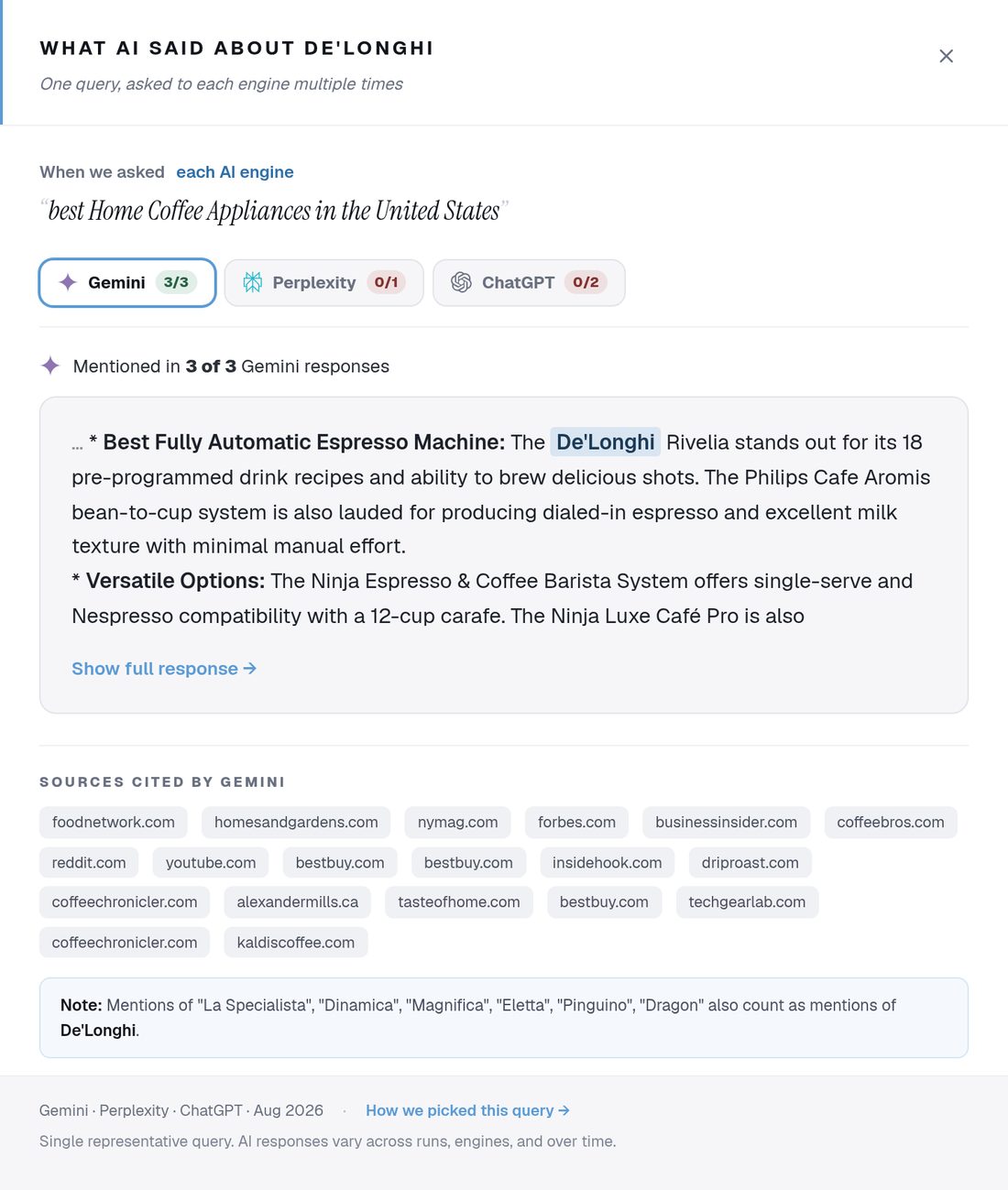
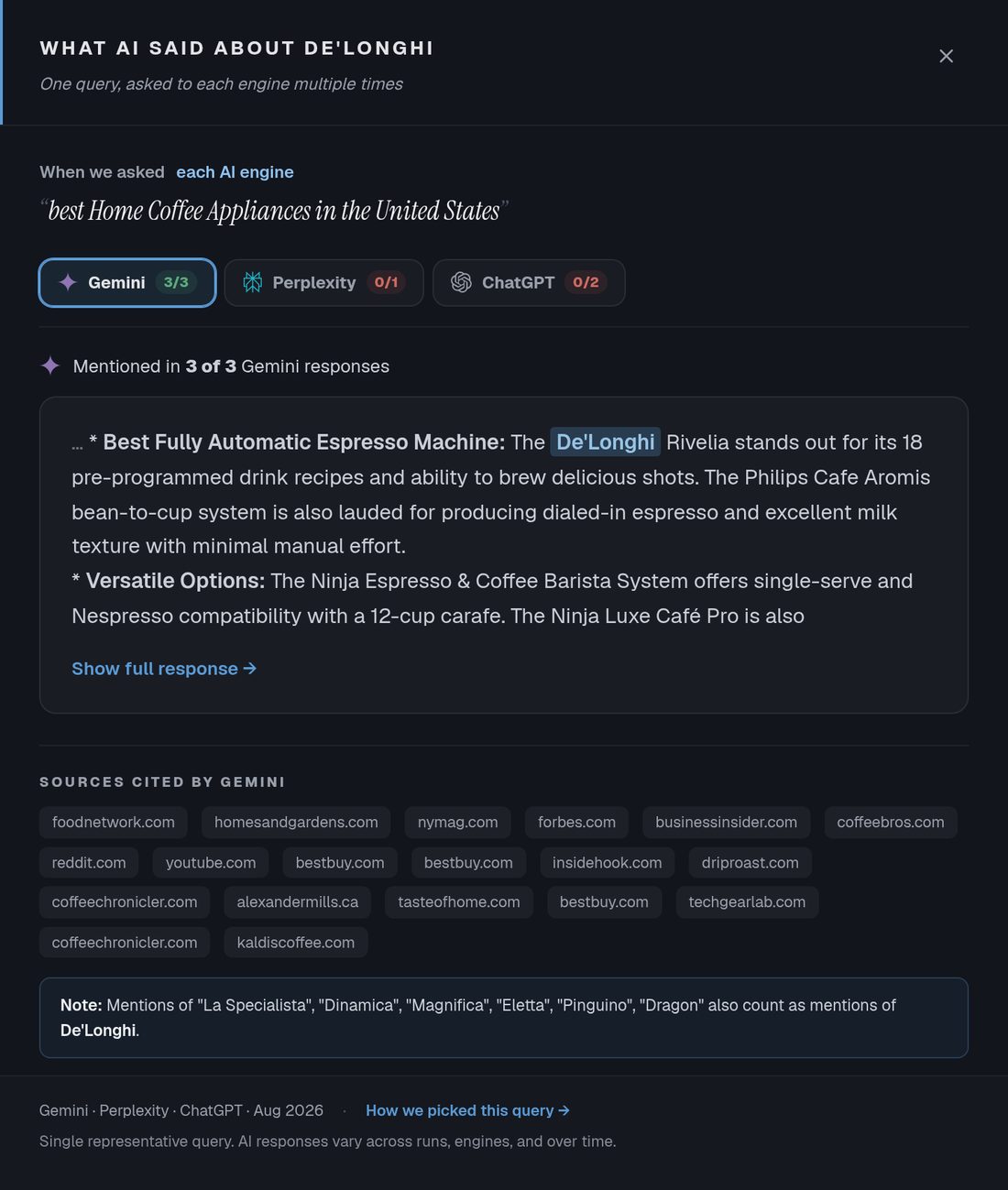
Most GEO tooling shows you a score and a list of recommendations but never lets you see the actual AI output the score was derived from. We think that's the wrong default. The "What AI Said" Panel sits on every audit and shows you the real, uncut responses from Gemini, ChatGPT and Perplexity to one representative query about your category, with mentions of your brand highlighted inline and the sources each engine cited listed underneath.
We deliberately use a single naturalistic query, not a battery of dozens. The query is chosen from a versioned, public template dictionary keyed to the brand's category and country - so anyone, including a journalist or a sceptical buyer, can put the same query to any of the three engines themselves and verify what we found. AI-generated questions per audit make scores higher in marketing collateral, but they break reproducibility, and reproducibility is the foundation of trustworthy methodology.
Each engine is asked the same query more than once. Grounded AI responses are non-deterministic - the same question asked twice in succession can produce meaningfully different answers, with consistency typically around 50 to 70%. One run would oversell consistent visibility; repeated runs surface the inconsistency honestly without over-engineering. The Panel reports the appearance count for every engine separately ("3 of 3 Gemini responses" next to "0 of 2 ChatGPT responses"), and we always display run 1 regardless of whether it is the most flattering - editorial honesty over marketing veneer.
Brand mention detection is alias-aware. For Land Rover, mentions of "Range Rover" or "Defender" count as Land Rover mentions. We resolve these via a separate Gemini call that returns the canonical brand name plus a list of sub-brands, each requiring a short relationship explanation - this is the safeguard against hallucinated aliases. The full alias list and the relationships that justify them are disclosed inline in the Panel itself so nothing is hidden behind methodology copy.
Localisation is handled by domain TLD detection across 19 supported markets. A .co.uk brand gets a UK-scoped query; a .de brand gets a Germany-scoped query. For ambiguous .com brands where market is unclear, we fall back to a globally-scoped query and surface the choice transparently - the Panel shows the country it scoped to so you can judge whether the localisation is fair to your brand.
We don't capture Panels for Semantic Bridge audits - those analyses ask "could I credibly enter this other category?", a forward-looking strategic question where present-state mention frequency in either the source or target category isn't a meaningful signal.
At a Glance
Query source. Versioned public template dictionary, keyed by category and country.
Engines. Gemini, ChatGPT and Perplexity, each shown with its own response, mention count and cited sources.
Runs. The same query is asked more than once per engine. The first run is always the displayed response.
Excluded. Semantic Bridge audits - different question, different answer.
Run your baseline evaluation.
See exactly how the scoring engine evaluates your brand today.
Run a free auditRelated Reading