We built an influencer mode for GenSight because people and companies aren't the same problem. A company has a website, schema markup, a press page, a Companies House listing. A person usually has none of that. What they have is profiles on platforms they don't own, and work that shows up under a thumbnail or a byline.
To see what the audit picks up, we ran it on one of the best known food travel creators in the world. Millions of subscribers, a decade of street food videos, the kind of face people recognise in markets on several continents.
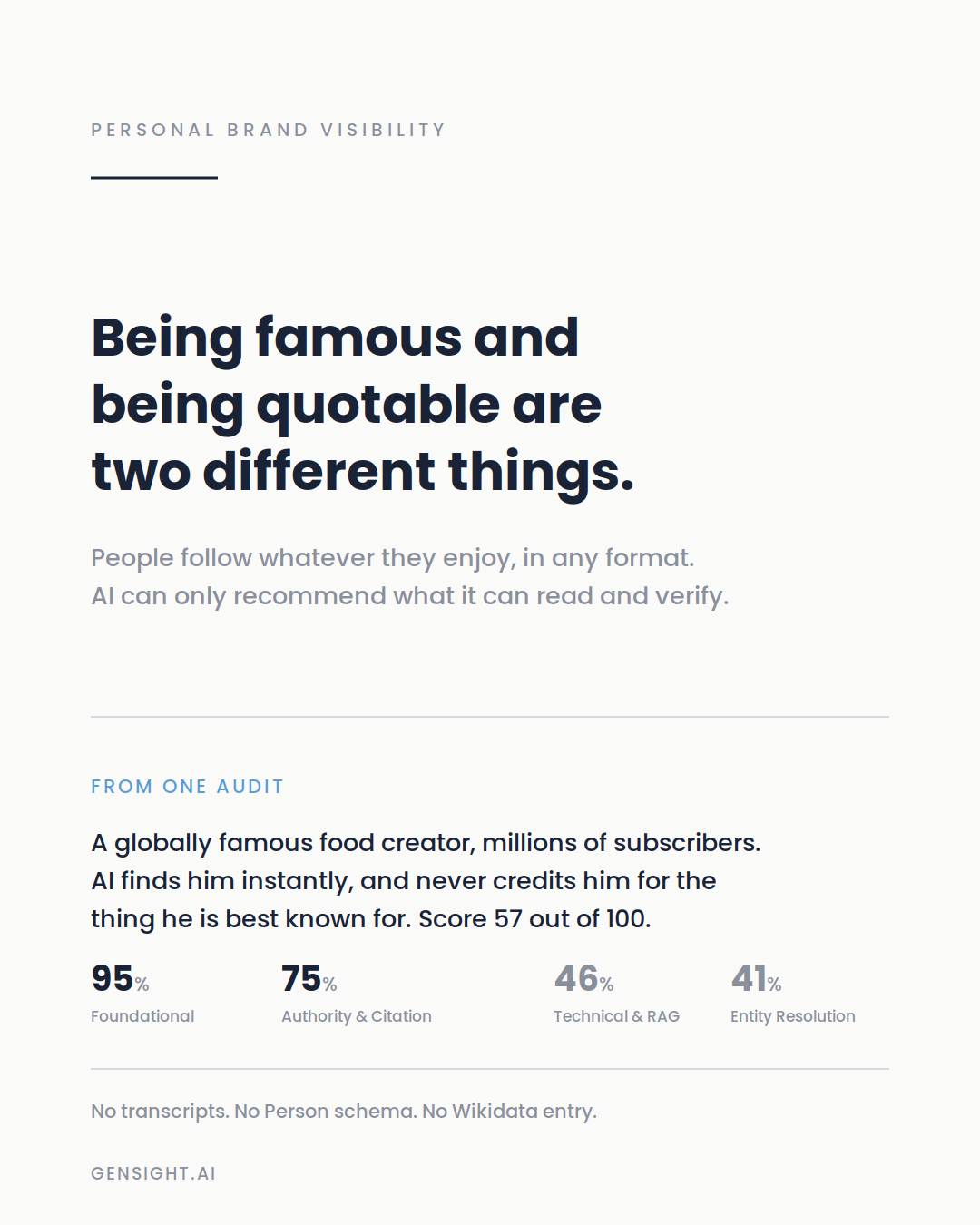
He scored 57 out of 100, which put him sixth among his peers. Two of the people above him have much smaller audiences than he does.
It isn't a fame problem
The engines find him instantly. He scores 95% on the Foundational pillar, and 75% on Authority & Citation, which is strong. Where he drops is Entity Resolution at 41% and Technical & RAG at 46%.
The reasons are all practical. There's no Person schema on his site, no Wikidata entry, and none of his videos have transcripts published anywhere. What exists instead is an enormous body of spoken and visual work that no AI can lift a sentence out of. The audit put it more bluntly than we would have: his intellectual property is largely trapped in video, which limits the ability of AI to index and cite his expertise. Brand strength immense, written record thin.
What the engines credit him for
When you ask the engines who the leading voices in food travel are, they settle on five topics that decide credibility in the category. He gets credited on two of them, both fairly: digital reach and influence, and authentic local immersion.
One he never gets credited for is "engaging storytelling and personality". Anyone who has seen his reactions to food would find that bizarre, because it's the thing he's best known for.
The three creators who got that credit instead are all writers. Books, columns, memoirs. Their storytelling is written down, so an AI can read it and quote it. His is a facial expression in a video.
The perception data tells a similar story. All three engines gave corroborated answers about him, backed by 31 independent sources, and the tone came out mixed: 12 praise, 1 caveat, 4 criticisms. Two of the criticisms were about whether his reactions are exaggerated and whether his recommendations have got less authentic as his audience has grown. Whatever you think of those claims, look at where they live. They're written, by other people, on the open web. When a creator's own account of their work is mostly video, the written record ends up belonging to everybody else.
Reach still counts for a lot
It's worth being clear about this, because the opposite conclusion is an easy one to draw and it's wrong. A huge audience generates mentions, interviews, coverage and third-party write-ups, and all of that is evidence an AI can use. A well-built website won't make a small creator outrank a famous one, and it shouldn't.
But someone who has both the audience and the written record has the edge, and that's a much smaller group than you'd expect. Most well-known creators have spent years building the first and none building the second, which is exactly the position our subject is in.
The part that matters for anyone building a personal brand
People pick creators based on whether they like the content, and nobody cares what format it's in. A video that makes you laugh is as good a reason to follow someone as an essay that makes you think.
An AI can't work that way. It can only recommend what it can read and verify, so a creator whose best work lives in video, on stage or in a podcast is at a disadvantage no matter how good they are. Not a judgment on the work. A retrieval problem.
The fixes are unglamorous and mostly one-off. Transcripts of your best video or audio work, published as text you own. A personal site that states clearly who you are, what you do and what you're known for, rather than acting as a landing page for your social links. Person schema with a complete sameAs array, so the scattered profiles resolve to one identity. A Wikidata entry, which is the structured source AI training pipelines lean on most heavily. An FAQ page, so the questions people ask about you have answers you wrote.
None of that is brand building in the usual sense. It's closer to filing: making true things about yourself legible to a machine that is already talking about you. And it's a lot less work than it sounds, particularly set against the decade of content most creators have already produced.
Whether you're a creator, a consultant, an author, an agency founder or an executive whose next role depends on being findable, AI systems are already answering questions about you, using whatever they can retrieve. Being famous and being quotable turn out to be two different things, and the second one is considerably easier to fix.
Influencer mode is available in GenSight.AI, and audits people against the same 35 signals and four pillars we use for brands. The audit described here was run as a public illustration; the creator is not a client and is not named.