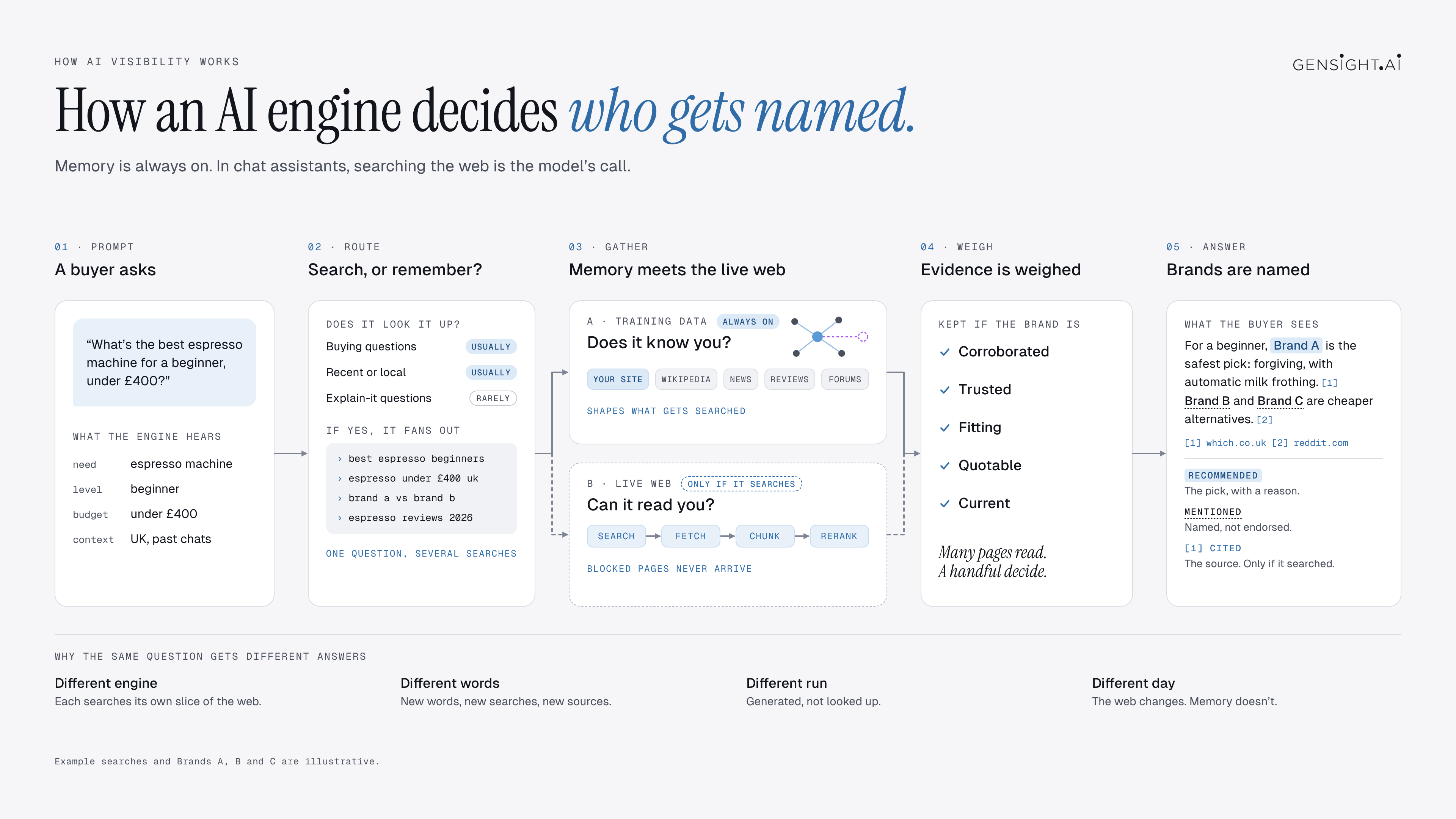
Most of the conversation about AI visibility starts at the end, with the answer. Was the brand mentioned, was it recommended, did it get a citation. Those are the right things to measure, but they are results, and a result on its own doesn't tell you why one brand made it into the answer and its nearest competitor didn't.
To see that, you have to follow a question through the system. We'll use the same one throughout: "What's the best espresso machine for a beginner, under £400?" Between that sentence and the two or three brands that come back, a chat assistant makes a series of decisions, and a brand can drop out at any of them. Each step below rests on the companies' own documentation or on independent testing, and we flag where that evidence is thin.
1. The question becomes a set of filters
The model doesn't treat the prompt as a phrase to match against web pages. It works out what the buyer wants (an espresso machine), who they are (a beginner), what they can spend (under £400) and, if the product knows it, where they are.
Each of those acts as a filter. A machine that nobody on the web has described as good for beginners, or as costing under £400, struggles to get through however good it is. If buyers ask for "beginner" and "under £400", reviewers need to have used those words about you.
2. The model decides whether to look anything up
Chat assistants such as ChatGPT and Claude don't search the web every time. The model has a search tool and decides, one question at a time, whether to use it. Google's documentation for developers building on Gemini describes the same design: the model "analyzes the prompt and determines if a Google Search can improve the answer." We've written separately about what happens when a model is confident enough to skip the search and turns out to be wrong.
What tips the decision is mostly the type of question. For ChatGPT, the independent tests we found agree on the direction. Questions about what to buy, the "best X for Y" kind, usually trigger a search, and questions that ask it to explain something stable, like how a pump works, rarely do. Anything that needs up-to-date information gets looked up, which OpenAI said from the start, and local questions came out highest in one study. Where the tests disagree is how often, partly because the rate moves with the exact kind of question, so treat any single figure with suspicion.
Products built on search work differently. Perplexity, and Google's AI Overviews and AI Mode, ground their answers in search results by design.
3. Two sources: what the model remembers and what it can read
Memory is always in play. It's everything the model absorbed in training, from Wikipedia and news coverage to reviews, forums and brands' own websites, and it shapes the answer even when the model searches, because the model writes the searches. Ask about espresso machines and some of the queries it sends out may already name brands before it has read a single page, which favours the brands it already knows.
There's no database inside the model with an entry for your brand, so there is nothing to submit and nothing to correct directly. What it knows about a brand is the residue of how the web described it before training, and that stays fixed until the model is retrained or updated.
If the model does search, the engine typically queries a search index, gets the pages (from the index, or by downloading them on the spot), splits them into passages and ranks those passages against the question. A brand can fall out at each stage. A page blocked in robots.txt, or refused with a 403 by an overcautious firewall, never arrives.
JavaScript catches a lot of sites out. Vercel's analysis of real crawler traffic in December 2024 found that OpenAI's and Anthropic's crawlers fetch JavaScript files but don't run them, while Gemini, which uses Googlebot's infrastructure, can render pages fully. At the time, a page built entirely in the browser could be readable to Gemini and close to empty for ChatGPT.
It also helps to know that "the AI crawler" is really several. OpenAI and Anthropic each run separate, documented bots for training, for building a search index and for fetching a page when a user asks for it, and each can be allowed or blocked separately in robots.txt (OpenAI notes that its user-triggered fetcher may not follow those rules). A blanket block added for good reasons at the time can quietly keep a site out of live answers now. We looked at that decision in our piece on the open, blocked and paid web.
How the two sources combine is where it's easy to overstate things. Memory doesn't fix the shortlist once a search runs. What the model reads can bring in a brand it had never heard of, and Mallen and colleagues found retrieval helps most on exactly the subjects models know least about. It can also push out a brand the model would otherwise have named. But the model isn't a neutral reader. Research on how models handle conflicting evidence found they readily take on coherent outside information, yet lean towards whatever in it agrees with what they already believe. So being known helps twice, in what gets searched and in how the results are read, without guaranteeing a place.
4. Most of what gets read is thrown away
By now the model has a stack of passages and a short answer to write, and most of what it retrieved never appears in the response.
No AI company publishes how it weighs sources, so what follows comes from research and observed behaviour rather than a rulebook. Brands named by several independent sources tend to do better than brands that mostly describe themselves, which is the argument we made in It is not enough for AI to see you. Sources the engine treats as authoritative for the subject, such as specialist reviewers and established publications, count for more. The brand has to fit every constraint in the question. The claim has to be one a model can lift into a sentence: "automatic milk frothing" can be quoted, "the art of the perfect cup" can't. And on anything time-sensitive, last month's review beats one from 2022.
Ranking still sits underneath all of this. The search engine's own ordering decides which pages reach the model at all, and research on how language models handle long inputs has found they make the best use of material at the start and end, and noticeably worse use of whatever is in the middle. Conventional search work still feeds this step.
5. Three ways to be in the answer
The buyer sees a paragraph. For the brands in it there are three separate results, and they don't always come together.
Recommended is the one that moves people: named as the pick, with a reason. Mentioned means named, usually as an alternative, without the endorsement. Cited means a page sits behind a claim as its source, and that page is often a reviewer, a publisher or a forum thread rather than the brand's own site.
Citations only exist when the model searched. A brand can be recommended straight from memory with no citation anywhere in the answer, and a brand's own page can be cited in an answer that recommends a competitor. We've argued before that citations and recommendations are two different prizes.
Why the same question gets different answers
Anyone who has checked on their brand by asking ChatGPT a few times will have watched the shortlist move. Engines search different indexes. One changed word changes the searches the model sends out, and therefore the sources. Answers are generated rather than looked up, so two runs of the same prompt can land differently. The web changes every day even though memory doesn't. And the person asking matters, because location, earlier messages, saved memories and whether they're logged in all shift the result.
So a screenshot proves very little. Visibility has to be read across many prompts and many runs, on the engines buyers actually use. Some tracking tools force a web search on every prompt, and testing by Graphite found that this changes which brands appear. A tool that always searches isn't showing you what a buyer sees.
Your own site is part of the memory too
A brand's own site goes into training data alongside third-party coverage, provided the training crawlers can reach it and read it. It's easy to opt out of that without meaning to. Blocking GPTBot, ClaudeBot or Common Crawl's CCBot keeps your pages out of those crawlers' future collection, while other people's descriptions of you still get in. There are legitimate reasons to block, licensing being the obvious one, but it should be a deliberate trade-off. The same readability rules apply here too: text that only appears once JavaScript runs, sits in an image or is behind a login may never be collected.
How often a brand is mentioned matters as well. Peer-reviewed work by Kandpal and colleagues and by Mallen and colleagues found that models answer factual questions far more accurately about widely documented subjects than about rarely mentioned ones. Your site can set the facts down clearly (what you're called, what you make, who it's for), and other sources provide the volume. Describing yourself consistently makes it more likely that those mentions attach to one brand rather than several near-misses.
Two separate jobs
In practice, then, there are two jobs. Being known gives a brand a head start: it shapes what the model searches for and how it reads the results, and when the model doesn't search, memory is all there is. Being readable matters whenever it does search, and that applies to the pages written about you as much as to your own site, because a citation can only go to a page the engine managed to read. We score the two separately in GenSight audits, under Entity Resolution and Technical & RAG, because a brand can be strong on one and weak on the other.
Sources: Google's Gemini API documentation on grounding with Google Search; OpenAI's and Anthropic's crawler documentation; OpenAI's announcement of ChatGPT search (2024); Vercel, The rise of the AI crawler (December 2024); 2025 and 2026 studies of when ChatGPT searches, from Nectiv, Cloro and AI+Automation; Graphite on forced search in prompt tracking (2026); Kandpal et al. (ICML 2023); Mallen et al. (ACL 2023); Xie et al., Adaptive Chameleon or Stubborn Sloth (ICLR 2024); Liu et al., Lost in the Middle (TACL).