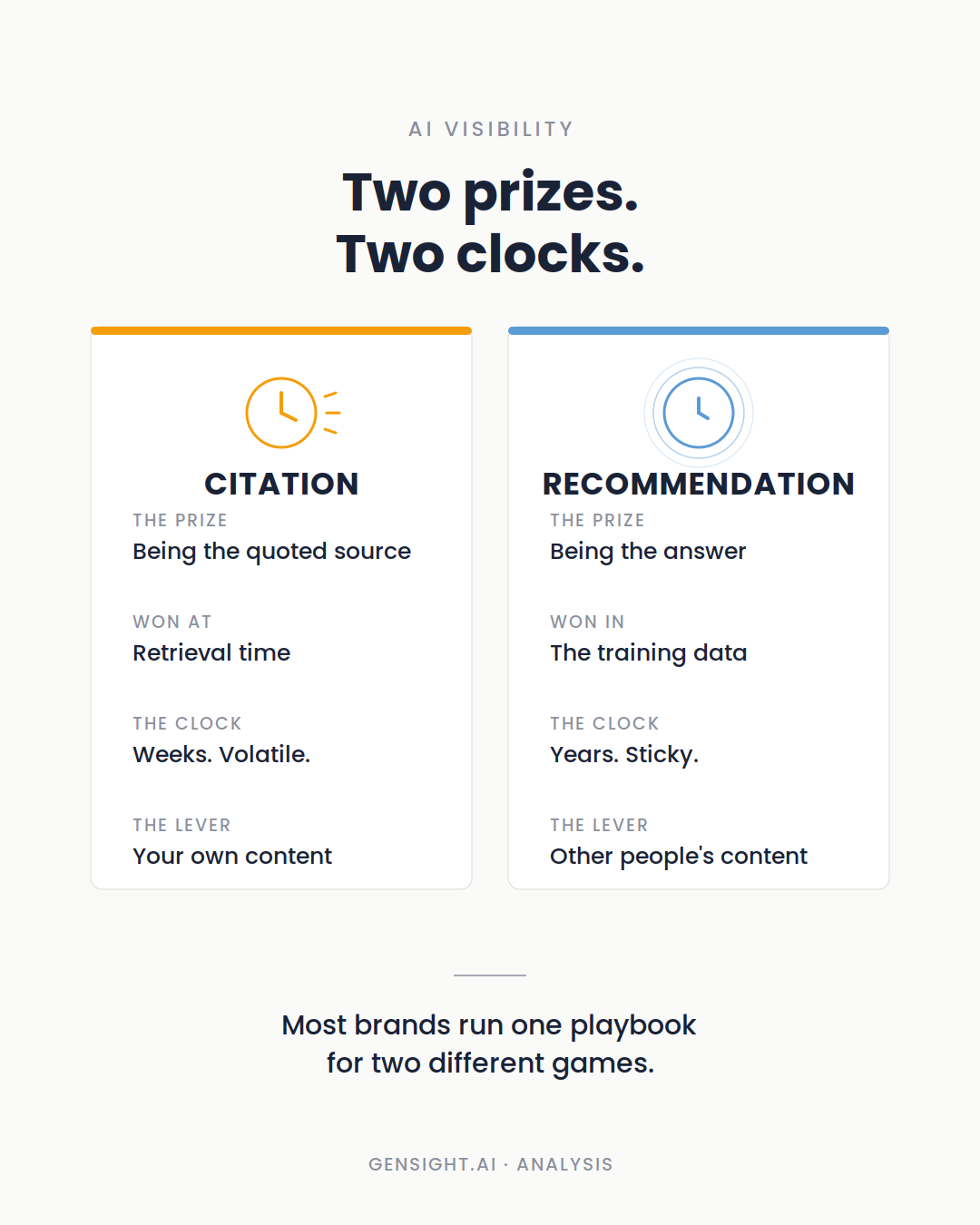
Almost every definition of AI search optimisation you will read this year says some version of the same thing: structure your content so AI engines cite and recommend your brand. Cite and recommend, said in one breath, as if they were one outcome with one playbook.
They are not one outcome. They are two different prizes, won on different surfaces, on entirely different clocks. Treating them as one goal is the quiet error sitting underneath most AI visibility strategies right now, and it explains why so many brands are doing real optimisation work and seeing it pay off in one column but not the other.
The two clocks
A citation is a retrieval-time prize. When an AI engine grounds its answer in live sources, it retrieves documents at the moment of the query and pulls from whatever is most extractable, most current, and most clearly structured. Citations are therefore fast-moving. Publish a genuinely useful, well-structured piece this month and you can be cited next month. Let it age and the citations fade. Industry tracking consistently shows AI citations fluctuating heavily month to month, because the answer is regenerated every time and the retrieval surface keeps shifting. Citation is weather.
A recommendation is, for the most part, a training-time prize. When someone asks an engine which product to choose or which brand to trust, the answer leans heavily on what the model already associates with the category: the accumulated weight of years of mentions, reviews, comparisons, and coverage in the corpus it learned from. That association moves slowly. It cannot be built in a quarter and it does not vanish in one either. Recommendation is climate.
One recent analysis of Gemini's behaviour illustrated the split in an unusually clean way: informational prompts, the how-to and best-practice questions, triggered live web search essentially every time, while recommendation-style prompts triggered it almost never. We have not verified that finding independently, and one analysis is one analysis. But it matches the mechanism. Citations are fetched. Recommendations are remembered.
Our own benchmark data keeps surfacing the same divergence from the other direction. When we audited 14 AI meeting assistants, the most-hyped tool in the category had excellent retrieval readiness, its content is modern and highly extractable, yet its citation worthiness and its presence in actual recommendations lagged well behind older, less fashionable tools. Polished and retrievable is not the same as established and associated. The two prizes came apart in the data, brand after brand.
The twist: for the queries that matter, the citation is not yours
Here is the part the get-cited industry tends to skip. Look at what actually gets cited when an engine answers a commercial query, the best-X and which-should-I-buy questions that drive revenue. It is almost never the brand being recommended. It is the third party doing the recommending: the comparison article, the review aggregator, the Reddit thread, the industry listicle. The brand appears inside the answer. The citation goes to the middle layer.
This is structural, not accidental. An engine answering a commercial question needs sources that compare options, and a brand's own site is, by definition, not a comparison. So when brands pour effort into making their own pages citation-worthy in the hope of winning recommendation queries, they are competing for a slot that mostly belongs to someone else.
The uncomfortable, useful conclusion: you do not primarily need AI to cite you. You need AI to cite the people who recommend you. Your recommendation outcome for commercial queries is being decided inside content you do not own, which makes it a placement and reputation problem at least as much as an on-site optimisation problem. The brands that show up in AI recommendations are the ones woven through the citable middle layer, present in the comparisons, reviewed on the aggregators, discussed in the threads the engines keep pulling.
Your own content still wins citations, but mostly for a different class of query: the informational ones, where your expertise, data, and original research can be the source the engine quotes. That is a real prize, and for some brands, publishers, consultancies, and anyone selling authority, it is the main prize. It is just not the same prize as being the recommended answer in your category.
Two playbooks, separated
Once the two prizes are pulled apart, the strategies stop blurring into one another.
To win citations, the levers are on your own surface and the clock is short. Publish original data and genuinely useful analysis. Structure it for extraction: clear claims, clean formatting, answers an engine can lift without untangling. Keep it fresh, because retrieval favours recency. Expect volatility and measure it monthly, the way you would track weather.
To win recommendations, the levers are mostly off your own surface and the clock is long. Get into the comparison content engines actually cite. Be present and accurately described on the aggregators and review platforms in your category. Earn the third-party coverage that, over time, hardens into the category association future models train on. Measure it quarterly at most, the way you would track climate, and judge progress in seasons rather than weeks.
And measure them separately. A single AI visibility number that blends citation activity with recommendation presence will mislead you in both directions: it will panic you about volatility that is normal in the citation layer, and lull you about stagnation that is dangerous in the recommendation layer.
The discipline does not need another reminder that AI visibility matters. It needs the distinction the phrase has been hiding. Two prizes, two clocks, two playbooks. The brands that separate them will spend the next year building the right asset on the right timescale, while everyone else keeps running one playbook for two different games.