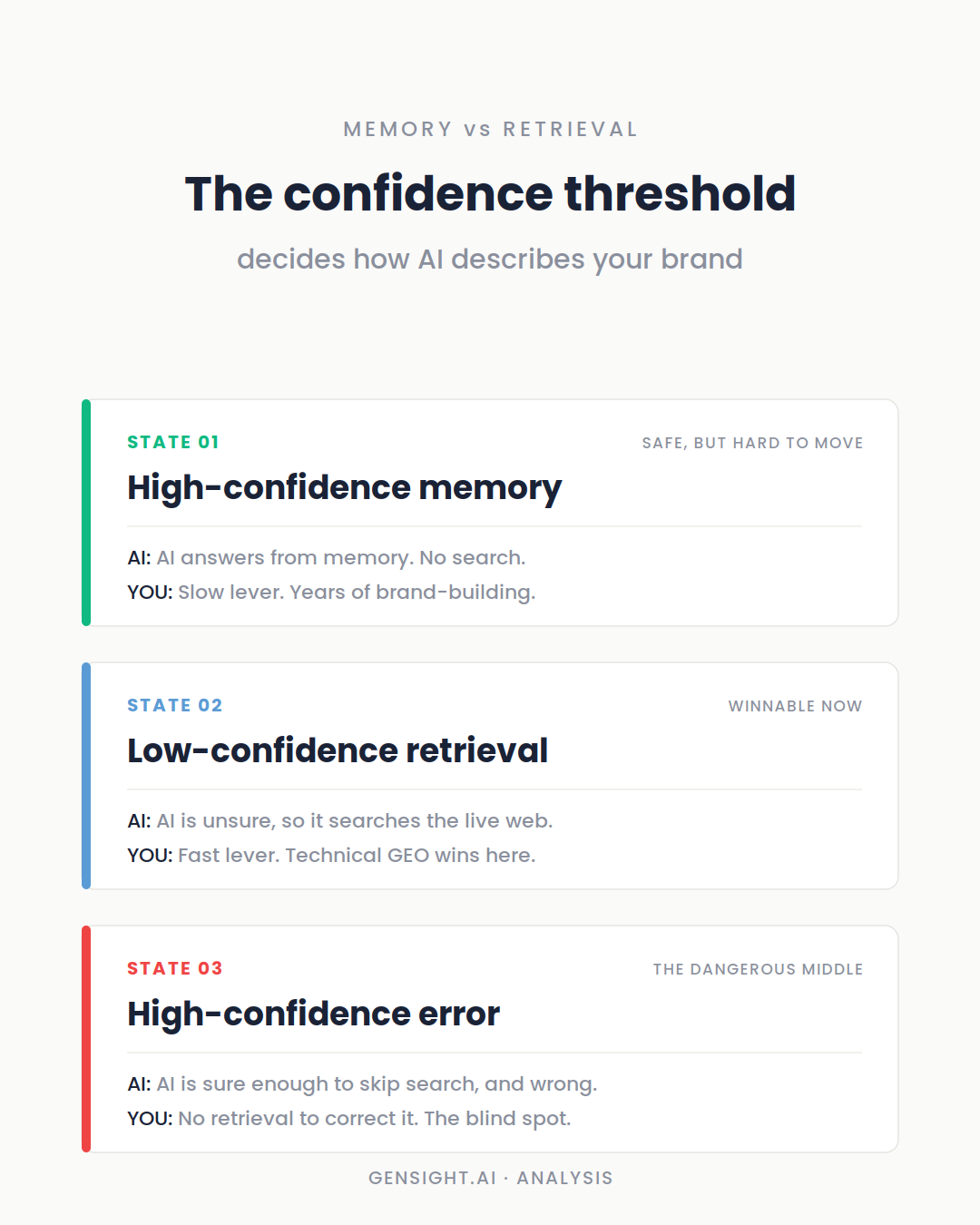
Ask an AI engine a question and it does not, by default, go and look anything up. It answers from memory: the patterns and associations baked into its weights during training. Retrieval, the live web search that pulls in current information, is the exception, not the rule. The engine reaches for it only when its own confidence in answering from memory drops below a certain threshold.
This is now well established in the research. A line of work on what is called confidence-based dynamic retrieval describes the mechanism plainly: if the model is confident enough about a query, it skips retrieval entirely and answers from its parametric memory; only when confidence falls below a set threshold does it trigger a search. Retrieval is expensive, so engines are tuned to avoid it whenever they think they already know the answer.
For brands, that single design decision quietly governs how AI describes you. And it creates three very different situations, only one of which most people are paying attention to.
The three states your brand can be in
For any given question, your brand sits in one of three states, and the state determines what you can do about it.
State one: high-confidence memory. The engine knows you, or thinks it does, well enough to answer without looking. Ask it to name flower delivery services and it returns the same familiar set from memory, no search required. If you are one of those names, this is a comfortable place to be, but it is comfortable precisely because it is hard to move. This state is built from years of training data: brand mentions, citations, associations accumulated across the public web over a long time. Technical optimisation does little here in the short term. This is the zone where the slow, compounding work of being talked about is what counts, and where the brands already inside the set are insulated by it.
State two: low-confidence retrieval. The engine is not sure about you, the category, or the specifics of the question, so its confidence drops and it goes to the live web. Now everything changes. In this state, what the engine says about you is determined by what it can find and parse right now: your content, your structure, your citability, the third-party sources that mention you. This is not the years-long zone. This is the zone where technical AI visibility work pays off quickly, because you are influencing the material the engine retrieves at the moment it answers. The majority of challenger brands, mid-market players, and long-tail queries live here, and it is almost entirely winnable.
State three: high-confidence error. This is the dangerous one, and it is the least discussed. The engine is confident enough to skip retrieval, but its memory of you is thin, outdated, or simply wrong. So it answers from memory, fluently and with conviction, and it is incorrect, and no retrieval is triggered to catch the mistake. The research is blunt about this failure mode: models tend to generate high-confidence errors when a question sits just beyond what they reliably know, and because confidence is high, the safety net of retrieval never deploys.
Why this does not mean technical work is futile
It would be easy to read all this and conclude that AI visibility is just brand-building by another name: that if memory rules, only years of accumulated reputation matter, and the technical side is a rounding error. That conclusion is wrong, and the three states are why.
The confidence threshold is not a fixed wall. It is a line, and brands sit on different sides of it for different queries. The entire job of AI visibility is to understand which side you are on, query by query, and to act accordingly. Where the engine retrieves, technical work is decisive. Where the engine is confidently wrong, the goal is either to correct the parametric impression over time or, in the nearer term, to influence the surrounding signals enough that the engine's confidence drops and retrieval re-engages, bringing your fresh content back into play. Both levers are real. One is slow and one is fast, and knowing which applies to a given query is the whole game.
This is the point the lazy version of the argument misses. Memory versus retrieval is not a verdict on whether you can act. It is a map of where to act, and how quickly to expect results.
Confidence is query-specific, not brand-specific
The most useful reframing is this: a brand does not have one confidence level. It has a different one for every question.
Take a UK challenger bank. Ask an engine "is it a bank" and the answer comes confidently from memory. Ask "is it good for business accounts for a sole trader trading into the EU" and confidence collapses, because that specific intersection of facts was never strongly represented in training. The same brand is in state one for the first query and state two for the second. The first is a long game. The second is available to win this quarter, through exactly the technical and content work that the memory-rules argument would tell you to abandon.
So the question is never "does AI know my brand from memory or not." It is "which of my commercially important queries fall on the retrieval side of the line, because those are the ones I can move now." Mapping that, separating the high-confidence-memory queries from the retrieval-triggered ones, and finding the confidently-wrong ones before a customer does, is fast becoming the core diagnostic of serious AI visibility work.
What to do about it
For queries where the engine retrieves, treat it as a live, winnable surface and do the technical work: structure, citability, fresh authoritative content. It lands quickly because you are shaping what the engine reads at the moment it answers. For queries where the engine is confidently wrong, accept that the fix is slower and runs through the parametric channel, accumulating the mentions, citations, and corrections that reshape what the model believes over time, while working in the interim to surface signals strong enough to re-trigger retrieval.
Do not treat your brand as a single visibility score. Treat it as a portfolio of queries, each sitting somewhere on the confidence line. The averages hide the risk. A brand can look healthy in aggregate while being confidently misdescribed on the three queries that actually drive purchase decisions.
And watch the line move. Every model update reshuffles what sits in memory and what triggers retrieval. A query that was safely answered from memory can shift, and a confidently-wrong answer can appear or disappear without warning. AI visibility is not a one-time fix; it is a moving map, and the threshold moves with every release.
The headline fear, an AI engine stating something false about your brand with total confidence and no retrieval to correct it, is real, and it is a direct consequence of how these systems are built to save effort. But it is not a reason to give up on the technical work. It is the strongest reason to do it precisely: to know which of your queries are safe in memory, which are live in retrieval, and which are quietly, confidently wrong.