The next buyer walking into UK retail is not a person. It is an agent. Google is rolling out its Universal Commerce Protocol, which will let shoppers buy directly from AI Mode and Gemini. Roughly two percent of ChatGPT queries, on the order of fifty million a day, are already shopping related. And while the checkout side of agentic commerce is stumbling, OpenAI quietly retired its Instant Checkout after a tiny fraction of promised integrations materialised, the discovery side has already moved. The question of which products an AI recommends is being settled now, well before the buying itself is fully automated.
An agent does not shop the way a person does. It does not feel the warmth of a brand it grew up with. It parses. It reads structure, extracts attributes, checks facts against sources, and assembles a recommendation from what it can machine-read. So we asked a simple question of UK retail: who is actually ready to be read?
We benchmarked 15 UK retail brands in three tiers: five digitally-native DTC brands (Gymshark, Huel, TALA, Grind, Beauty Pie), five mid-size independents (ProCook, Seasalt Cornwall, NEOM Wellbeing, Emma Bridgewater, Bird and Blend Tea), and five legacy high-street giants (John Lewis, Next, M&S, Argos, Dunelm). We then did something we would encourage anyone publishing AI-visibility numbers to do: we ran the benchmark twice, hand-verified the headline claims by fetching and inspecting the underlying files ourselves, and report only the findings that reproduced.
Machine-readability runs opposite to size
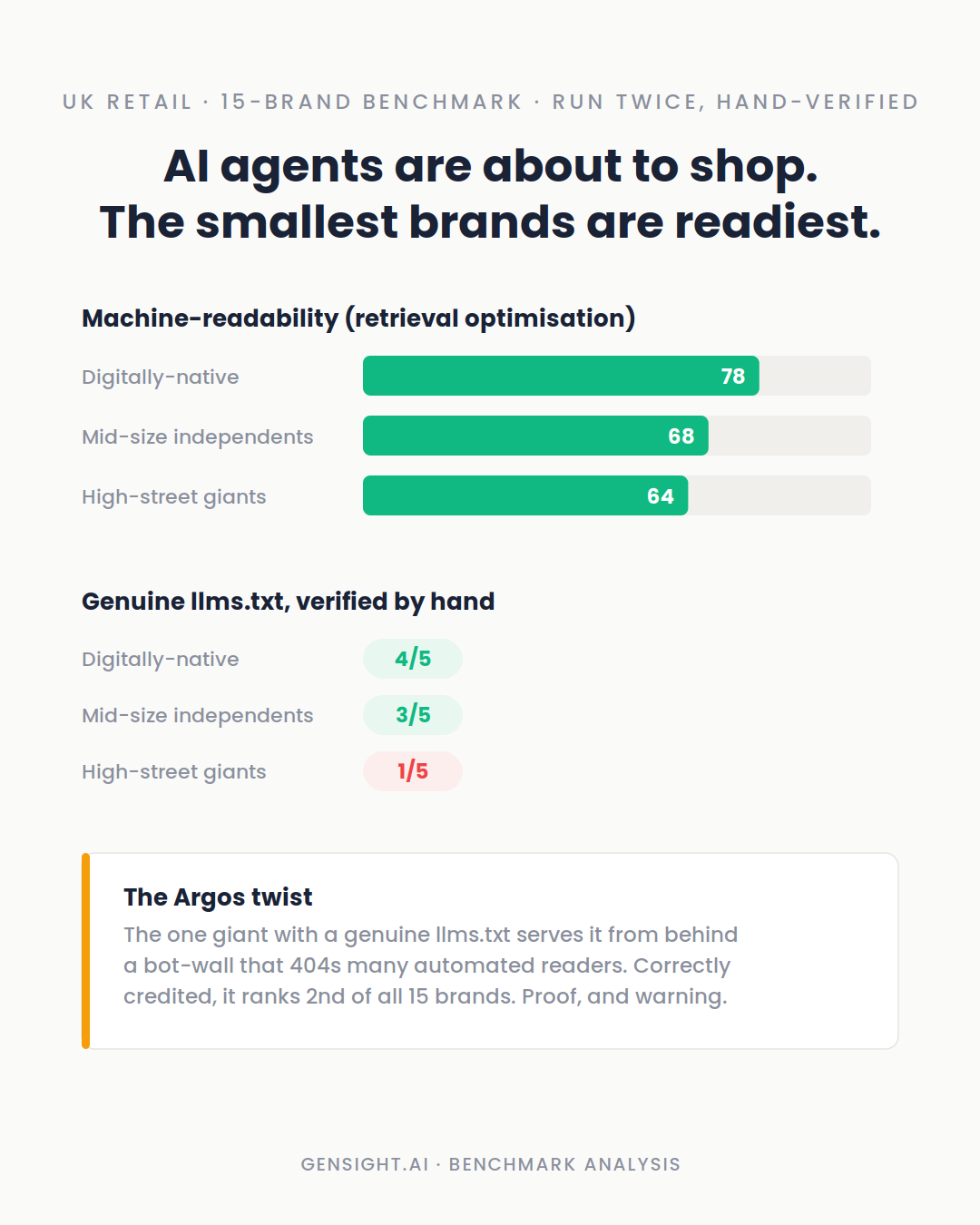
On retrieval optimisation, the pillar measuring how well a site is structured for a machine to parse and extract from, the three tiers separated cleanly, and in the wrong order for the incumbents. The digitally-native brands averaged 78. The mid-size independents averaged 68. The legacy giants averaged 64. The youngest, smallest brands in the set are the most machine-readable, and the gap runs exactly opposite to size, budget, and engineering headcount.
One signal tells the story in miniature. An llms.txt file is an emerging standard: a plain declaration at a site's root telling AI systems what the site is and how to read it. This signal is easy to measure wrongly, catch-all routing makes missing files look present, and bot-walls make present files look missing, so we verified every claim by hand, fetching each file and inspecting its contents. The verified result: four of the five digitally-native brands ship a genuine llms.txt. Three of five mid-size brands do. Among the five high-street giants, with their in-house engineering teams and eight-figure technology budgets, exactly one does.
The Argos twist
That one exception is the most instructive brand in the benchmark. Argos serves a real, well-formed llms.txt file. But it serves it from behind a bot-wall so aggressive that many automated systems receive a 404 where a browser sees the file, our own first pass included, until we hardened the check. The one giant that did the work has partially hidden it from the very machines it was written for.
And the work shows. Once its machine-readability was correctly credited, Argos scored 70 in our benchmark, second in the entire set of fifteen, behind only Huel and ahead of every other brand of any size. The best-prepared high-street name is not the one with the most premium reputation. It is the one that quietly shipped the structural work.
That second half deserves dwelling on, because it will bite more brands than Argos. Enterprise security layers are tuned to block automated traffic, and AI crawlers are automated traffic. A retailer can invest in schema, structure, and machine-readable declarations, and have its own bot-wall quietly return 404s to the systems those investments were meant to reach. If your AI-visibility work and your bot-defence policy have never been in the same meeting, there is a reasonable chance one is undoing the other right now.
Why the smallest brands are winning the structural game
The likely explanation for the gradient is more interesting than negligence. The digitally-native brands largely sit on modern commerce platforms that ship machine-readability as a default, the platform layer does the AI-readiness work whether the brand thinks about it or not. The giants run custom stacks behind enterprise bot-defences, where every new standard needs a ticket, a sprint, and a business case, and where the security layer can quietly undo the visibility work. The result is that a challenger tea company can be better prepared for machine buyers than a retailer with 150 years of high-street presence, not because it tried harder, but because its platform made the choice for it.
For the digital natives, though, the win is narrower than it looks. Machine-readability gets you parsed; it does not get you preferred. An agent that can read you perfectly still needs reasons, reviews, coverage, corroboration across the wider web, to choose you over the name it has seen a thousand times. Legibility is the entry ticket, not the prize. The natives have bought the ticket cheaply. The contest for preference is still ahead of them, and the incumbents bring a century of accumulated presence to it.
What to do with this
For large retailers, two actions. First, translate the reputation into machine-readable form: the structural work is cheap relative to any brand campaign, and Argos demonstrates a giant can lead the whole field on it. Second, and less obviously, audit what your bot-defence serves to AI crawlers specifically. A 404 to the wrong user agent can erase the entire investment, invisibly, with nobody in the building aware it is happening.
For challenger brands, bank the structural advantage but do not mistake it for the win. You are readable at the exact moment the machine buyers arrive, which is a genuine first-mover position. Spend it building the corroboration layer, the reviews, mentions, and third-party presence that gives an agent a reason to pick the brand it can read.
And for everyone, the timing point stands. The checkout layer of agentic commerce is visibly unfinished, which is tempting cover for waiting. But discovery is not waiting. The recommendations agents will act on tomorrow are being formed from the structural signals of today.
Methodology note: 15 UK retail brands audited in enterprise mode across three tiers, each assessed on its own category queries. The benchmark was run twice against a hardened detection pipeline, and every llms.txt claim was additionally verified by hand, fetching each file and inspecting its contents. We report only structural findings that reproduced across both runs; pillar scores driven by generative assessment showed run-to-run movement and are excluded. Signals dependent on deep product-page crawling were also excluded from this analysis.