AI meeting assistants are about as young as a software category gets. Most of the names in the space are under four years old. Funding rounds, product launches, and "this changed how I work" threads arrive weekly. If any category should be wide open in AI search, with no entrenched favourites and everything still to play for, it is this one.
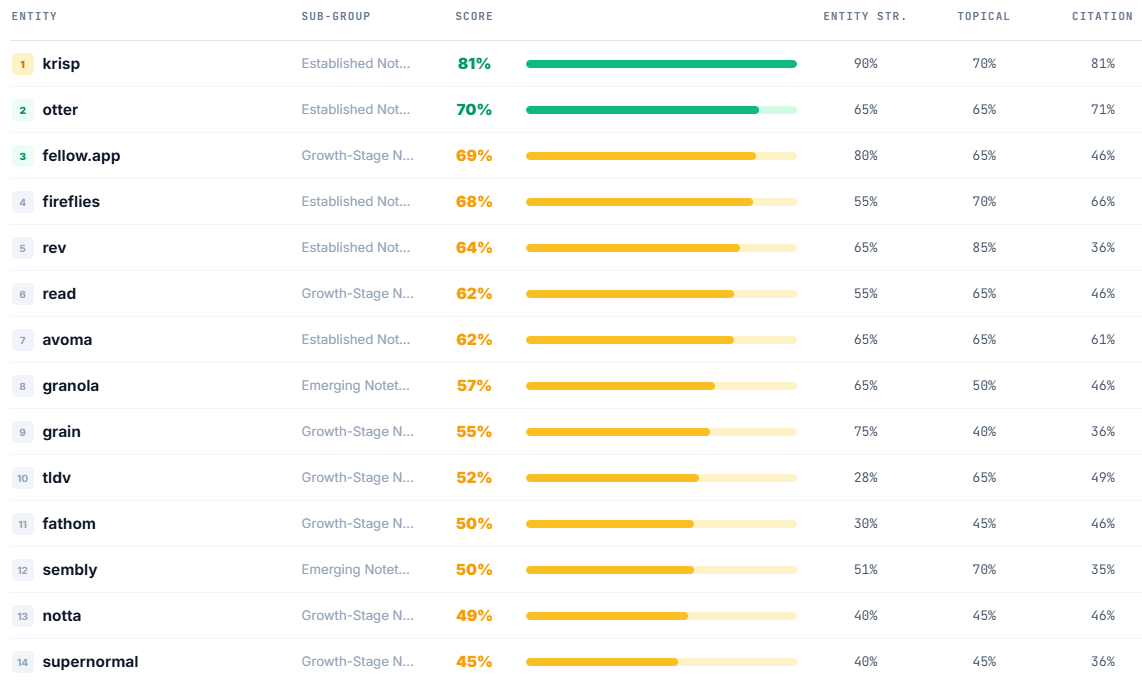
We ran our AI visibility audit across 14 of them to test that assumption. The audit scores each brand from 0 to 100 on how well generative AI systems can identify, understand, and cite it, across signals like entity resolution, citation worthiness, and retrieval readiness. The question we wanted to answer: in a category too young to have a settled leader, does AI recommend the best tool, or has a default already formed?
A default has already formed. And it does not match the hype.
Maturity already predicts AI visibility
We grouped the 14 tools by stage before running the audit: established players, growth-stage challengers, and emerging newcomers. The scores fell into a clean gradient along exactly those lines.
The established notetakers averaged 69. The growth-stage tools averaged 55. The emerging ones averaged 54. Krisp topped the table at 81, with Otter at 70 and Fireflies at 68 close behind, all of them among the older names in the category. The age of a tool, in a category where "old" means founded around 2020, is already one of the clearest predictors of how visible it is to AI.
This is the part that should give challenger founders pause. The assumption that a new category is a level playing field, where the most thoughtfully built product wins AI visibility on merit, is not what the data shows. Even here, with the whole category barely out of its first funding cycles, incumbency has begun to compound. The tools that have been around longest have accumulated the citations, the third-party coverage, and the entity footprint that AI systems lean on, and newer tools are already playing catch-up.
The Granola question
The sharpest illustration is Granola. By buzz, Granola is arguably the most talked-about notetaker of the past 18 months, a design-press favourite with the kind of founder-and-investor attention most challengers would envy. On our audit it scored 57, mid-table, behind seven other tools including less glamorous names like Rev and Avoma.
The reason is visible in the sub-scores. Granola's retrieval readiness is excellent at 80, its content is well structured and easy for AI to parse. But its citation worthiness, the degree to which AI systems treat it as a source worth pulling from and naming, sits at 46. It is built well. It is simply not yet woven into the web of references, comparisons, and third-party coverage that AI leans on when deciding who to recommend.
Hype lives on social platforms and in group chats. AI visibility lives in the citation graph. Those are different surfaces, and Granola is a clean example of a brand winning the first while still building the second.
Why citation, not polish, is the dividing line
Across all 14 tools, the signal that separated the leaders from the pack was not how well their sites were built. Retrieval readiness was high almost everywhere, most of these tools have clean, modern, well-structured sites, because they are software companies and that is table stakes. Eleven of the 14 even had an llms.txt file in place.
What separated them was citation worthiness. Krisp (81), Otter (71), and Fireflies (66) scored highly on being treated as primary sources. Most of the growth-stage and emerging tools clustered at 46 or below. In a category where everyone has built a tidy website, the differentiator is not the website. It is whether the rest of the internet, and therefore the models trained on it, already treats you as an authority.
That maps onto something we have found in other categories too. Structural polish is necessary but it is not what wins recommendation. What wins is accumulated external reference, and that takes time and presence to build, which is precisely why the older tools are ahead.
What this means if you are building in a young category
The optimistic read of a new category is that visibility is up for grabs. The data complicates that. Visibility is up for grabs in the sense that no position is permanent, but it is not up for grabs in the sense that effort automatically converts to AI presence. The tools ahead today got there by accumulating citations and references over years, not by launching a better product last quarter.
For a challenger, three things follow. First, a beautifully built product with thin external coverage will be under-recommended relative to its quality, and Granola is the proof. Second, the work that moves AI visibility is the unglamorous work of becoming citable: earning comparison-article inclusion, third-party reviews, structured data, and the kind of coverage that puts your name in the corpus models learn from. Third, the window matters. The gap between established and emerging tools is real but it is still measured in points, not chasms. It is closable now. It will be harder to close once the category's pecking order hardens further.
We ran this expecting to find an open field. We found a category that has quietly already decided who its authorities are, three years in, while most of the attention is pointed elsewhere.
Methodology note: 15 AI meeting assistants were submitted for audit; 14 returned complete results and are included here. One returned an incomplete audit and was excluded. Tools were grouped by maturity stage before scoring. Scores reflect structural AI visibility signals, not product quality or user satisfaction.