In a recent piece we argued that AI engines have outsourced much of their trust layer, the judgement of who is credible in a category, to commercial review platforms and directories they treat as neutral. That was the argument. This is the data.
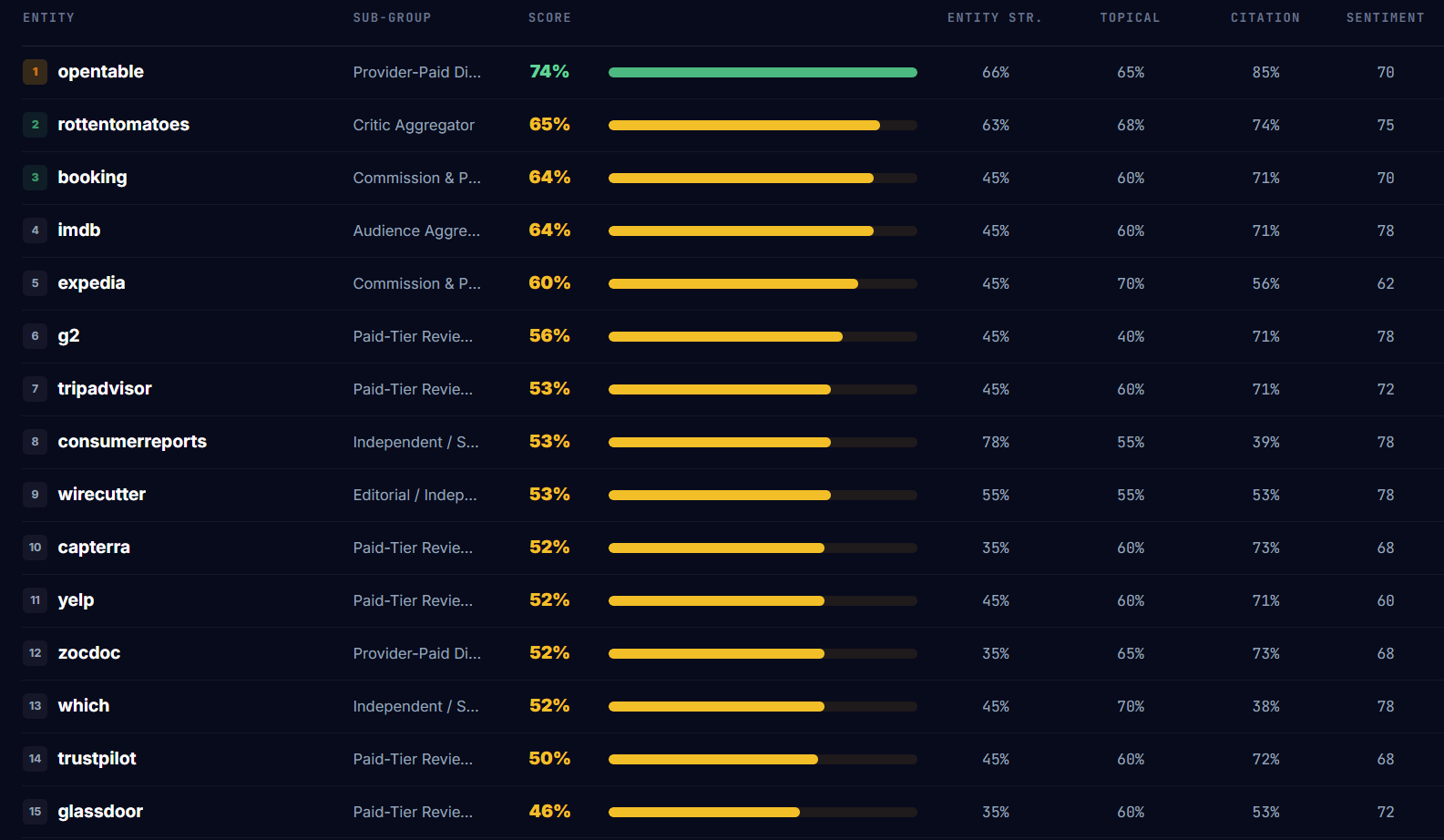
We ran our AI visibility audit across 15 of the review sites, directories, and aggregators that AI engines most often lean on, from G2 and Capterra in software to Trustpilot, Yelp, TripAdvisor, Booking, and Expedia, alongside the independent consumer champions Consumer Reports, Which, and Wirecutter. We wanted to see, on the signals that actually make an AI engine treat a source as citable, how the commercial platforms compare to the independent ones.
The result is stark, and it runs in the uncomfortable direction.
The independent sites score lowest on the thing that matters
The single most important signal for whether AI leans on a source is citation worthiness: the degree to which an engine treats the platform as a primary source worth pulling from and naming. On that signal, the split between commercial and independent platforms is not subtle.
The commercial, paid-model platforms averaged 70 on citation worthiness. The independent, subscriber-funded ones averaged 43. That is a 27-point gap on a 100-point scale, and it points the wrong way for anyone who assumes AI rewards trustworthiness.
Look at the extremes. Capterra scored 73 on citation worthiness. Trustpilot scored 72. Yelp, TripAdvisor, G2, Zocdoc all clustered at 71 to 73. These are platforms funded, in whole or in part, by the businesses they rate. Now the other end: Consumer Reports, the ninety-year-old gold standard of independent product testing, the organisation that buys every product it reviews anonymously and refuses advertising on principle, scored 39. Which, the UK equivalent, scored 38. The two most independent sources in the entire set are the two least citation-worthy to AI.
Why this happens, and why it is not a conspiracy
It would be easy to read malice into this. The truth is more mechanical, and in a way more troubling, because mechanical problems do not fix themselves.
The commercial platforms are built for distribution. Their content is open, crawlable, heavily structured, constantly updated, and optimised for search. Every incentive in their business model pushes them to be maximally visible and maximally extractable, because visibility is how they attract both the businesses that pay them and the users those businesses want to reach. They are, in effect, engineered to be cited.
The independent platforms are built for something else. Consumer Reports and Which fund themselves through subscriptions precisely so they do not depend on the businesses they review. That independence comes with consequences for machine visibility: their most valuable content sits behind paywalls, it is published with editorial restraint rather than at volume, and it is not engineered for maximum extractability. The very choices that make them independent, paywalls, refusing advertising, careful low-volume publishing, are the choices that make them harder for an AI engine to read and cite.
So the engine is not choosing the paid platform because it is paid. It is choosing it because it is open, and openness and commercial funding happen to travel together, while independence and inaccessibility happen to travel together. The bias is real in its effect even though no one designed it. The most trustworthy sources are penalised not for being untrustworthy but for the very practices that make them trustworthy.
The bar AI is using is lower than it looks
There is a second finding underneath the first, and it makes the picture worse. Across all 15 platforms, source eligibility, whether an engine is technically allowed and able to crawl the site, averaged 86. Very high. Nearly everyone is open to the crawlers. But retrieval optimization, how well the content is actually structured for an engine to parse and extract cleanly, averaged just 49. And entity strength averaged 48.
In other words, the platforms AI leans on are not winning because they are well-built for AI. Most of them are coasting on being open. Trustpilot, which AI finds highly citable at 72, scored just 10 on retrieval optimization. These sites clear the bar not by being genuinely well-structured but by being wide open, and AI rewards the openness regardless. The bar is low, and the independent sites cannot clear even that, because openness is the one thing their model will not give.
What this means
For anyone who relies on AI recommendations, the implication is uncomfortable. When an AI engine answers a question by leaning on review platforms, it is leaning hardest on the ones with the most commercial entanglement and least on the ones built to be independent. The neutrality the engine appears to offer is borrowed from sources that are, on average, the opposite of neutral, and the genuinely neutral sources are the ones it can barely see.
For independent publishers, the lesson is bleak but actionable: in an AI-mediated discovery world, independence without machine-visibility is a vanishing act. The values that made Consumer Reports authoritative for ninety years, paid independence and editorial restraint, are precisely the values that make it invisible to the systems now mediating discovery. Closing that gap without compromising independence is one of the harder problems in front of trustworthy publishing.
And for brands, the takeaway connects back to where this started. The trust layer AI borrows from is not a neutral reflection of quality. It is a reflection of which sources are most open and most optimised, which skews commercial. Understanding which platforms compose that layer for your category, and what their incentives are, is no longer a nice-to-have. It is how you understand what is actually deciding your AI visibility.
Methodology note: 15 review platforms and directories were audited in enterprise mode. Scores reflect structural AI visibility signals, not the accuracy, quality, or editorial integrity of the platforms themselves. The independent-platform finding rests on the three subscriber-funded and editorial sources in our set and should be read as indicative rather than definitive given the sample size.