For the past year, the most common advice in AI visibility has been some version of publish more. More "best of" listicles with your own brand at number one. More comparison pages. More machine-generated articles engineered for machines to read. The logic sounded plausible: AI engines learn from content, so flood the zone with content about yourself and the engines will learn you.
The people worried about AI slop, the tide of low-effort generated content washing over the web, looked at this advice and saw an industry making the problem worse on purpose. They were right. And the proof is that the punishment has now arrived.
The bill came in January
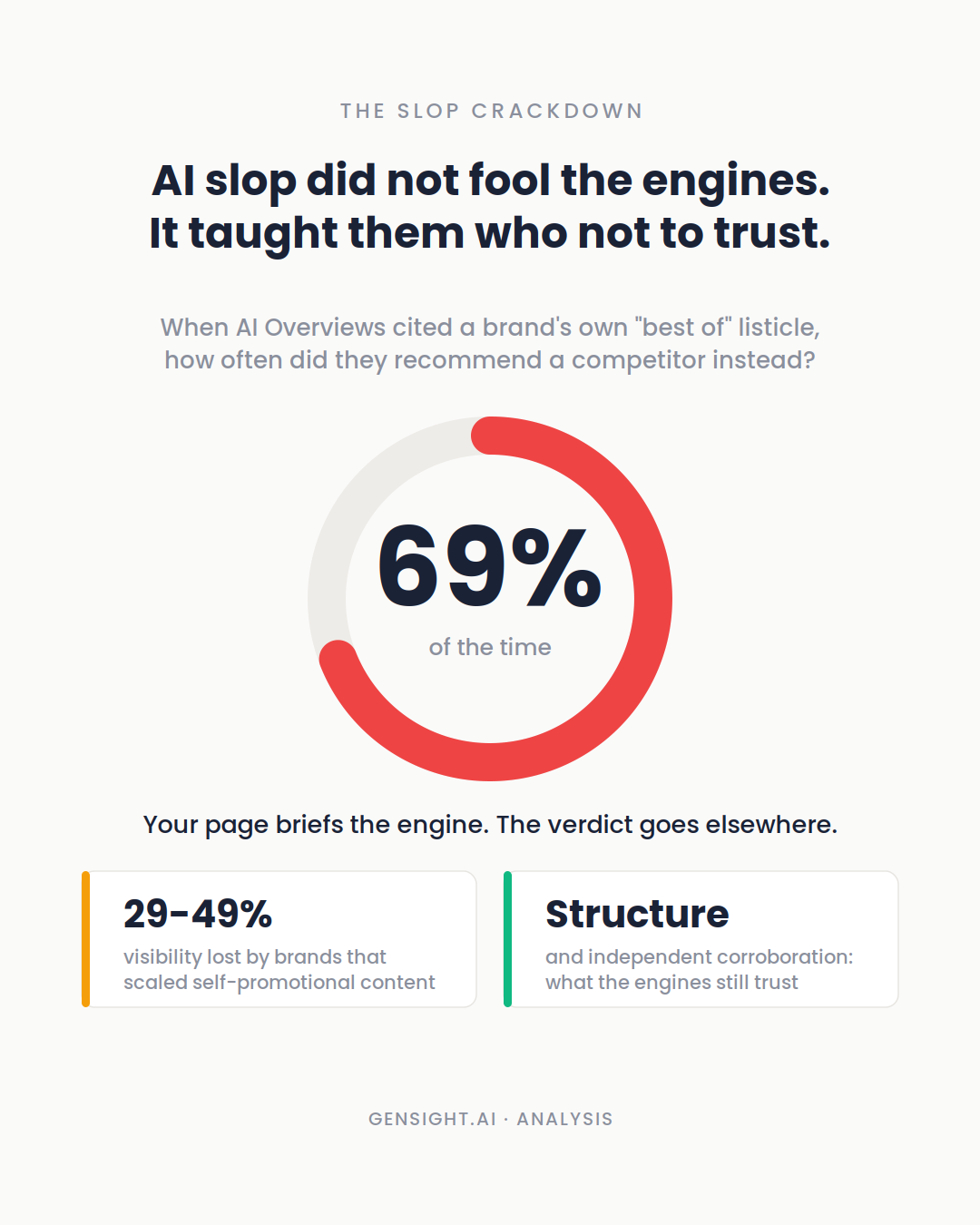
Following Google's December 2025 core update, a wave of visibility collapses began in mid-to-late January, and the pattern among the affected sites was consistent. Research from search analyst Lily Ray, tracking the fallout across dozens of sites, documented major brands losing 29 to 49 percent of their organic visibility, with the losses concentrated overwhelmingly in their blogs and resource hubs, the sections stuffed with self-promotional listicles, scaled comparison pages, and templated machine-written articles. Some of the affected sites had published hundreds of "best X" pages ranking themselves first. In several documented cases, the generated content sat in a single subfolder, and the visibility drop hit the entire domain anyway.
By February, this was no longer an observed pattern but a stated position: Google and Microsoft representatives issued public warnings against tactics aimed specifically at gaming AI crawlers, and practitioners analysing the fallout concluded that several popular AI-visibility tactics are now simply treated as spam.
And because AI engines sit downstream of search indices, the damage does not stay in the rankings. Google's AI products draw on Google's index; ChatGPT's retrieval leans on Bing's; Perplexity retrieves from the open web in real time. Content that a search index demotes as manipulation becomes content the AI engines are less likely to retrieve, trust, or cite. Brands that built their AI visibility strategy on scaled self-promotional content did not take an SEO risk. They took an everything risk.
The crueller finding
Then it gets worse, in a way that would be funny if it were not so expensive. A follow-up analysis of a hundred B2B software queries in Google's AI Overviews recorded what happened when self-promotional listicles were cited. The pages were cited constantly, over three hundred times across the sample. But in 69 percent of those cases, the engine cited a brand's own "best of" page and then recommended somebody else.
It makes sense once you think about how these systems weigh sources. A page on your own domain declaring you the best in your category is close to the weakest possible evidence of the claim. The engine can read it, and does, but it treats it as a description of the category, not as a verdict, because the verdict is exactly the part you cannot be trusted to supply about yourself. For the verdict, the engines lean elsewhere: the same analysis found citations shifting toward third-party sources, review platforms, and community discussion, with Reddit citations rising sharply. Which readers of this Knowledge Hub will recognise: the trust layer sits outside your own site, and no volume of self-published content substitutes for it.
Why the flood makes engines harder to impress, not easier
There is a mechanism underneath all this worth understanding, because it explains why the publish-more era was always going to end here. As generated content floods the web, the engines' problem shifts from finding information to filtering it. Every retrieval pulls in more text of unknowable provenance, so the systems, and the quality frameworks behind them, tighten. Google's quality guidance now explicitly directs raters to flag mass-produced content with no original value at the lowest rating. The more slop there is, the more conservative the engines become about what they treat as evidence, and the more heavily they lean on the signals slop cannot fake: consistency across independent sources, verifiable structured facts, genuine third-party corroboration, and authority accumulated over time.
This is the part the publish-more crowd had exactly backwards. The content flood does not lower the bar for getting into AI answers. It raises it, and it raises it in precisely the dimension that generated volume cannot climb.
The honest nuance: scale is the crime, not the format
It matters to be precise about what got punished, because the wrong lesson is already circulating. This was not a penalty on listicles as a format. The researchers documenting the pattern have been explicit that the problem is not the tactic but the scale, and follow-up analyses support the distinction: one properly useful comparison page, with real tables, honest trade-offs, and cases where a competitor is the better choice, remains legitimate content that engines cite. What got hit was the industrialised version: hundreds of templated, near-identical, machine-written pages whose only informational payload is that the publisher is number one. The engines did not learn to hate a page structure. They learned to recognise a manipulation pattern.
That distinction is also the answer to a question we get asked, sometimes pointedly: does not the whole AI-visibility industry encourage this? It is a fair challenge, and the honest answer is that any tool whose advice reduces to "produce more content" was and is part of the slop problem. But that has never been what the structural work is. The audit findings that actually move visibility are things like a missing machine-readable identity, claims that no independent source corroborates, schema absent or malformed, pricing buried in markup no parser can read, and absence from the third-party sources the engines actually trust. None of the fixes for those is "write more articles." Most of them involve writing nothing at all.
The part that does not revert
Here is the deeper reading, and it is the reason this is more than a penalty news cycle. We have argued in earlier pieces that AI engines outsource their trust to third-party sources, and that a brand's own site is treated as testimony rather than verdict. The slop era is why. The moment generating text became effectively free, self-published content stopped being usable evidence about its publisher. A thousand pages saying you are the best now costs nothing to produce, so it proves nothing. The engines responded the only way a filter can: they discounted the channel. Trust moved off the brand's own domain, onto independent corroboration, structured verifiable facts, and the third-party layer, because those are the signals a flood cannot cheaply counterfeit.
That 69 percent finding is this re-weighting caught in the act. The engine still reads your self-promotional page, but it reads it as information about the category and sources the verdict elsewhere. Your own voice has become the weakest form of evidence about you.
Which reframes what the December update and its fallout actually were: not a periodic spam purge, but a visible step in a one-way migration of trust, away from what brands say about themselves and toward what can be verified about them. Every future flood of generated content tightens it further.
What survives the crackdown
Put the pieces together and the durable playbook is short. Make your identity and facts machine-verifiable, once, properly. Earn presence in the third-party layer the engines treat as evidence, because your own site is testimony and testimony is weighed accordingly. Keep the content you do publish scarce, original, and honest enough that a quality rater, or a model trained on quality-rater judgements, would call it useful. And treat any tactic that feels like a clever way to talk to the machines behind the users' backs, separate content for crawlers, self-serving pages at scale, markup that says what the page does not, as a liability with a delay on it, because that is what every one of them has turned out to be.
The AI content flood was supposed to be the cheap route to AI visibility. Twelve months on, the brands that took it are less visible than when they started, their generated pages are quietly briefing the engines on behalf of their competitors, and the tactics are on the record as spam. But the lasting damage is subtler than any penalty: the flood permanently devalued the one asset every brand fully controls, its own voice, and inflated the value of the two things it does not, structure and independent corroboration. Slop did not fool the engines. It taught them who not to trust, and they learned.