Somewhere in the near future, one of your customers never runs out of coffee again. Not because they got organised, but because they stopped being the one who buys it. Their assistant watches the supply, checks the criteria it was given, price ceiling, delivery window, the roast they like, and reorders before the jar is empty. The customer tastes the coffee. They never see the purchase.
The question that should interest every brand is the one hiding inside that scene: whose coffee did the agent order, and what, exactly, did it base that decision on?
Two layers, and almost everyone is optimising the wrong one for this
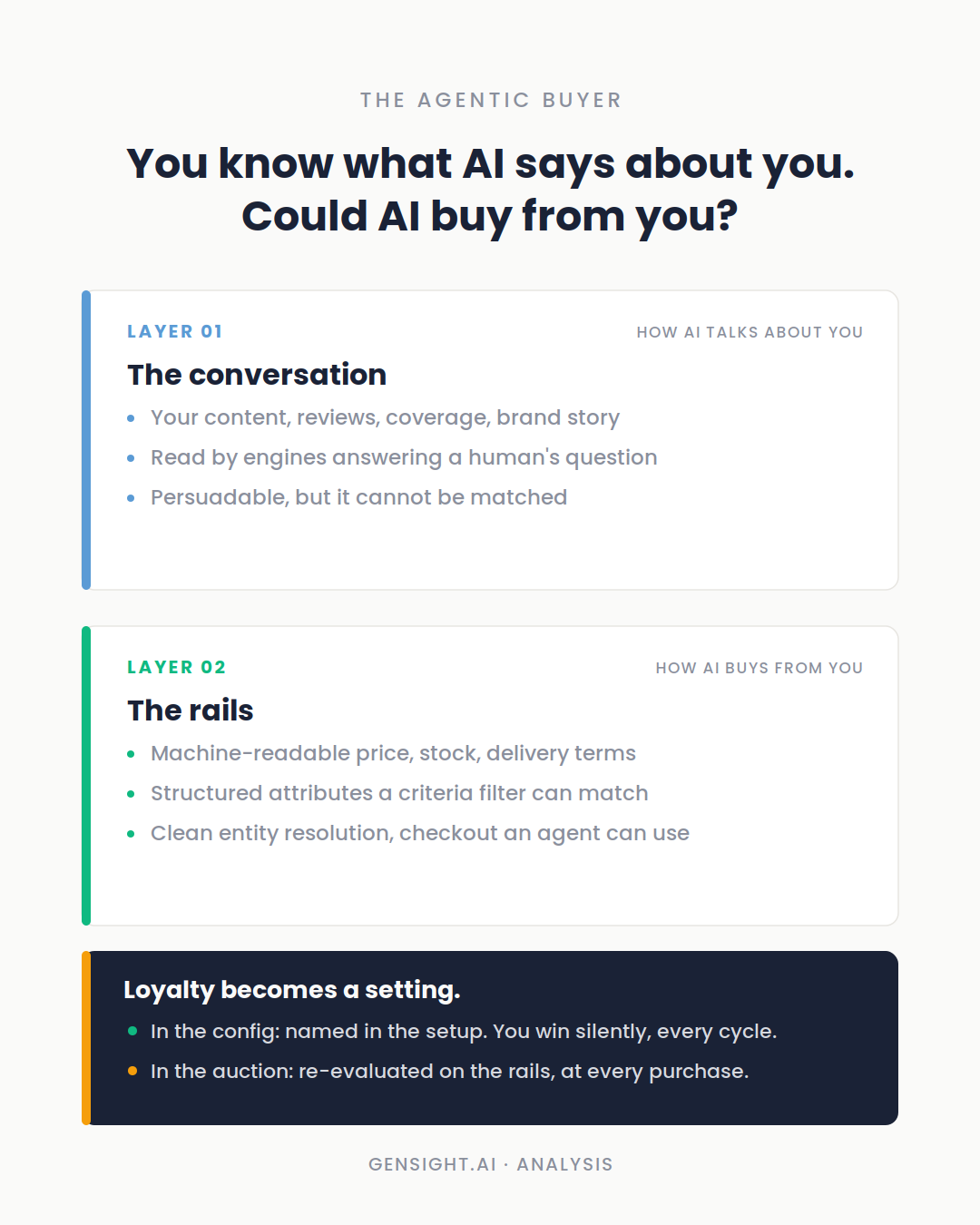
The AI visibility conversation of the past two years, including a good deal of what we publish, has been about what AI says. Citations, mentions, recommendations, how engines describe you. Call it the conversation layer. It runs on content: your pages, your reviews, your coverage, the prose the engines read when a human asks a question and a human reads the answer.
Buying runs on a different layer. When an agent moves from recommending to purchasing, it stops needing to be persuaded and starts needing to be able to specify. It reads your price as a value it can compare, your availability as a fact it can check, your delivery promise as a term it can hold you to, your certifications as attributes it can filter on, and your checkout as a door it can physically get through. Call it the rails.
To be precise, because the sharp version of this claim is the defensible one: an agent can read your brand story. Today's agents read pages and reviews perfectly well while forming a choice. What your brand story cannot do is be matched. A sustainability commitment written in warm prose is free text: unverifiable, unfilterable, weightless inside a criteria check. The same commitment expressed as structured data is an attribute: checkable, comparable, decisive. Rhetoric does not become invisible in agentic commerce. It becomes non-load-bearing. The weight moves to the layer that can hold it.
Loyalty becomes a setting
Here is where it stops being an infrastructure story and becomes a marketing one. Today, a great deal of what brands call loyalty is really friction. The customer who has bought the same washing tablets for six years is not devoted; switching simply costs effort a human will not spend on washing tablets. Mediocre brands survive on that arithmetic. An agent deletes it. Re-evaluating every option against the criteria costs the agent nothing, and it happens every single cycle.
But the honest version of what follows is not that loyalty dies. People will not let their agents freewheel; they will set defaults. Order my usual coffee. Stick with the brand I named unless the price moves. Loyalty does not disappear. It migrates, out of habit and into configuration. And that splits every category into two regimes.
If your brand is named in the customer's setup, you hold something stickier than habit ever was: a default that defends itself silently, cycle after cycle, without the customer ever re-opening the question. If you are not named, you are in the auction: re-specified from scratch at every purchase, up against everyone who matches the criteria, with no incumbency and no benefit of the doubt. The strategic question of the agentic era is not "do our customers love us?" It is "are we in the config, or are we in the auction?" And for the auction, the criteria you match on live entirely in the rails.
It arrives unevenly, and you can locate yourself on the curve
The timing deserves honesty, because the shift is beginning rather than complete, and it will not arrive everywhere at once. Delegation follows boredom. The purchases people hand over first are the ones they never wanted to make: replenishment, groceries, household staples, refills, the subscription that quietly renews. If you sell anything bought on a cycle, this is your near future, and the config-or-auction question applies to you first and hardest. Considered purchases sit far down the curve; nobody is delegating their wedding venue or their first house to an agent, and the conversation layer, persuasion, story, trust built with a human reader, stays decisive there for a long time.
The self-location is the useful exercise: the more habitual, frequent, and low-emotion the purchase, the sooner your buyer stops being a person. Most brands sell across a spectrum. Few have asked which end of it their revenue sits on.
What being buyable requires
So what does the rails layer consist of, concretely? Machine-readable pricing and availability, not numbers styled into a page but values a parser can lift and trust. Structured attributes for everything you would want a filter to find: certifications, dietary and sustainability claims, dimensions, compatibility, delivery terms. Feeds fresh enough that an agent checking stock at 2am gets the truth. Entity resolution clean enough that the agent is certain your product is the one it was told about. And a path to purchase that an automated buyer can traverse end to end, which is less trivial than it sounds: when we benchmarked 15 UK retailers on structural readiness recently, the single best-prepared high-street name was serving its machine-readable declarations from behind a bot-wall that returned 404s to automated readers. Security teams and visibility teams are currently, in many companies, working against each other without either knowing it.
Readers of our earlier pieces will recognise the shape of this. We have argued that recommendation visibility runs on a memory-versus-retrieval split, and that the trust behind recommendations has migrated off brands' own domains into verifiable third-party signals. Agentic buying is the same logic taken one layer down: config versus criteria, and criteria run on structure. The whole arc points the same direction, away from what brands say, toward what can be verified about them.
The question to ask this quarter
None of this requires believing the fridge is ordering your milk next month. It requires noticing that the layer agents will buy on is being laid now, that replenishment categories are already feeling it, and that the work of becoming buyable, structure, attributes, feeds, resolution, access, takes quarters, not days, to do properly.
It is also, candidly, why we built GenSight as a technical diagnostic rather than a prompt tracker. Tools that monitor what AI says about you are measuring the conversation layer, and the conversation matters. But the audit we run, schema, entity resolution, structured attributes, retrievability, access, measures the rails, and the rails are the layer agentic commerce will run on. Most of the market is measuring the talk. We measure whether the machine could complete the transaction.
You already know what AI says about you; if you do not, that is one audit away. The question that decides the next five years is the other one. Could AI buy from you? Almost nobody has checked, and the brands that check first will be in the config while their competitors are still polishing the story.