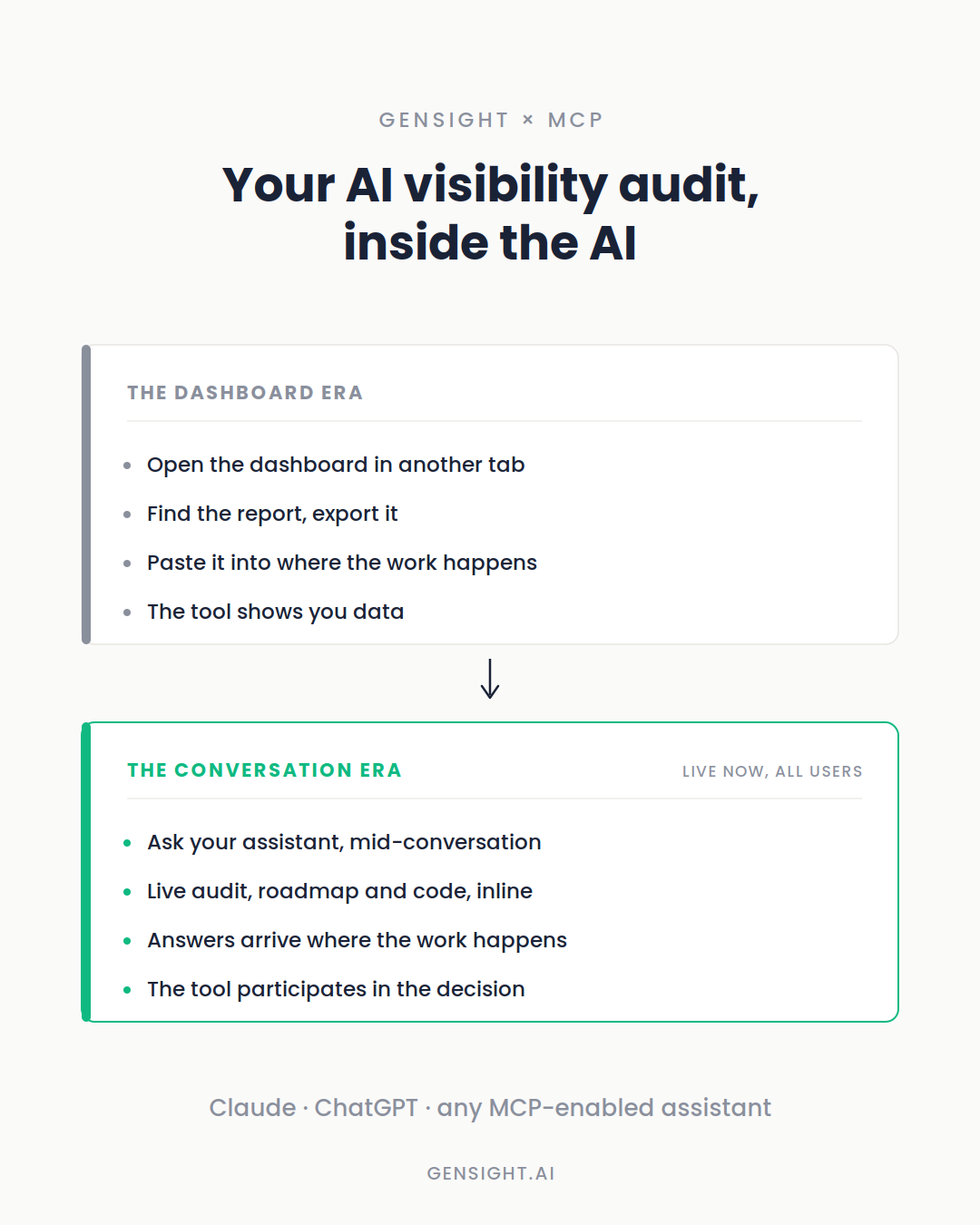
Every marketing tool of the last twenty years has made the same demand: come to me. Open the dashboard, learn the interface, export the report, paste it somewhere useful. The tool sits in its tab and you commute to it. That model made sense when the work happened in browsers. It makes progressively less sense now that a growing share of marketing work starts as a conversation with an AI assistant.
So we did the obvious-in-hindsight thing. GenSight now connects directly to Claude, ChatGPT, and other AI assistants through MCP, the open protocol that lets an assistant securely use external tools. Connect your account once, and your assistant can query your live GenSight data mid-conversation: your latest audit scores, how your brand appears engine by engine, your semantic bridges, your UK AI Visibility Index rank, and your full remediation roadmap. It is live now, for every user, on every plan.
What it actually looks like
Here is a real exchange from our own use of it. We asked Claude, mid-conversation, for the priority fixes on a specialty coffee brand we track. No dashboard, no export. It came back in seconds with the audit's full prioritised roadmap: seven items, ordered by impact, each with the reasoning attached and a time-to-impact estimate. The first was creating the brand's missing Wikidata entity, with the audit explaining that the probe found no entity and that this is the structural identity layer AI trains on most heavily. The second was Product schema, and the answer included the paste-ready JSON-LD block, pre-filled with the brand's details, ready to hand to a developer.
Then we asked the question a dashboard cannot answer: "which of these should we do first, given we have one developer-day this sprint?" And because the assistant has both the roadmap and the reasoning, it can actually weigh it: the Wikidata entity takes minutes of work but weeks of review; the schema blocks are deploy-today items; the resource hub is a quarter-long project. That is the difference between a tool that shows you data and a tool that participates in the decision.
The argument underneath the feature
We have said from the start that GenSight is AI-first rather than rebranded SEO, and this is what we mean by it in practice. The prevailing pattern in marketing software right now is to take an existing dashboard and bolt a chatbot onto the corner of it. That gets the relationship backwards. The assistant is not a feature of the dashboard. Increasingly, the dashboard is a feature of the assistant, one surface among several where your data can show up, and often not the most useful one.
Think about where AI visibility questions actually arise. They come up while you are drafting a content plan with your assistant. While you are preparing a client review. While you are asking, in plain language, why a competitor keeps getting recommended and you do not. In every one of those moments, the answer you need lives in your audit data, and the conversation is already happening somewhere else. Making you leave the conversation to go and fetch the answer is friction the AI era does not need to inherit from the browser era.
There is also a quietly recursive point here that we find genuinely satisfying. The whole discipline of AI visibility is about making your brand legible to AI engines: structured, queryable, present where the engines look. It would be a strange irony if the tool for measuring that legibility were itself illegible to AI, locked in a dashboard no assistant can read. The platform now practises what it audits. The tool for measuring AI visibility is visible to AI.
What you can ask it
The connection covers the working core of the platform. Ask for your latest audit and you get the score with its full pillar breakdown. Ask how you show up on specific engines and you get the panel data: appearance rates and how each engine describes you. Ask what to fix and you get the prioritised roadmap, with the paste-ready artefacts, JSON-LD, schema blocks, structured markup, delivered inline. Ask about your semantic bridges and you get the topic-association analysis. Ask where you sit in the UK AI Visibility Index and you get the rank.
And because it is a conversation rather than a report, you can do the thing that reports never let you do: interrogate it. Push back, ask why, ask what happens if you skip an item, ask it to explain a recommendation in terms your CEO will accept, ask it to turn the top three fixes into tickets. The audit stops being a PDF someone reads once and becomes a colleague you argue with.
Where this goes
We think this is the direction the whole category moves: not more dashboards with AI sprinkled on, but data and diagnostics that live wherever the work is happening. Today that means your GenSight audit inside Claude or ChatGPT. The connection is live for all users now. Connect it, ask your assistant how your AI visibility is doing, and see what your audit sounds like when it can talk back.