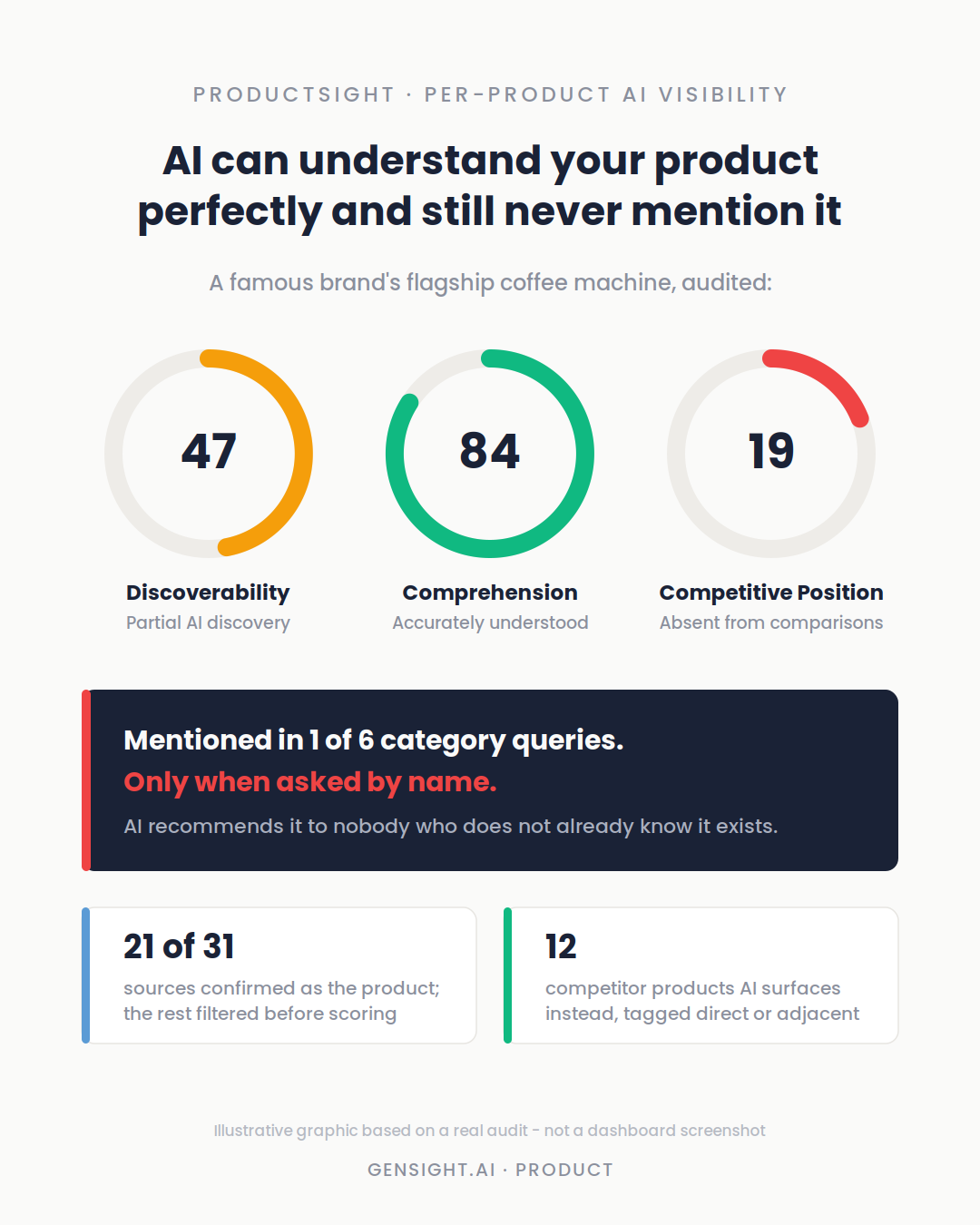
Last week we ran a test that summed up why we built ProductSight. We pointed it at the flagship bean-to-cup machine of one of the world's best-known coffee brands. A famous product, from a famous company, in a category people ask AI about every day.
The engines understand it almost perfectly. Comprehension scored 84 out of 100: they know what it is, what it does, its attributes, its positioning. No confusion, no errors, accurately understood.
Then we looked at whether they ever bring it up. Across six category-level recommendation queries, the kind a real buyer types, "best coffee machine", the product appeared exactly once. And that once was the query that included its name.
Its competitive position score: 19 out of 100. "Absent from comparisons." Meanwhile twelve other machines, some direct rivals, some adjacent, kept showing up in the answers, a few of them tagged as top recommendation across every single panel run.
Brand visibility is not product visibility
Here is the thing that makes this a new problem rather than a rebranded old one. The parent brand is fine. It is well known, decently covered, and scores respectably in a standard brand-level audit. None of that transferred to the product.
That is not a fluke; it is how the layers work. Brand-level signals, coverage, authority, entity presence, tell an engine who you are. Product-level signals tell it what to recommend when someone asks a buying question. And buying questions are product questions. Nobody asks ChatGPT "should I buy from this company", they ask "what is the best coffee machine under 500 quid", and the answer is assembled from whatever product-level evidence exists. A famous name with thin product evidence loses to an obscure name with rich product evidence, every time, in the exact moment that decides the sale.
So ProductSight audits at the level where that moment happens. You add a product, its category, its key attributes, and the audit runs against real category queries, then scores three things in plain English: Discoverability (can AI find this product as a distinct thing), Comprehension (does AI understand what it is), and Competitive Position (does AI put it forward when buyers ask). Our coffee machine went 47, 84, 19. The verdict line the dashboard produced was blunter than we would dare to be in a sales deck: comprehension is strong, the other dimensions lag.
The part we sweated over: is it even talking about your product?
A product audit has a trap a brand audit mostly avoids: names collide. Ask the web about a product and you get back a soup of sources about the category, sibling products, similarly-named things from other companies. Score that soup naively and the numbers are fiction.
So before ProductSight scores anything, it adjudicates every retrieved source: is this about the product, or about something else wearing similar words? In the coffee machine run it retrieved 31 sources, confirmed 21 as being about the product, and filtered 10 that were really about other machines pulled in by generic "best coffee machine" queries. The scores are computed on the confirmed set only. The dashboard shows you what got filtered and why, and if a product is essentially invisible to AI, the audit says so plainly rather than dressing a void up as a score. Boring engineering, but it is the difference between a number you can act on and a number that flatters you.
What you walk away with
Each audit gives you the three dimension scores and the receipts behind them: the actual answers the engines gave (quoted, per engine), the full list of competitor products AI surfaces in your category, tagged direct or adjacent, with how often and how favourably each appears, and a prioritised roadmap where every action is tagged with an owner, a timeframe, and the evidence it addresses, down to paste-ready product schema for the developer tasks. The first fix on the coffee machine's list would take a developer an afternoon.
And one detail for readers of our earlier pieces: the audit separates what the models already know from memory against what they find when they retrieve live. At product level that split is often dramatic, our test product scored 15 on training-corpus presence and 95 on retrieval surface, which tells you exactly which game you are playing: the engines have not memorised you, so every recommendation runs through live retrieval, and the retrieval layer is the one you can influence this quarter.
Why product-level, why now
Because the unit of an AI recommendation is shifting from the brand to the SKU, and the unit of an AI purchase always was the SKU. We wrote recently about agents moving from recommending to buying: when that lands, it lands on product data. The brands treating product-level AI visibility as a real, measurable thing now are building the evidence base agents will act on later.
ProductSight is live in beta inside the GenSight platform. But before any of that, try the ten-second version on your own catalogue: ask an AI assistant for recommendations in your category without naming yourself. If your hero product only shows up when you say its name, you now know what it feels like to be understood and invisible at the same time. That is the gap ProductSight measures, and closing it is considerably cheaper than wondering about it.