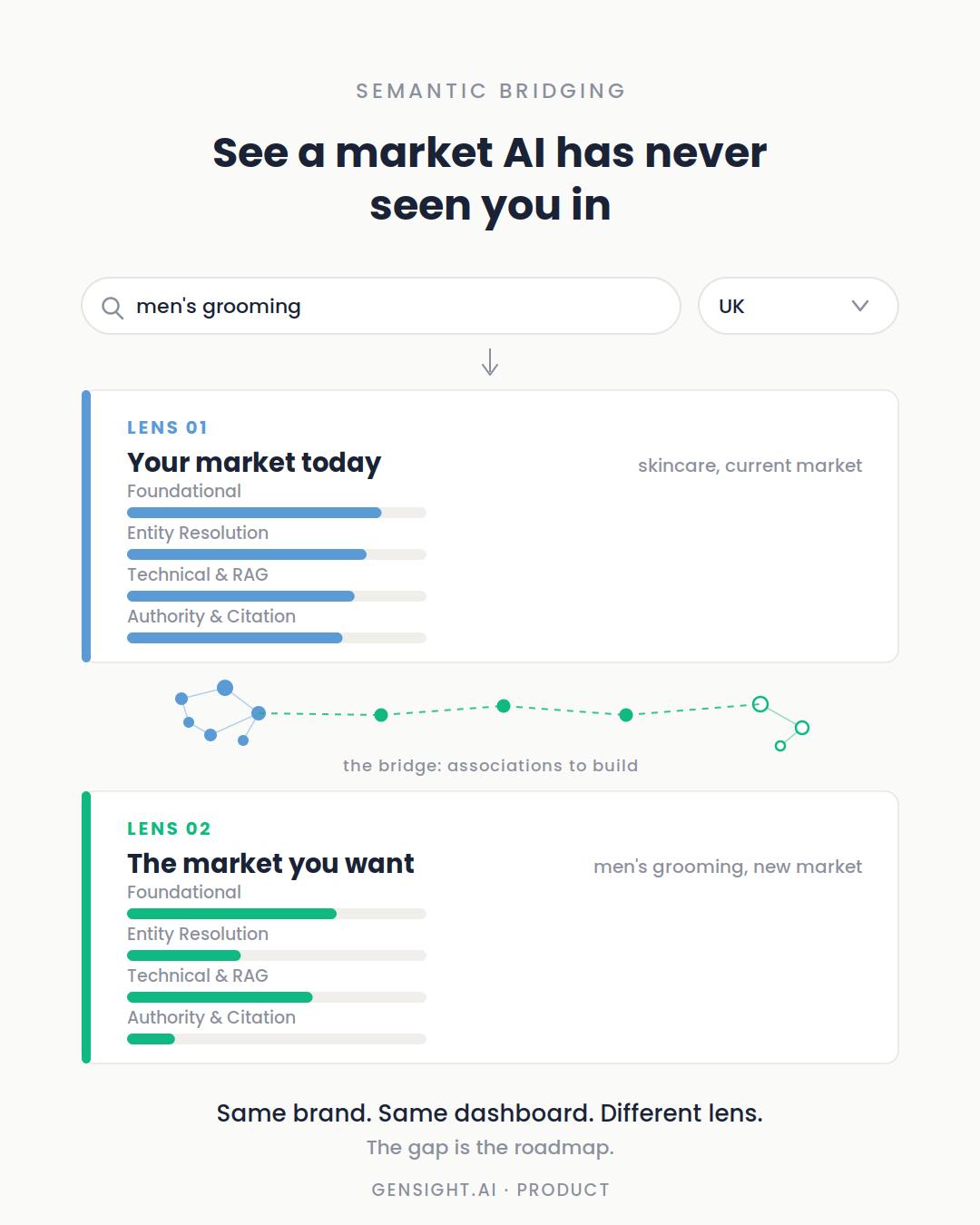
Every brand that tries to expand runs into the same invisible wall, and most never see it clearly. AI engines recommend from association. Years of trading in your home category have built years of signal connecting you to it: mentions, citations, third-party presence, the accumulated pattern that makes a model confident you belong in the answer. The market you want next has little or none of that, and it does not have to be an exotic leap for the wall to appear. A skincare brand moving into men's grooming, an outdoor clothing brand adding ski wear, a kitchenware brand eyeing small appliances: one shelf away in the shop, and yet in the model's association space the brand is barely there. To the engines answering that market's buyers, you are not a weak player. You are, for the most part, not a player at all.
Regular readers will recognise where this sits in the mechanics we have written about. New markets are, almost by definition, the low-confidence zone: the engine has no settled memory of you in that category, so when the queries come, it retrieves, and retrieval is winnable. That is the good news. The bad news is that winning it requires knowing exactly what the target market's answer landscape looks like, which associations carry credibility there, which sources make up its trust layer, and where your current presence falls short. Almost no brand can answer any of that before spending the money to find out the hard way.
What Semantic Bridging does
Semantic Bridging is the part of GenSight built for this moment, and mechanically it is almost provocatively simple. In your dashboard, you enter the target, any category, niche, demographic, or region, and the entire diagnostic re-runs through that lens. Same brand, same dashboard, all 35 signals across the same four pillars, Foundational, Entity Resolution, Technical & RAG, and Authority & Citation, but scored against the market you are aiming at rather than the one you are in. The target can be as broad as a category or as narrow as a query-shaped niche: a boutique skincare brand can bridge toward post-procedure recovery skincare; a B2B analytics tool toward tools for fractional CFOs.
What comes back is the thing expansion planning usually lacks: a precise map of the gap. How the engines currently see you from inside that category, which is often "barely at all," made specific. Which associations the credible players there hold that you do not. Where that market's trust layer sits, the sources, aggregators, and reference points AI leans on when answering its buyers, and whether you appear in any of it. And a prioritised set of actions for building exactly the signal that is missing.
Why "bridging"
The name comes from how the models themselves work. The feature is designed around how these systems represent meaning: models hold concepts in a space of associations, and a brand's visibility in a category is, in effect, the strength of the paths connecting it to the concepts that define that category. You do not enter a new market by shouting into it. You enter it by building paths from what the models already firmly know about you to what they firmly know about the market, anchoring new claims to established associations until the connection is strong enough to surface in answers. The bridge audit shows you which paths exist, which are missing, and which are shortest.
The length of the bridge varies, and the audit handles both ends of the range. An adjacent move, skincare to men's grooming, shares most of its concepts, so the missing paths are few and short. A genuine cold start, a fintech eyeing luxury travel, shares almost none, so the map matters even more. That framing also explains why even cold entry is more tractable than it feels. You are not starting from nothing; you are starting from everything the models already believe about you, most of which transfers. Adjacent categories share concepts. Credibility in one market is a foundation to anchor to, not a sunk cost. The work is directed, not infinite, and the audit is what supplies the direction.
Who reaches for it
In practice, three situations. The challenger eyeing an adjacent category, the skincare brand and men's grooming, the coffee roaster and office supply, who wants to know the size of the visibility gap before committing the budget. The brand entering a new country with the same offering, a UK retailer expanding to Ireland or Germany, where the category is familiar but the trust layer, the sources AI leans on there, is completely different, and assuming your home-market playbook transfers is the classic expensive mistake. And agencies, who use it to answer a client's "could we play in X?" with a diagnostic rather than a hunch, which is a rather stronger way to open that conversation.
It is also, quietly, the feature behind a line we use about the platform: that you can engineer your visibility even in markets you have never been in before. That claim only works if you can see those markets before you enter them. This is the seeing.
Semantic Bridging is included with every GenSight subscription (it is not part of one-time audits), and the number of bridge audits scales with your tier. If there is a market you have been circling, the gap between you and it is now a search field away from being measurable.