AI search is no longer a forecast. ChatGPT processes 2.5 billion prompts a day. Gemini is integrated into Google's primary search surfaces. Perplexity has become a default research tool for a meaningful share of professional users. The discovery layer that defined the past two decades is being reshaped, in real time, by systems that do not behave like the search engines they are partly replacing.
The question every brand now has to answer is straightforward. When buyers, journalists, employees, and competitors ask an AI engine about your category, what do they hear? Are you named? Are you cited? Are you recommended? Or are you absent from a conversation you used to lead?
To make this question answerable for the UK market, we built the UK AI Visibility Index.
What the Index is
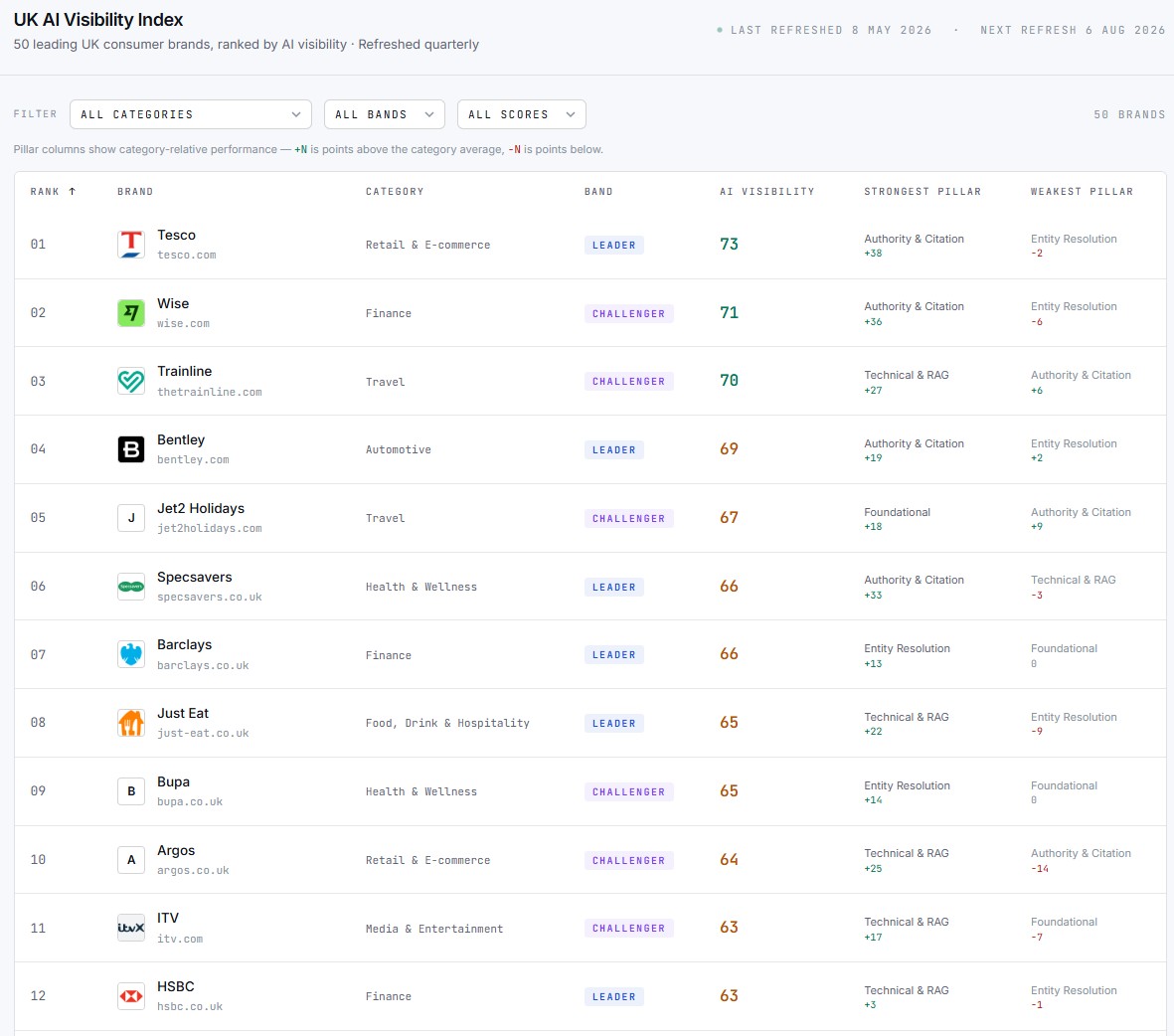
The UK AI Visibility Index is a quarterly ranking of 50 leading UK consumer brands by their structural readiness to be identified, verified, and cited by generative AI systems. It is live at gensight.ai/ai-visibility-index/uk.
The 50 brands span fifteen consumer categories - Grocery, Finance, Travel, Beauty, Fashion, Health & Wellness, Media, Automotive, Hospitality, Retail, Telecommunications, Food & Drink, Sports, Online Retail, and DIY & Home Improvement. Each brand was selected for its prominence in its category, drawing on cultural recognition and category leadership as the qualifying criteria.
Each brand is scored on a 0-100 scale across four pillars: Foundational, Entity Resolution, Technical & RAG, and Authority & Citation. The pillars roll up into a single AI Visibility Score that summarises a brand's overall structural readiness. Per-pillar breakdowns are available on each brand's dedicated page, alongside the specific signals contributing to the score.
The Index refreshes quarterly. The May 2026 launch is the first release; the next refresh is scheduled for August 2026.
What the Index measures
The Index audits 35 deterministic signals per brand, covering the structural infrastructure AI systems need to identify, parse, verify, and cite a brand. The signals fall into four pillars.
Foundational measures whether a brand's content is technically accessible to AI systems. Server-side rendering, semantic HTML architecture, canonical URL declaration, robots.txt configuration for AI crawlers, and the presence of structured data.
Entity Resolution measures whether AI systems can confidently resolve a brand to a single, unambiguous entity. Organisation schema completeness, knowledge graph presence, Wikidata footprint, sameAs array integrity, and the consistency of brand declaration across machine-readable sources.
Technical & RAG measures how efficiently AI retrieval systems can parse and extract from a brand's content. Markdown structure consistency, direct-answer formatting, structured data tables, FAQ schema, and content patterns optimised for retrieval-augmented generation.
Authority & Citation measures whether external sources treat the brand as a primary reference. Citation patterns from authoritative third parties, inclusion in category comparison sources, presence of cited statistics and proprietary data, review aggregator coverage, and the density of the brand's entity graph in the wider knowledge layer.
Each signal is binary or quantitative. Each is observable in public web infrastructure. None require prompt sampling, LLM query panels, or any methodology that varies day-to-day with model behaviour.
What the Index does not measure
Three things, named explicitly because the distinction matters.
The Index does not measure per-engine recommendation outcomes. It does not track how often a specific brand appears in ChatGPT's, Gemini's, or Perplexity's responses to specific queries. Those outcomes are observable but noisy - they vary by query phrasing, model version, retrieval context, and the day of the audit. The Index measures the structural signals that determine whether a brand is eligible to be recommended, not the recommendation behaviour itself.
The Index does not measure cultural recognition or category prototypicality. A brand's mental availability - the degree to which it comes to mind first when consumers think about a category - is one of the strongest drivers of AI recommendation outcomes. It is also extraordinarily difficult to quantify directly. The Index complements this dimension rather than capturing it.
The Index does not measure visibility outside the brands selected. The 50 audited brands were chosen because they are prominent in UK consumer categories. The findings describe what AI search looks like for established brands competing in mature categories. They should not be extrapolated to small businesses, B2B brands, or categories without strong cultural anchors.
How the Index is structured
Each of the 50 brands has a dedicated page on the Index, accessible by clicking through from the main ranking table. The brand page shows the headline AI Visibility Score, the per-pillar breakdown, the specific signals contributing to and detracting from the score, and a "What AI Said" panel - the actual responses three major AI engines gave to a category-relevant query about the brand.
The main Index page allows filtering by category, score band (Leader, Challenger, Emerging), and score range. The methodology page details each of the 35 signals, how they are measured, and why each one matters to AI visibility outcomes.
A JavaScript embed widget is also available, free for editorial use, that allows journalists and analysts to display the live ranking on their own sites with automatic quarterly updates.
Reading the Index
A high score signals that a brand has built the structural infrastructure AI systems need. It does not guarantee recommendation outcomes - those depend additionally on factors the Index does not measure, including category prototypicality and per-query interpretation by specific engines.
A low score signals structural gaps that are likely to constrain visibility outcomes over time, particularly as AI engines become more discriminating and as new competitors enter mature categories with stronger machine-readable foundations.
The most useful reading of the Index is comparative. Score positions relative to category peers, and position changes quarter-over-quarter, are more informative than the absolute number. A brand at 65 in a category averaging 70 has different work to do than a brand at 65 in a category averaging 55. The August refresh will make movement visible.
Why this Index exists
Three reasons, in order of importance.
First, the discourse around AI search visibility has been argued largely from first principles. Tool vendors claim their products predict AI outcomes. SEO practitioners claim the discipline has not meaningfully changed. Brand consultants claim the future belongs to whoever ranks first in ChatGPT. Very few of these claims have been argued from data covering a comparable set of brands measured by a consistent methodology. The Index supplies that data for the UK consumer market.
Second, brands deserve to know where they stand. AI search readiness is becoming a board-level concern in marketing, communications, and digital strategy. Brand teams are being asked to report on it. Most do not have a defensible answer because the measurement infrastructure has not existed at the category level. The Index gives any audited brand - and any competitor of an audited brand - a defensible reference point.
Third, the conversation matures faster with a shared instrument. Search Engine Land, Marketing Week, and the practitioner community now have a UK-specific data set to reference, dispute, and build on. The Index is one input to that conversation, not the final word.
What comes next
The August 2026 refresh will show quarter-over-quarter movement for the existing 50 brands. The Index will track which brands have closed structural gaps, which have not,