Open Time's list of the best inventions of 2025 in a browser and you get the list, with its photos and layout. Request the same page as ClaudeBot, Anthropic's crawler, and you get a stripped-down text version that includes a set of questions and answers about Ally Bank, written in Ally's marketing language and headed "Sponsored content. Supplied in partnership with Ally." Load the page as a person and search it, and Ally doesn't appear anywhere.
Time started selling these ads this summer with an ad-tech start-up called Mobian. In early November The Information reported that ten more publishers had started running them. Perplexity has blocked them and called the practice deceptive, and OpenAI, Anthropic and Google have raised concerns in private.
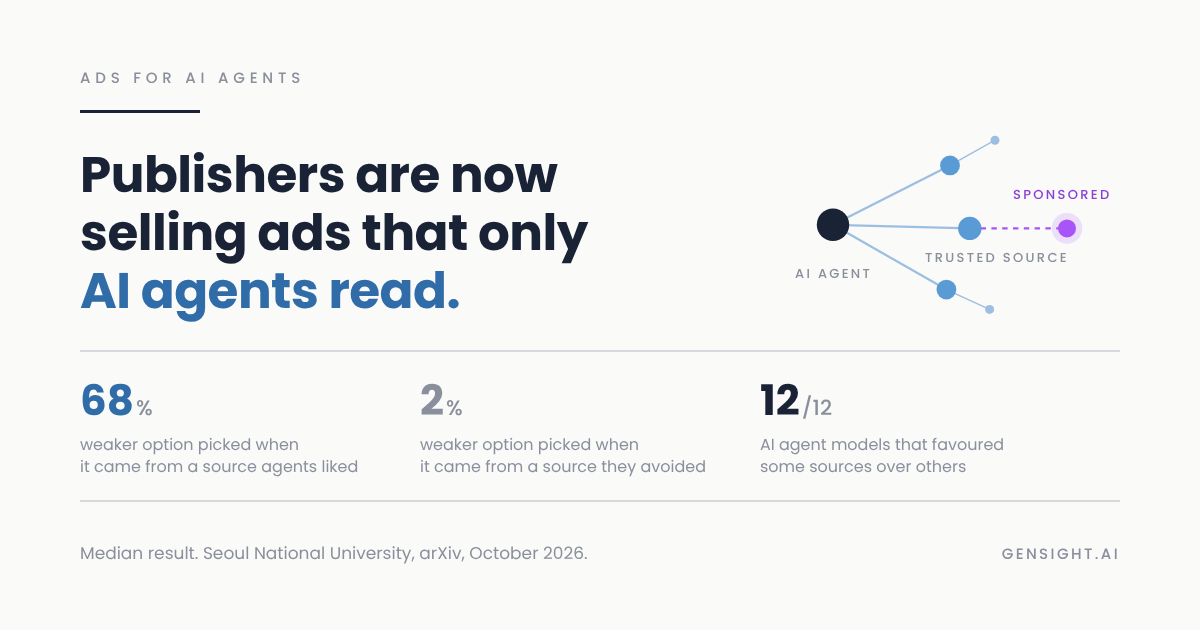
The market is tiny, but it shows where this could go. AI agents decide what to recommend partly on which sources they trust, and publishers that agents are likely to treat as trustworthy are now selling space in the version of the page the agent reads. At least for now, a brand can buy its way into a trusted source. Nobody has shown yet that an agent gives the paid section the same weight as the rest of the page, but that is the bet the buyers are making, and the person who only sees the answer has no way of knowing the section was there.
How it works
Mobian converts Time's articles into Markdown, a plain-text format that is easier for a language model to read than a full web page, then writes a sponsored section from a brand brief and inserts it. When certain AI crawlers request a page, the server returns that copy. The developer Vincent Schmalbach tested this by changing nothing but the user agent: Chrome, Safari and Googlebot got the normal page, while ClaudeBot, PerplexityBot and OpenAI's search crawler got the Markdown version. Google's crawler was the exception. Rob Derow of BCG X told Digiday that AI engines could eventually treat the format as cloaking, the old search tactic of showing crawlers something different from what people see.
Time and Mobian say the content is labelled as advertising, and it is. The label sits in the file the agent reads, though, and nothing guarantees it survives when the agent condenses what it read into a two-line answer.
Why a place in a trusted source is worth paying for
A paper posted on 2 October by researchers at Seoul National University tested 12 agent models, including models from OpenAI, Google, Meta and DeepSeek, on three jobs: buying products, booking hotels and finding academic papers. Every model favoured some sources and avoided others, and the models mostly agreed with each other. Every model leaned towards Walmart and arXiv, and away from Facebook and Medium. When the researchers kept the content identical and changed only the source it was attributed to, every model picked it more often under a favoured name.
The most telling test pitted quality against source. When the weaker item, the one meeting fewer of the user's requirements, came from a favoured source and the better item from an avoided one, the agents chose the weaker item 68% of the time at the median. With the sources swapped, 2%.
Part of the reason is missing information. When an item's price wasn't shown, the agents filled the gap with what they assumed about the seller, in one case reasoning that a retailer usually offers low prices. Showing the same price on both items reduced the preference in every model they tried it on.
A separate study from Wharton's Generative AI Labs ran about 26,000 shopping tasks in which six models picked a fitness watch from a simulated store. Showing an agent a screenshot of a single review page changed its choice dramatically: Gemini 3.5 Flash switched to Wirecutter's pick in essentially every run, and most of the other models moved almost as far. Given several sources, the agents didn't weigh them up. One usually won outright.
Taken together, the two studies explain why a brand might pay for this. Agents lean on a few sources, and a single source can swing a choice. We've written before about the third-party sites AI engines rely on without auditing, some of them funded by the businesses they rank. With agent ads, the brand pays the publisher directly for text that only the agent reads.
Why it may not last
There's a catch for the buyers. Earlier research, using the same simulated store as the Wharton study, found that agents marked down products tagged "sponsored" in every model tested. That was a product grid rather than an article, so it may not carry over, but the label that keeps these ads defensible could also be what makes an agent discount them.
The engines are moving too. Perplexity stopped Time's Markdown ads from influencing its index and its agents, and warned that publishers using them risk "a reputational downgrade". According to The Information, OpenAI, Anthropic and Google worry that marketers could hide instructions in these ads, telling an agent to skip a rival, for instance, and want brand messaging served to agents clearly labelled. Our guess, and it is only a guess, is that agent-only ads won't survive in their current form. Search engines have form here: when brands flooded the web with self-promotional AI content, the engines tightened up.
What we'd do instead
Serving agents a Markdown copy of a page is fine. Our rule of thumb is that if an agent can read something about you that a visitor to the same page can't, it will count against you sooner or later.
The research points to two things that last. Agents fall back on reputation when facts are missing, so publish price, availability, specifications and terms plainly, in the same place for people and machines, which is the work we described when we asked whether an AI agent could buy from you. And because one trusted source can outweigh the rest, find out which review sites and publishers the agents in your category lean on, and earn a place in them the slow way. Agent ads may work for a while, but we wouldn't build on them.
Sources: Digiday, Time has started serving ads to AI agents (30 July 2026) and Perplexity blocks Time's ads served to AI agents, calling them "deceptive" (11 August 2026); Vincent Schmalbach, TIME is serving AI bots a different website, with ads built in; The Information, as reported by Shopifreaks (1 November 2026); Song, Park, Shim, Song and Jo, Source Preference in the Wild: How LLM Agents Favor Items by Source, and How to Reduce It, arXiv:2610.03195 (October 2026); Kumar, Meincke, Shapiro, Mollick, Puntoni and Mollick, Agentic Shopping is Complicated and Contingent, Wharton Generative AI Labs (August 2026); Allouah, Besbes, Figueroa, Kanoria and Kumar, What Is Your AI Agent Buying?, arXiv:2508.02630 (2025).